Help us get this right
Does this portrait look right for Gumuz?
One tap. It takes a second and it is recorded.
3 say it looks right, 0 say it looks off.
Gumuz Erotic
Benishangul-Gumuz Region (Ethiopia)
Traditional African religion
About Gumuz People
The Gumuz live along the Blue Nile gorge and the lowland belt that runs from western Ethiopia into Sudan, in a country where most of their neighbors are highland Cushitic and Semitic farmers. That geography matters: the Gumuz are people of the hot lowlands, the qola, in a nation whose political and demographic center sits two thousand meters higher up. For centuries this elevation gap shaped how the Gumuz were seen by the highland kingdoms above them — as outsiders, as raiding targets, as a frontier to be crossed rather than a population to be incorporated. The legacy of the slave raids that reached into Gumuz country well into the twentieth century still shapes how the community talks about its own history and its wariness of outsiders.
Linguistically, Gumuz is a striking case. It belongs to the Nilo-Saharan family, which puts it in a different lineage from almost everything spoken around it — Amharic, Oromo, and the other major Ethiopian languages are Afroasiatic. Internally, Gumuz is split into a chain of dialects along the river, and speakers from the northern and southern ends do not always understand each other easily. The language has stayed robust where the community has stayed rural; it thins quickly in towns where Amharic dominates schooling and trade.
Religious life is grounded in older indigenous practice rather than Christianity or Islam, despite both being present in the region. Ancestral spirits, local shrines, and ritual specialists who manage healing and divination remain central, and ceremonies tied to harvest, marriage, and death keep their pre-Abrahamic shape. Subsistence is built on shifting cultivation of sorghum and maize, supplemented by riverine fishing, honey gathering from forest hives, and small game — a pattern suited to a landscape of seasonal rivers, woodland, and tsetse country. Gumuz society is organized into exogamous clans, and bridewealth negotiations and the older convention of sister-exchange marriage still structure how families form.
The pressure on the Gumuz now comes less from raiding than from large-scale infrastructure. The Grand Ethiopian Renaissance Dam sits on their river, and commercial agricultural schemes and resettlement programs have pushed into lowlands that were, within living memory, almost entirely theirs. Recent ethnic violence in Benishangul-Gumuz has made the region one of the more volatile corners of the country, and the community's footing on its own land is, at this moment, unsettled.
Related ethnic groups
Groups that share Gumuz's homeland, region, language, or religious tradition. These are likely candidates for comparative phenotype reference.
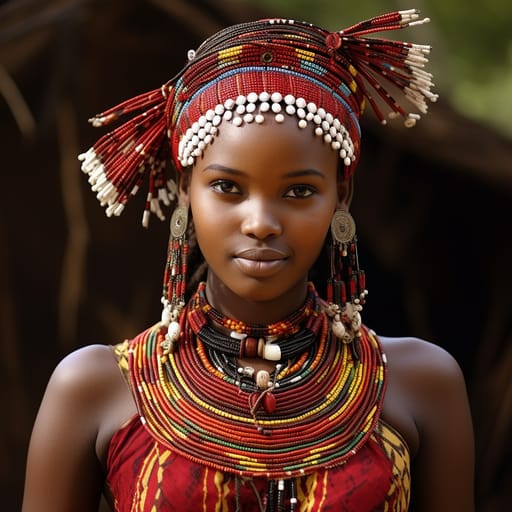
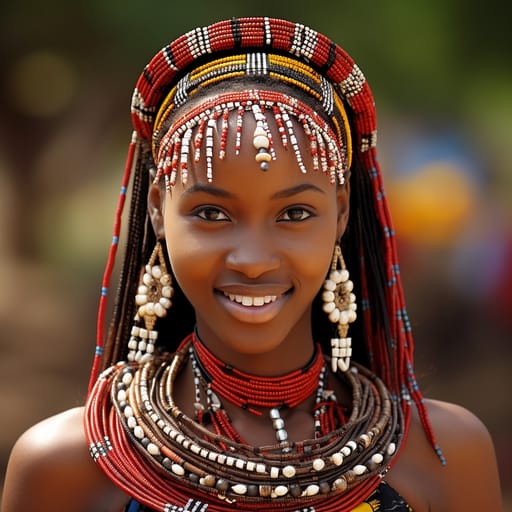
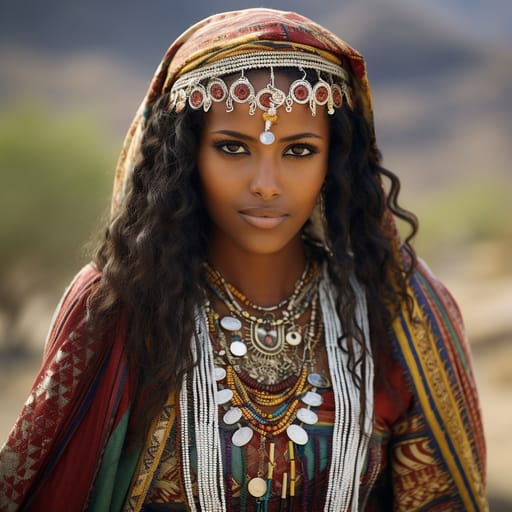
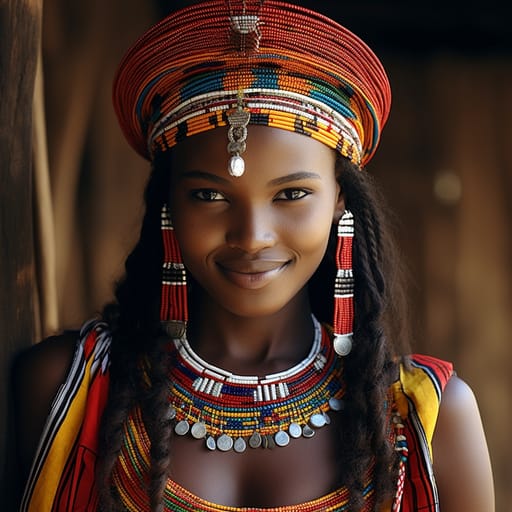
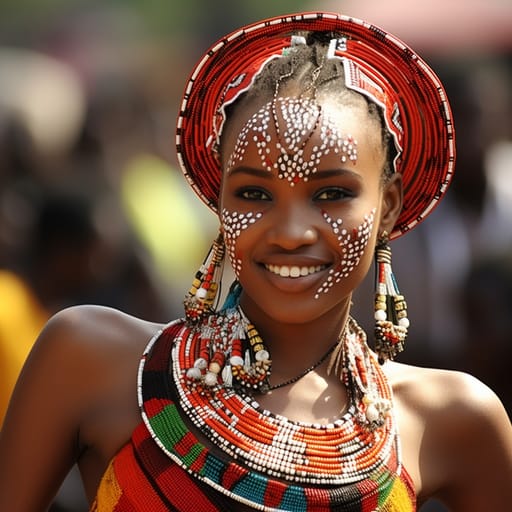
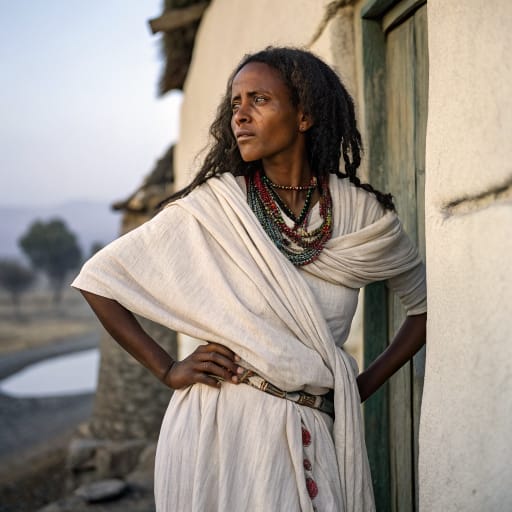
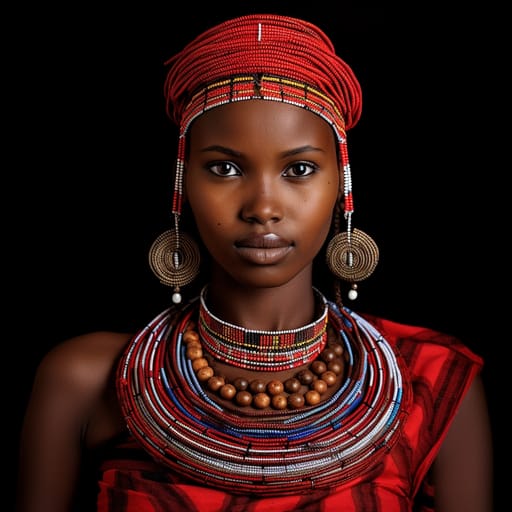
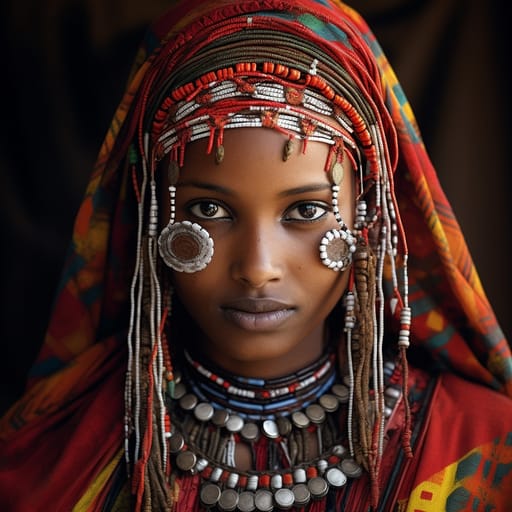
Typical Gumuz Phenotypes
Reference for AI generation: hair, eyes, skin, facial structure, build
The Gumuz are a Nilo-Saharan-speaking population of the lowland frontier between western Ethiopia and Sudan, and their phenotype reads more as a Nilotic-Sudanic cline than as anything resembling the Cushitic or Semitic highlanders to the east. The defining impression is very dark skin — Fitzpatrick VI is the rule rather than an outlier — with cool, blue-black undertones rather than the warm reddish-brown common in highland Ethiopian groups. Sun exposure on the lowland Blue Nile floodplain reinforces this; only the palms, soles, and inner lips break the depth of tone.
Hair is tightly coiled Type 4, dense and short-stapled, almost always near-black. Greying tends to come late and patchy. Eyes are dark brown to near-black, set in a horizontal almond shape with no epicanthic fold; brow ridges are modest, and the orbital region sits relatively flat against the face rather than deep-set.
Facial structure is where Gumuz diverge clearly from their highland neighbors. Noses tend to be broader at the alae with a low, soft bridge — closer to the Nilotic pattern than the narrow, high-bridged Habesha nose. Lips are full, often markedly so, with a well-defined vermilion border. Cheekbones are present but not sharply projecting; jaws are moderate, faces somewhat rounded in youth and lengthening with age. Older women in some communities retain the lip plate tradition, though this has receded sharply in younger cohorts.
Build is lean and wiry rather than tall-and-rangy. Gumuz are noticeably shorter than the Nilotic peoples further west — adult men typically cluster in the 165–172 cm range, women around 155–162 cm — with low body fat, narrow shoulders relative to stature, and long limbs proportional to torso length. The combination of very dark skin, broad-based nose, full lips, and short-to-medium stature is the most reliable Gumuz signature, and it holds across the northern (Metekel) and southern (Kamashi) branches with only minor variation in average height and facial breadth.
Gumuz Body & Anatomy Reference
Cushitic / Nilo-Cushitic East African phenotype: anatomy reference for AI nude generation
Gumuz Boobs & Breasts
Gumuz tits and boobs run small-to-medium-cup, high-set, conical, the classic Cushitic / Nilo-Cushitic East African bust profile. Gumuz nipples and areolas show moderate-to-high areolar pigmentation against the brown-to-deep-brown skin tone, with areolar diameter typically in the 28-38mm range and forward-set positioning rather than the lateral spread of the West African phenotype. Gumuz breasts trend firmer and less projecting than the African-American or West African norm, a function of the lean ectomorph-to-mesomorph body habitus and the mean adult female BMI 19-22. For anatomically accurate AI-generated Gumuz nudes the render preserves the small-to-medium-cup, high-set, conical shape, 28-38mm areolas with moderate-to-high pigmentation, and the torso proportions of the Cushitic / Nilo-Cushitic East African phenotype.
Gumuz Ass & Hips
Gumuz hips and butt usually read as small-to-medium, high-set, rounded. The skeletal base is narrow-to-medium iliac crests, longer torso-to-leg ratio, the Cushitic / Nilo-Cushitic East African pattern. Set against the wide-set heavy-projection West African or African-American norm, the difference is easy to see, and the hip-to-waist ratio is often what identifies Gumuz women in photos.
Gumuz Vagina & Pussy
Expect brown-to-deep-brown labial pigmentation, narrow-to-medium labia minora projection on Gumuz women, in keeping with Cushitic / Nilo-Cushitic East African ancestry. The pubic hair is tightly-coiled coarse texture, densely distributed. Coloring should run evenly from the brown to deep brown skin of the thighs to the labia, and Gumuz nude imagery should keep the hair's tightly-coiled coarse texture.
Gumuz Dicks & Penis
Gumuz dick and penile anatomy in adult AI generation should anchor on the regional reference data: regional mean ~13.5cm erect, moderate girth, ~12cm circumference, and deeper-pigmented than the West African norm. The Gumuz cock profile reflects the Cushitic / Nilo-Cushitic East African population's anthropometric measurements. The shaft pigmentation should track the surrounding brown to deep brown skin tone, and the pubic hair should keep its tightly-coiled coarse texture in the typical inverted-V escutcheon.
Gumuz Body, Curves & Build
Gumuz body type: lean ectomorph-to-mesomorph, with mean adult female BMI 19-22. This is the typical Cushitic / Nilo-Cushitic East African build. Height range, shoulder-to-hip ratio and fat distribution all follow from it, which is what an accurate Gumuz nude body should show.
Gumuz Skin Tone & Hair Texture
Gumuz skin tone falls in the brown to deep brown (Fitzpatrick V-VI) band, the surface signal most often miscalibrated by generic AI nude generators. Gumuz hair texture is typically tight 4A-4C coil, often worn natural or in braided/twisted protective styles, characteristic of the Cushitic / Nilo-Cushitic East African phenotype. In Gumuz nude renders the skin should hold that band consistently across the body.
Data depth
0/100Coverage of image-grounded phenotype observations · drives AI generation diversity
- Sample size
- 0/40· 0 images
- Image quality
- 0/30· 0% high
- Confidence
- 0/20
- Source diversity
- 0/10
- ·No image observations yet
Explore phenotype categories
Structured taxonomy with peer-reviewed scales · 22 anatomical categories
Erotic Poses & Sex Positions
From the pose catalog: 219 named positions with reference skeletons
Frequently asked questions about Gumuz people
Where is the Gumuz homeland?
The Gumuz homeland is Benishangul-Gumuz Region (Ethiopia) in Eastern Africa.
What language do Gumuz people speak?
Gumuz people primarily speak Nilo-Saharan / Gumuz.
What religion do Gumuz people practice?
The predominant religion among Gumuz people is Traditional African religion.






Make your own Gumuz images
Five a day, free, no credits to buy. The studio starts from this group's phenotype data, so you can set body type, pose and style and keep the traits accurate.
Start with Gumuz