Help us get this right
Does this portrait look right for Gbagyi?
One tap. It takes a second and it is recorded.
5 say it looks right, 0 say it looks off.
Gbagyi Erotic
Traditional African religions
About Gbagyi People
The Gbagyi — sometimes written Gwari, the name imposed by neighbors and now grudgingly accepted in some contexts — are the indigenous people of the granite-strewn middle belt around what is now Abuja. When Nigeria's military government chose the site for the new federal capital in the 1970s, it was Gbagyi land that was cleared, and Gbagyi villages that were displaced outward into the surrounding hills of Niger, Kaduna, Nasarawa, and Kogi states. That dispossession is recent enough to still shape how the community talks about itself: a people whose homeland became the symbolic center of the Nigerian state, while they themselves were pushed to its margins.
Their language, Gbagyi, belongs to the Nupoid branch of Benue-Congo within the larger Niger-Congo family, putting them in linguistic conversation with the Nupe and Gwandara rather than with the Hausa who long surrounded and pressured them. Two main varieties — Gbagyi proper and Gbari — are close enough that speakers generally understand each other, though communities will insist on the distinction. Centuries of living in the corridor between the Hausa emirates to the north and the Yoruba-influenced south meant repeated raids during the slaving era; the Gbagyi response was to retreat into defensible inselberg country, building hamlets among the boulders rather than open villages on the plains. That habit of dispersed, hill-anchored settlement is still legible on the landscape today.
The traditional religion centers on Maigiro, a high creator, with ancestral veneration and a calendar of agricultural rites tied to the yam and guinea corn cycles. Christianity and Islam have both made significant inroads — Abuja's growth accelerated this — but indigenous practice persists, often layered rather than replaced, particularly around funerals and harvest. One of the more distinctive Gbagyi customs is the women's practice of carrying loads on the shoulder rather than the head; it's a small thing, but in a region where head-carrying is near-universal, it functions as an immediate ethnic signature. Pottery, especially the work of Ushafa village potters, has carried Gbagyi craft into wider recognition, and the blacksmithing tradition retains ritual weight beyond its practical function.
What holds the Gbagyi together as a recognizable people, more than any single trait, is the experience of being the quiet host to Nigeria's loudest project — and continuing, in dispersed villages around the federal capital's ring of hills, to live on terms not entirely set by it.
Related ethnic groups
Groups that share Gbagyi's homeland, region, language, or religious tradition. These are likely candidates for comparative phenotype reference.
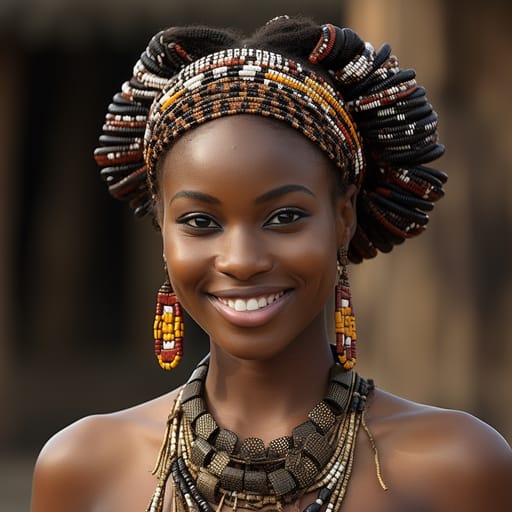
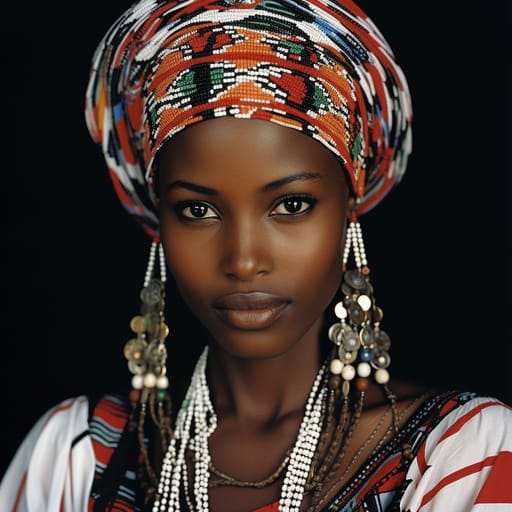
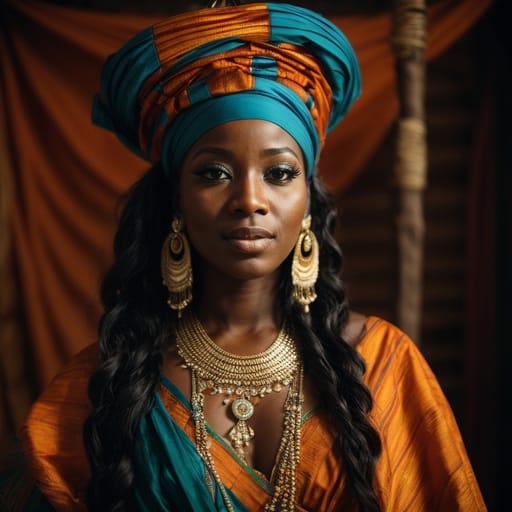
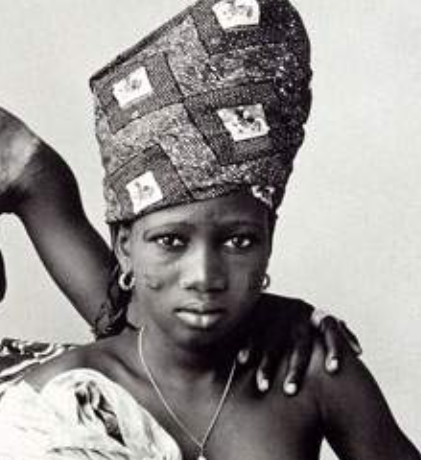
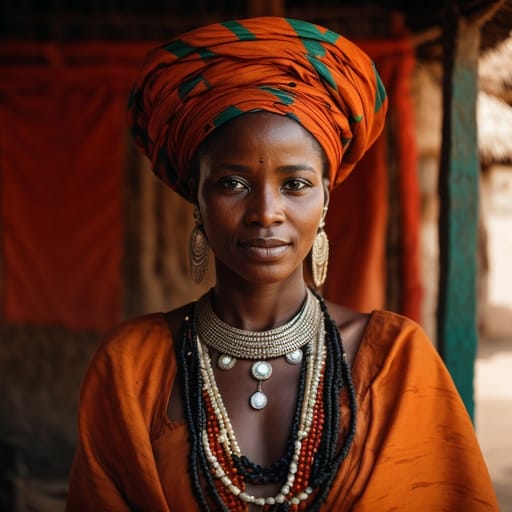
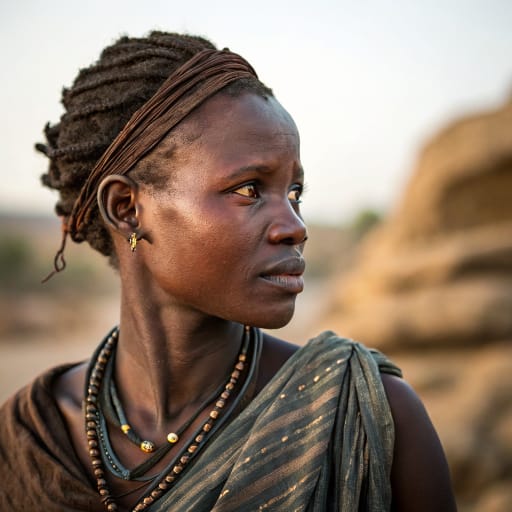
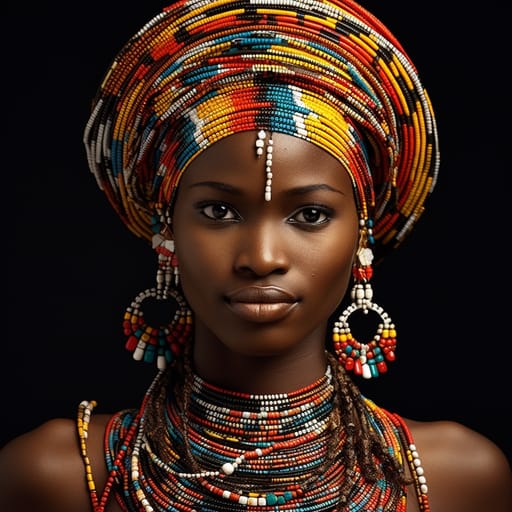
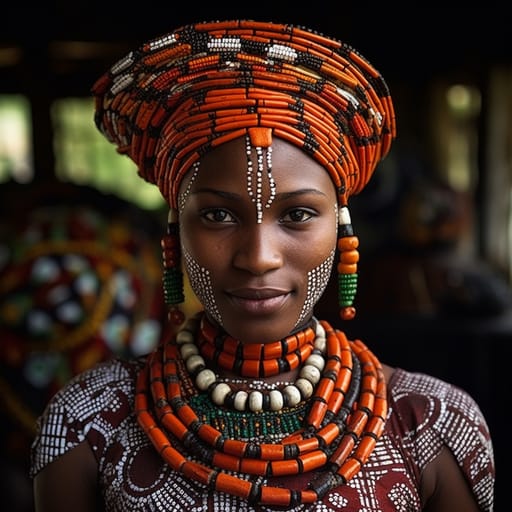
Typical Gbagyi Phenotypes
Reference for AI generation: hair, eyes, skin, facial structure, build
The Gbagyi (also Gwari) are a Niger–Congo people of Nigeria's Middle Belt, concentrated around the Federal Capital Territory, Niger, Kaduna, and Nasarawa states. Their phenotype sits within the broader West African range but trends toward the deeper-pigmented, finer-featured end of that spectrum, distinct from the heavier facial mass typical of forest-zone Yoruba or Igbo populations to the south.
Hair is uniformly Type 4 — tightly coiled, dense, with the spring-like 4B to 4C curl pattern characteristic of West African groups. Color is near-uniformly black-brown in youth, greying late. Traditional grooming favored short-cropped or shaved styles for both sexes, and male-pattern recession is common with age, as seen on Ibrahim Babangida.
Eye color sits in the dark brown to near-black range, with no epicanthic fold and a relatively horizontal palpebral fissure — eyes read as open and rounded rather than almond-shaped. Brows are dense and arched.
Skin tone runs Fitzpatrick V to VI, typically a deep brown with warm red-brown or cool blue-black undertones depending on sub-lineage. The Gbagyi-Matai (northern) branch tends slightly darker and leaner-featured; the Gbagyi-Ngenge (southern, more forest-adjacent) trends toward a marginally lighter brown and broader facial breadth. Sun exposure across the savanna keeps the dominant tone fairly even across body and face.
Facial structure is the group's most distinctive feature: a moderately broad nose with a low-to-medium bridge and rounded, slightly flared alae — narrower than typical Yoruba or Hausa noses. Lips are full but proportionate, less everted than southern Nigerian averages. Cheekbones are high and forward-set, jawlines defined, foreheads broad. The overall face reads angular and elongated rather than rounded, a look Bez exemplifies.
Build trends tall and lean. Adult male stature commonly falls in the 173–183 cm range, female 162–172 cm, with narrow shoulders, long limbs, low body fat, and the characteristically high gluteal projection of West African populations. Musculature is wiry rather than bulky, shaped historically by farming and the distinctive Gbagyi tradition of carrying loads on the shoulder rather than the head.
Gbagyi Body & Anatomy Reference
Anatomy by feature, West African Niger-Congo phenotype
Gbagyi Boobs & Breasts
The typical Gbagyi bust is medium-to-large cup, full, projecting, in line with the wider West African Niger-Congo pattern. Areolas usually fall in the 35-50mm range, with deep-brown to near-black areolar pigmentation against the medium-to-deep-brown skin tone. Compared with the smaller conical Cushitic East African profile, Gbagyi breasts sit forward and are generally fuller and more projecting than the East African norm. A faithful AI render of Gbagyi tits keeps that shape and areola size.
Gbagyi Ass & Hips
Butt shape among Gbagyi women: wide-set, full, heavily projected glutes, over wide iliac crests, broad gynoid pelvic pattern, high glute-to-waist ratio. This follows West African Niger-Congo ancestry and looks quite unlike the slim narrow-hip Cushitic East African profile. An accurate Gbagyi ass in adult AI imagery keeps both the silhouette and the overall build (mesomorph with strong gluteal-femoral fat distribution) instead of a generic average.
Gbagyi Vagina & Pussy
Vulvar anatomy among Gbagyi women: deep-brown to near-black labial pigmentation, fuller labia minora. Pubic hair tends to be tightly-coiled coarse texture, densely distributed, in the usual inverted-triangle pattern. Both follow West African Niger-Congo pigmentation, which is why Gbagyi pussy renders should not fall back on a pale, sparse Western template.
Gbagyi Dicks & Penis
The Gbagyi cock profile, from West African Niger-Congo anthropometric data: regional mean ~14-15cm erect; above-average girth, ~13cm circumference; deep-brown-to-near-black shaft pigmentation. Pubic hair has a tightly-coiled coarse texture and forms the usual inverted-V pattern. Whether Gbagyi men are circumcised follows religious and cultural practice rather than phenotype.
Gbagyi Body, Curves & Build
Build and curves among Gbagyi women follow the West African Niger-Congo pattern: mesomorph with strong gluteal-femoral fat distribution, mean adult female BMI 24-27. Proportions matter as much as skin tone, so Gbagyi figures should keep their regional height and limb ratios.
Gbagyi Skin Tone & Hair Texture
The Gbagyi skin range is medium-brown to deep-brown (Fitzpatrick V-VI), and hair tends to be tight 4A-4C coil, often worn natural, braided, or relaxed. That combination marks the West African Niger-Congo phenotype, and skin tone is the trait AI generators most often get wrong for Gbagyi women.
Data depth
0/100Coverage of image-grounded phenotype observations · drives AI generation diversity
- Sample size
- 0/40· 0 images
- Image quality
- 0/30· 0% high
- Confidence
- 0/20
- Source diversity
- 0/10
- ·No image observations yet
Explore phenotype categories
Structured taxonomy with peer-reviewed scales · 22 anatomical categories
Notable Gbagyi People
2 reference figures, sourced from Wikipedia
- Ibrahim Babangida, former president of Nigeria
- Bez, musician
Erotic Poses & Sex Positions
From the pose catalog: 219 named positions with reference skeletons
Frequently asked questions about Gbagyi people
Where is the Gbagyi homeland?
The Gbagyi homeland is Nigeria in Western Africa.
What language do Gbagyi people speak?
Gbagyi people primarily speak Niger-Congo / Nupoid / Gwari.
What religion do Gbagyi people practice?
The predominant religion among Gbagyi people is Traditional African religions.
What does a typical Gbagyi woman look like?
Gbagyi women typically have deep brown skin, Fitzpatrick V to VI, and tightly coiled black-brown hair, traditionally worn short. Eyes are dark and open, with dense arched brows, and faces tend to be angular and elongated, with high cheekbones and full but proportionate lips. Women are tall and lean, commonly 162 to 172 cm.






Make your own Gbagyi images
Five a day, free, no credits to buy. The studio starts from this group's phenotype data, so you can set body type, pose and style and keep the traits accurate.
Start with Gbagyi