







Help us get this right
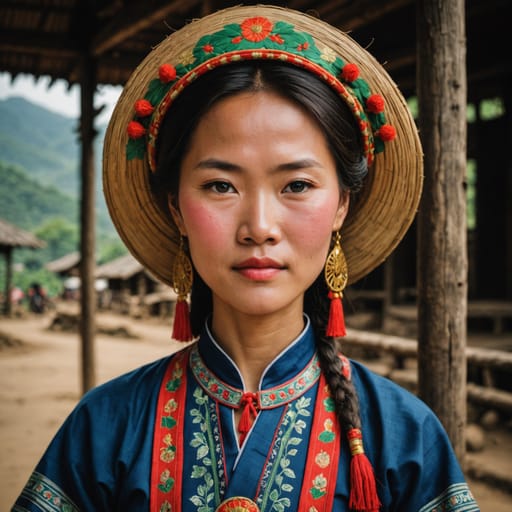
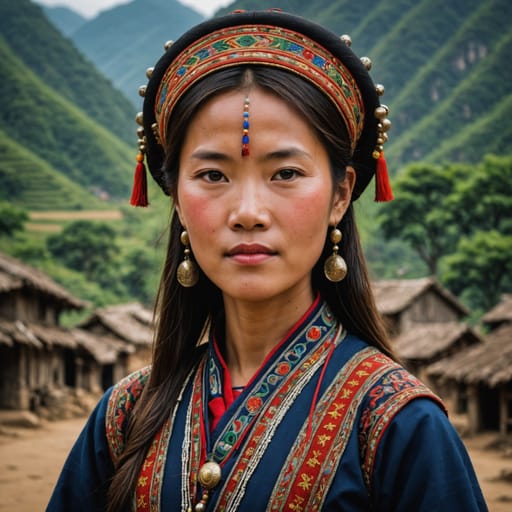
Does this portrait look right for Kinh?
One tap. It takes a second and it is recorded.
1 says it looks right, 0 say it looks off.


Vietnam
VNSoutheast Asia
Vietnam is home to 12 documented ethnic groups in Southeast Asia, led by Kinh (~85%), Vietnam Other (~3%), Tay (~2%), Thai Vietnam (~2%). This page blends their phenotype and demographic data into one weighted reference: skin tone, facial features, hair texture and build, drawn from published census and ancestry sources.
Demographic Composition
Composition weights are derived from self-identification in published census and demographic surveys. Each row links to the source ethnic-group atlas page.
| Ethnic group | Weight | Source |
|---|---|---|
 Kinh Kinh | 85.3% | General Statistics Office of Vietnam 2019 Census, self-identified Kinh / Viet (~85.3%, ~82M+ of ~96M total); the dominant ethnic group, concentrated throughout Vietnam with particular density in the Red River Delta (Northern Vietnam), the Mekong Delta (Southern Vietnam), the central coastal plains, and the major urban centers |
 Vietnam Other Vietnam Other | 2.8% | Vietnam 2019 Census residual; includes Stieng, Mnong, Bahnar, Ko-ho, Sedang, Hre, Co-tu, Mong, Ta-oi, plus approximately 40 other smaller ethnic groups across Vietnam's 54 officially-recognized ethnic groups |
 Tay Tay | 1.9% | Vietnam 2019 Census, self-identified Tay (~1.9%, ~1.85M); concentrated in northern Vietnam (Cao Bang, Lang Son, Bac Kan, Tuyen Quang, Ha Giang). Tai-Kadai language family. The largest non-Kinh ethnic group in Vietnam |
 Thai Vietnam Thai Vietnam | 1.8% | Vietnam 2019 Census, self-identified Thai (~1.8%, ~1.82M); concentrated in northwestern Vietnam (Son La, Lai Chau, Dien Bien, Yen Bai, Thanh Hoa, Nghe An). Tai-Kadai language family, related to Thai of Thailand and Lao of Laos |
 Muong Muong | 1.5% | Vietnam 2019 Census, self-identified Muong (~1.5%, ~1.45M); concentrated in northern Vietnam (Hoa Binh, Thanh Hoa, Phu Tho, Son La). Vietic / Austroasiatic language family — closely related to Vietnamese (Kinh) language but with substantial linguistic and cultural distinctness. The Muong are sometimes characterized as the 'Indigenous' Vietic population that maintained pre-Sinitic-influenced cultural-linguistic traditions while the Kinh population underwent substantial Sinification during the millennium of Chinese rule |
 Khmer Vietnam Khmer Vietnam | 1.4% | Vietnam 2019 Census, self-identified Khmer Krom (~1.4%, ~1.32M); the Khmer minority of southern Vietnam (the historic Lower Mekong / Khmer Krom region of southwestern Vietnam: Soc Trang, Tra Vinh, An Giang, Kien Giang, Bac Lieu, Vinh Long, Can Tho — historically part of the Khmer Empire's lower Mekong territory before Vietnamese expansion in the 17th-19th centuries). Cross-border population shared with the much larger Khmer-Cambodian population |
 Hmong Vietnam Hmong Vietnam | 1.4% | Vietnam 2019 Census, self-identified Hmong / Mong (~1.4%, ~1.39M); concentrated in northern Vietnam mountainous regions (Ha Giang, Lao Cai, Yen Bai, Lai Chau, Son La, Dien Bien, Cao Bang). Hmong-Mien language family. Cross-border population shared with the much larger Hmong / Miao populations of China (~11M+) plus Laos, Thailand, and the substantial Hmong-American diaspora |
 Nùng Nùng | 1.1% | Vietnam 2019 Census, self-identified Nung (~1.1%, ~1.08M); concentrated in northern Vietnam (Lang Son, Cao Bang, Bac Giang). Tai-Kadai language family, closely related to Tay |
 Dao Dao | 0.9% | Vietnam 2019 Census, self-identified Dao / Yao (~0.9%, ~890,000); concentrated in northern Vietnam mountainous regions. Hmong-Mien language family. Cross-border population shared with the much larger Yao populations of China (~3.3M+) plus Laos, Thailand |
 Hoa Vietnam Hoa Vietnam | 0.8% | Vietnam 2019 Census, self-identified Hoa (Vietnamese-Chinese) (~0.8%, ~750,000); the Chinese-Vietnamese minority. Substantially reduced from earlier 20th-c. peaks (the post-1975 expulsion / departure of Chinese-Vietnamese in the late 1970s — the so-called 'boat people' crisis included substantial Chinese-Vietnamese refugee outflow). Concentrated in Ho Chi Minh City (Cholon Chinatown) plus Hanoi and other major cities |
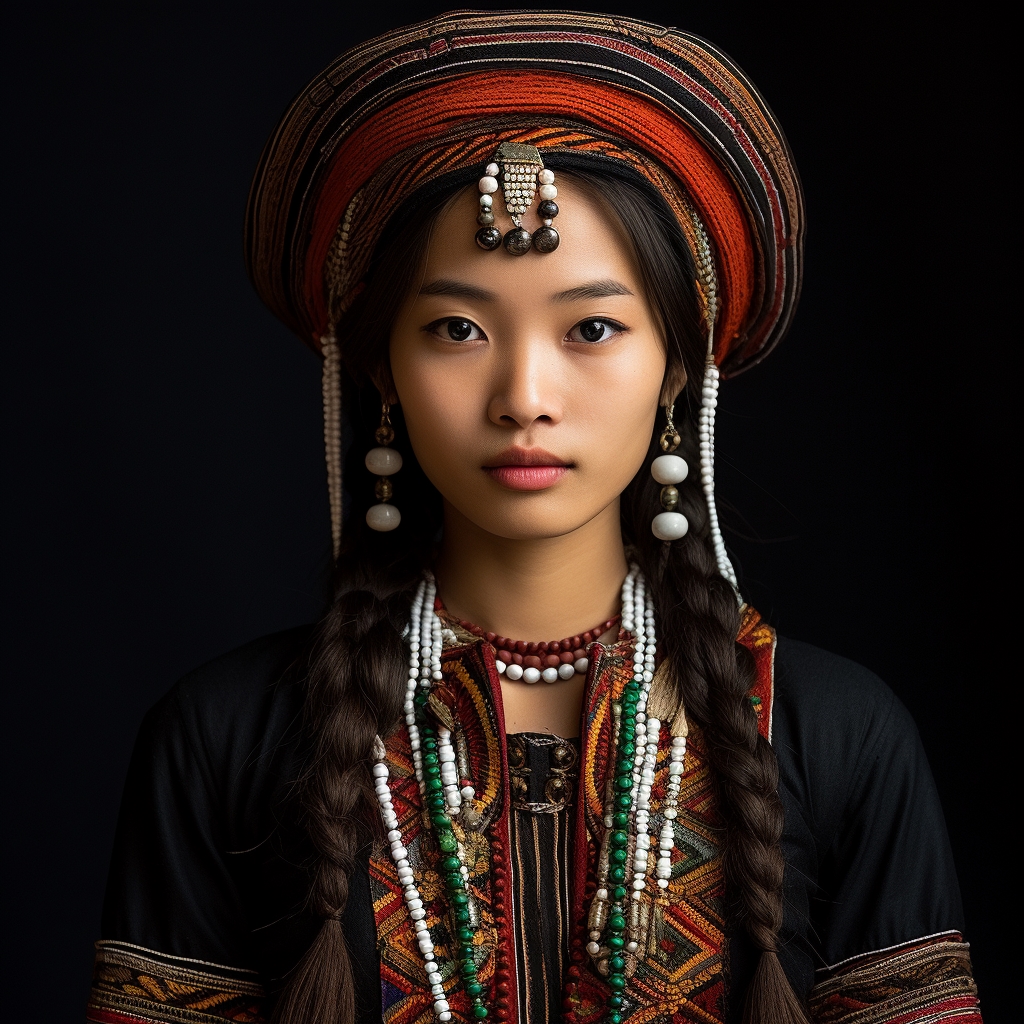 Jarai Jarai | 0.5% | Vietnam 2019 Census, self-identified Jarai (~0.5%, ~510,000); concentrated in the Central Highlands (Gia Lai, Kon Tum, Dak Lak provinces). Austronesian / Malayo-Polynesian language family — distinct from the Kinh and other Vietnamese populations through Austronesian linguistic affiliation |
 Cham Vietnam Cham Vietnam | 0.2% | Vietnam 2019 Census, self-identified Cham (~0.2%, ~180,000); concentrated in central Vietnam (Ninh Thuan, Binh Thuan) and the Mekong Delta. The Cham are the descendants of the historic Champa Kingdom (~2nd-19th c. CE) — Austronesian-Chamic-language-speaking. The Vietnamese-Cham population is divided between Hindu Cham (predominantly in central Vietnam) and Muslim Cham (predominantly in the Mekong Delta plus cross-border with Cambodia) |
Vietnam Phenotype Profile
Vietnam's population is dominated by Kinh (Viet) ethnic group (~85% per 2019 Census) with the substantial 53 officially-recognized ethnic minorities (~15% combined) distributed predominantly in the Northern Mountains, Central Highlands, and lower Mekong Delta border regions. The country's demographic structure reflects approximately 4,000+ years of population processes: the foundational Vietic / Austroasiatic ethnogenesis in the Red River Delta region, the millennium of Chinese imperial rule (111 BCE - 938 CE) producing substantial Han-Chinese cultural-linguistic-genetic admixture, the post-938 CE Vietnamese imperial period and southward expansion (Nam Tien) absorbing or displacing the Champa Kingdom and the lower Mekong Khmer territory, the French colonial period (1858-1954), the post-1954 Vietnam War period and the 1975 reunification, and the post-1975 demographic dynamics including the substantial 'boat people' refugee outflow (predominantly Chinese-Vietnamese plus broader South Vietnamese) and the post-1986 Doi Moi economic-reform period.
Genome-wide studies place Vietnamese populations in a Southern East Asian / Southeast Asian cluster, distinct from but related to Southern Han Chinese populations and to broader Tai-Kadai populations of southern China and Southeast Asia. Skin tone across the broader Vietnamese population spans Fitzpatrick III-V with III-IV the modal value nationally. Hair is uniformly straight (Andre Walker 1A-1B) and uniformly black or very dark brown across the broader population. Eye color is uniformly brown to dark brown. Facial features track Southern East Asian / Southeast Asian source populations. The Central Highlands Austronesian-language populations (Jarai, Ede, Cham, plus other smaller groups) show characteristic Austronesian / Indonesian-related source-population features distinct from broader Vietnamese populations. The Northern Mountain Tai-Kadai (Tay, Thai, Nung) and Hmong-Mien (Hmong, Dao) populations show characteristic Tai-Kadai and Hmong-Mien source-population features. Build is intermediate to shorter; adult Kinh Vietnamese male mean stature is approximately 167-170 cm in 2010s-2020s urban cohorts.
Vietnam Body & Anatomy Reference
Per-feature anatomical profile for AI nude generation: Southeast Asian Austronesian / Austroasiatic phenotype dominant in Vietnam
Vietnam Women: Boobs & Breasts
Vietnam women's tits and boobs reflect the small-to-medium cup, modest projection Southeast Asian Austronesian / Austroasiatic bust profile dominant in the Vietnam demographic composition. Vietnam nipples and areolas show medium-brown to dark-brown areolar pigmentation against the tan-to-medium-brown skin tone, with areolar diameter typically in the 26-38mm range, distinct from the the fuller South Asian or Polynesian bust. Vietnam breast morphology trends firm, modest projection, a function of the ectomorph, petite frame body habitus and mean adult female BMI 20-23. For anatomically-accurate AI-generated Vietnam nude women the render should preserve: small-to-medium cup, modest projection shape, 26-38mm areolas with regional pigmentation, and the torso proportions of the Southeast Asian Austronesian / Austroasiatic phenotype.
Vietnam Women: Ass & Hips
Vietnam women's ass and hip morphology presents as small-to-medium, modest projection, narrower hip profile, distinctly different from the fuller glutes of the Pacific Islander phenotype. Vietnam pelvic profile shows narrow-to-medium iliac crests, anchored in the Southeast Asian Austronesian / Austroasiatic skeletal pattern that dominates the Vietnam ethnic composition. Vietnam butt shots in adult AI imagery should render the small-to-medium, modest projection, narrower hip profile silhouette with the ectomorph, petite frame build and the gluteal-femoral fat distribution typical of the Southeast Asian Austronesian / Austroasiatic phenotype rather than defaulting to a globally-averaged shape that generic AI generators produce.
Vietnam Women: Vagina & Pussy
Vietnam women's pussy and vulvar anatomy presents medium-brown to dark-brown labial pigmentation, consistent with the Southeast Asian Austronesian / Austroasiatic phenotype's pigmentation pattern dominant in Vietnam. Vietnam pubic hair is typically straight-to-wavy fine-to-medium texture, distributed in the inverted-triangle pattern with regional-typical density. AI-generated Vietnam nude imagery should preserve the medium-brown to dark-brown labial pigmentation and the straight-to-wavy fine-to-medium texture hair texture rather than defaulting to a Western-European pink-and-sparse template. For anatomically-accurate Vietnam pussy renders the labial pigmentation should match the surrounding tan to medium-brown skin tone of the Southeast Asian Austronesian / Austroasiatic phenotype.
Vietnam Men: Dicks & Penis
Vietnam men's dick and penile anatomy in adult AI generation should anchor on the regional reference data: regional mean ~11cm erect, moderate girth, and medium-brown shaft pigmentation. Vietnam cock profile reflects the Southeast Asian Austronesian / Austroasiatic ancestral population's anthropometric measurements rather than a globally-averaged Western-pornography default. For anatomically-accurate Vietnam nude male imagery the shaft pigmentation should track the surrounding tan to medium-brown skin tone, with continuous glans-to-shaft pigmentation transition and the straight-to-wavy fine-to-medium texture pubic-hair texture distributed in the typical inverted-V escutcheon. Circumcision status across Vietnam men varies by religious and cultural tradition rather than ancestral phenotype.
Vietnam People: Body, Curves & Build
Vietnam body type and overall build presents as ectomorph, petite frame, with mean adult female BMI 20-23: the characteristic Southeast Asian Austronesian / Austroasiatic habitus dominant in the Vietnam demographic composition. Vietnam curves and proportions in adult AI imagery should preserve the regional skeletal frame (height, shoulder-to-hip ratio, limb proportions) rather than scaling to a Western-European mesomorph default. The Vietnam nude female form, when rendered with anatomical fidelity, shows the height range, frame width, and adipose distribution pattern typical of the Southeast Asian Austronesian / Austroasiatic phenotype. Generic AI image generators tend to collapse regional body types into a few default shapes; the Ethnic Erotic phenotype-anchored approach preserves the Vietnam build as its own reference category.
Vietnam People: Skin Tone & Hair Texture
Vietnam skin tone falls in the tan to medium-brown (Fitzpatrick III-V) band, the surface signal most often miscalibrated by generic AI nude generators trained on Western-photographic datasets. Vietnam hair texture is typically straight-to-wavy 1A-2A, dark-brown to black, characteristic of the Southeast Asian Austronesian / Austroasiatic phenotype. For anatomically-accurate Vietnam nude renders the skin should hold the Fitzpatrick band consistently across body surface rather than showing the lighter-than-face body shading that AI generators default to. Vietnam hair pigmentation and texture on body, pubic, and head should match across the figure rather than mixing textures (a common AI artefact).
A descriptive view, not a claim about individuals
This page shows a weighted aggregate of phenotype observations across the Vietnam population, based on demographic composition from published census and ancestry sources. Phenotypes within any country are far more varied than the aggregate suggests; this is a descriptive reference, not a deterministic claim about any individual. For source-level detail on individual ethnic groups, see the constituent atlas pages linked below.
Methodology Notes
Composition weights are derived from the General Statistics Office of Vietnam 2019 Census, the most recent comprehensive Vietnamese census. Vietnam enumerates 54 officially-recognized ethnic groups. Caveats: (1) the Kinh / Hoa boundary is socially and politically meaningful — the Hoa population was substantially reduced from earlier 20th-c. peaks through the post-1975 'boat people' crisis and continuing emigration; (2) the various Northern Mountain Tai-Kadai populations (Tay, Thai, Nung) are linguistically and culturally distinct but share substantial cultural-genetic continuity; (3) the Central Highlands Austronesian populations (Jarai, Ede, Cham, plus others) are politically sensitive given the historical Montagnard / FULRO insurgency and continuing land-rights tensions; (4) the substantial Vietnamese diaspora globally (~5M+) is not captured in source-country composition; (5) the Khmer Krom population continues to be politically marginalized despite formal recognition as one of Vietnam's 54 ethnic groups.
Primary Sources
- 1.General Statistics Office of Vietnam (Tổng cục Thống kê). 2019 Population and Housing Census. Hanoi: GSO; 2020.
- 2.HUGO Pan-Asian SNP Consortium. Mapping human genetic diversity in Asia. Science. 2009;326(5959):1541-1545.
- 3.Taylor KW. A History of the Vietnamese. Cambridge University Press; 2013.
- 4.Salemink O. The Ethnography of Vietnam's Central Highlanders: A Historical Contextualization, 1850-1990. University of Hawaii Press; 2003.
- 5.Chiu Y. Cholon Boat People: The Chinese-Vietnamese Refugee Movement of 1978-1979. Journal of Refugee Studies. 1999;12(4):362-381.
Other countries in Southeast Asia
Aggregate phenotype references for neighbouring Southeast Asia nations, weighted by demographic composition.