Help us get this right
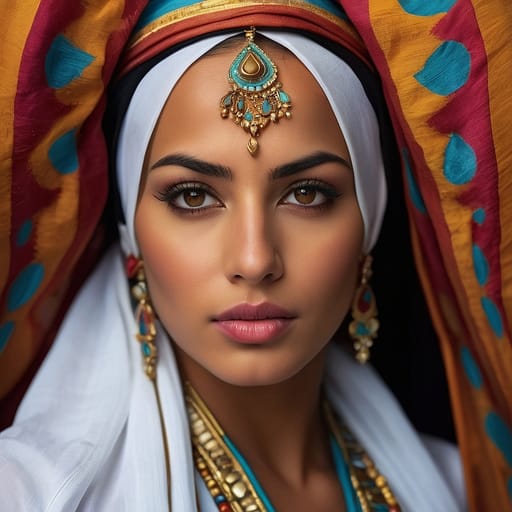
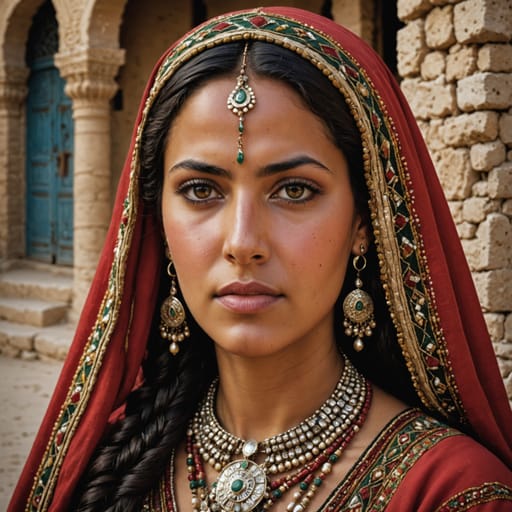
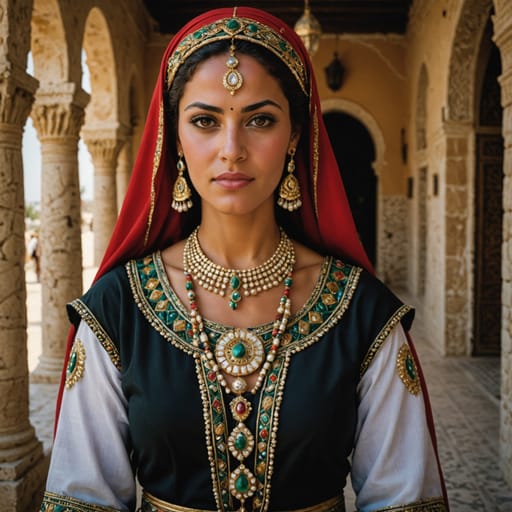
Does this portrait look right for Arab Tunisian?
One tap. It takes a second and it is recorded.
1 says it looks right, 0 say it looks off.

Tunisia
TNNorth Africa
Tunisia is home to 3 documented ethnic groups in North Africa, led by Arab Tunisian (~95%), Berber Tunisian (~5%), Tunisia Other (~1%). This page blends their phenotype and demographic data into one weighted reference: skin tone, facial features, hair texture and build, drawn from published census and ancestry sources.
Demographic Composition
Composition weights are derived from self-identification in published census and demographic surveys. Each row links to the source ethnic-group atlas page.
| Ethnic group | Weight | Source |
|---|---|---|
 Arab Tunisian Arab Tunisian | 94.5% | Institut National de la Statistique (INS) Tunisia 2014 Census plus subsequent estimates; Arab-Tunisian (~94.5%) is the dominant ethno-linguistic identification reflecting the post-7th-c. Arab Islamic conquest plus the substantial 11th-c. Beni Hilal Arab tribal migration. The Arab-Tunisian population is genealogically substantially Berber-descended (genome-wide studies place average Tunisian ancestry as predominantly North African / Berber-source) |
 Berber Tunisian Berber Tunisian | 5.0% | Estimates; Berber-Tunisian (~5%, ~600,000+); concentrated in southern Tunisia (Matmata, Tatouine, Zraoua, Chenini, Sened, Douiret) plus Djerba island. The Tunisian Berber community is much smaller than Algerian or Moroccan Berber populations due to more thorough Arabization through the 11th-c. Beni Hilal migration |
 Tunisia Other Tunisia Other | 0.5% | Estimates residual; includes the small remaining Italian-Tunisian and French-Tunisian communities (most emigrated post-1956 independence), Tunisian Jewish community (now ~1,000 in Tunisia after substantial post-1948 emigration to Israel and France from a community of approximately 105,000 in 1948 — the Tunisian Jewish community on the Djerba island is the longest continuous Jewish community in North Africa, traced to approximately 6th c. BCE), plus Sub-Saharan African migrant communities |
Tunisia Phenotype Profile
Tunisia's population is dominated by Arab-Tunisian (~94.5%) ethnic identification with smaller Berber-Tunisian (~5%) and other (~0.5%) communities. The country has the most thoroughly Arabized population structure in the Maghreb — the post-647 CE Arab Islamic conquest plus the substantial 11th-c. Beni Hilal Arab tribal migration produced more thorough Arabization than in Morocco or Algeria, leaving the contemporary Berber-Tunisian community as a small residual concentrated in southern Tunisia and Djerba.
Skin tone across the population spans Fitzpatrick II-IV with III the modal value nationally — among the lighter-skinned North African populations on average. Hair texture is most often straight to wavy with some curly variants; hair color is predominantly dark brown to black with non-trivial frequencies of medium brown and rarely lighter shades. Eye color is predominantly brown with elevated frequencies of hazel and rarely lighter variants. Facial features track North African source populations. Build is intermediate; adult Tunisian male mean stature is approximately 173-176 cm in 2010s-2020s urban cohorts.
The country is approximately 99% Sunni Muslim (Maliki school) with smaller Christian, Jewish (the Djerba Jewish community is one of the longest-continuous Jewish communities globally), and Bahai communities.
Tunisia Body & Anatomy Reference
Per-feature anatomical profile for AI nude generation: Berber / Mediterranean-Saharan phenotype dominant in Tunisia
Tunisia Women: Boobs & Breasts
Tunisia women's tits and boobs reflect the medium-to-large cup, full, moderate projection Berber / Mediterranean-Saharan bust profile dominant in the Tunisia demographic composition. Tunisia nipples and areolas show medium-brown to dark-brown areolar pigmentation against the olive-to-light-brown skin tone, with areolar diameter typically in the 30-44mm range, distinct from the the smaller East Asian bust profile. Tunisia breast morphology trends fuller and softer than the Cushitic East African norm, a function of the mesomorph with fuller hip-and-bust deposition body habitus and mean adult female BMI 24-28. For anatomically-accurate AI-generated Tunisia nude women the render should preserve: medium-to-large cup, full, moderate projection shape, 30-44mm areolas with regional pigmentation, and the torso proportions of the Berber / Mediterranean-Saharan phenotype.
Tunisia Women: Ass & Hips
Tunisia women's ass and hip morphology presents as medium-to-full, moderate projection, broader hip profile, distinctly different from the slim narrow-hip Cushitic East African profile. Tunisia pelvic profile shows medium-to-wide iliac crests, fuller gluteal-femoral fat distribution, anchored in the Berber / Mediterranean-Saharan skeletal pattern that dominates the Tunisia ethnic composition. Tunisia butt shots in adult AI imagery should render the medium-to-full, moderate projection, broader hip profile silhouette with the mesomorph with fuller hip-and-bust deposition build and the gluteal-femoral fat distribution typical of the Berber / Mediterranean-Saharan phenotype rather than defaulting to a globally-averaged shape that generic AI generators produce.
Tunisia Women: Vagina & Pussy
Tunisia women's pussy and vulvar anatomy presents medium-brown to dark-brown labial pigmentation, fuller labia minora, consistent with the Berber / Mediterranean-Saharan phenotype's pigmentation pattern dominant in Tunisia. Tunisia pubic hair is typically wavy-to-coiled medium-coarse texture, dense distribution, distributed in the inverted-triangle pattern with regional-typical density. AI-generated Tunisia nude imagery should preserve the medium-brown to dark-brown labial pigmentation and the wavy-to-coiled medium-coarse texture hair texture rather than defaulting to a Western-European pink-and-sparse template. For anatomically-accurate Tunisia pussy renders the labial pigmentation should match the surrounding olive to medium-brown skin tone of the Berber / Mediterranean-Saharan phenotype.
Tunisia Men: Dicks & Penis
Tunisia men's dick and penile anatomy in adult AI generation should anchor on the regional reference data: regional mean ~13-14cm erect, moderate girth, and medium-brown shaft pigmentation. Tunisia cock profile reflects the Berber / Mediterranean-Saharan ancestral population's anthropometric measurements rather than a globally-averaged Western-pornography default. For anatomically-accurate Tunisia nude male imagery the shaft pigmentation should track the surrounding olive to medium-brown skin tone, with continuous glans-to-shaft pigmentation transition and the wavy-to-coiled medium-coarse texture pubic-hair texture distributed in the typical inverted-V escutcheon. Circumcision status across Tunisia men varies by religious and cultural tradition rather than ancestral phenotype.
Tunisia People: Body, Curves & Build
Tunisia body type and overall build presents as mesomorph with fuller hip-and-bust deposition, with mean adult female BMI 24-28: the characteristic Berber / Mediterranean-Saharan habitus dominant in the Tunisia demographic composition. Tunisia curves and proportions in adult AI imagery should preserve the regional skeletal frame (height, shoulder-to-hip ratio, limb proportions) rather than scaling to a Western-European mesomorph default. The Tunisia nude female form, when rendered with anatomical fidelity, shows the height range, frame width, and adipose distribution pattern typical of the Berber / Mediterranean-Saharan phenotype. Generic AI image generators tend to collapse regional body types into a few default shapes; the Ethnic Erotic phenotype-anchored approach preserves the Tunisia build as its own reference category.
Tunisia People: Skin Tone & Hair Texture
Tunisia skin tone falls in the olive to medium-brown (Fitzpatrick III-V) band, the surface signal most often miscalibrated by generic AI nude generators trained on Western-photographic datasets. Tunisia hair texture is typically wavy-to-curly 2B-3C, often dark-brown to black, characteristic of the Berber / Mediterranean-Saharan phenotype. For anatomically-accurate Tunisia nude renders the skin should hold the Fitzpatrick band consistently across body surface rather than showing the lighter-than-face body shading that AI generators default to. Tunisia hair pigmentation and texture on body, pubic, and head should match across the figure rather than mixing textures (a common AI artefact).
A descriptive view, not a claim about individuals
This page shows a weighted aggregate of phenotype observations across the Tunisia population, based on demographic composition from published census and ancestry sources. Phenotypes within any country are far more varied than the aggregate suggests; this is a descriptive reference, not a deterministic claim about any individual. For source-level detail on individual ethnic groups, see the constituent atlas pages linked below.
Tunisia in the History of Erotic Depiction
Manuals, literature & art traditions of this country · full timeline →
The Perfumed Garden of Sensual Delight
manualArab–Berber (Maghreb) · 15th century CE
Tunisian manual whose chapter on the 'manners' of congress names positions such as the Stopperage, Frog Fashion, and Driving the Peg Home (Burton's renderings).
Methodology Notes
Composition weights are derived from the Institut National de la Statistique (INS) Tunisia 2014 Census plus subsequent demographic estimates. Tunisia does not directly enumerate Arab vs Berber ethnicity in census instruments — the composition derived from linguistic / cultural self-identification surveys plus academic estimates. Caveats: (1) the Arab-Tunisian / Berber-Tunisian boundary is socially fluid given that the Arab-Tunisian population is genealogically substantially Berber-descended; (2) the historic Tunisian Jewish community has been substantially reduced through post-1948 emigration; (3) the substantial Tunisian diaspora globally (~1.5M+ predominantly in France, Italy, Germany) is not captured in source-country composition; (4) the post-2010 Tunisian Revolution and broader Arab Spring period has affected migration patterns including substantial transit migration of Sub-Saharan African populations through Tunisia toward Europe.
Primary Sources
- 1.Institut National de la Statistique (INS). Recensement Général de la Population et de l'Habitat 2014. Tunis: INS; 2015.
- 2.Henn BM, Botigué LR, Gravel S, et al. Genomic ancestry of North Africans supports back-to-Africa migrations. PLoS Genet. 2012;8(1):e1002397.
- 3.Perkins KJ. A History of Modern Tunisia (2nd ed). Cambridge University Press; 2014.
- 4.Brett M, Fentress E. The Berbers. Wiley-Blackwell; 1996.
- 5.Schroeter DJ. The Sultan's Jew: Morocco and the Sephardi World. Stanford University Press; 2002 (with broader Maghreb Jewish context including Tunisia).
Other countries in North Africa
Aggregate phenotype references for neighbouring North Africa nations, weighted by demographic composition.