No portrait yet
Ursari Erotic
Romania and Moldova, with related communities in Bulgaria, Serbia and other parts of the Balkans
Vlax Romani (Indo-Aryan); also Romanian (Romance), Bulgarian or Serbian (South Slavic) as local languages
Mainly Eastern Orthodox Christian, with growing Pentecostal congregations
A traditional occupational group within the Vlax branch of the Romani people; bear-leading Roma in Bulgaria are known as Mechkari
About Ursari People
The Ursari are named for what they once did. Urs is Romanian for bear, and for generations Ursari families led trained brown bears through the villages and market towns of the lower Danube. They earned coins for a shuffling dance kept in time with a drum or tambourine. The bears are gone, but the name has stuck. Across the Romani world, work-based names mark recognized groups of families: Kalderash recalls coppersmithing and Lăutari recalls music. Many people who have never seen a working bear still call themselves Ursari.
Their core homeland is Romania and Moldova. Related bear-leading Roma live in Bulgaria, where they are called Mechkari, and in Serbia and other parts of the Balkans. Ursari who still speak Romani mostly use a Vlax dialect, an Indo-Aryan language full of Romanian words picked up over centuries in the Danubian principalities. Nearly all also speak Romanian or the national language where they live. Their religion generally matches their neighbors': most are Eastern Orthodox Christians, and Pentecostal churches have won converts in recent decades, as they have among many Roma in the region.
Their history is not gentle. In Wallachia and Moldavia, Roma were held as slaves until the 1840s and 1850s, owned by princes, monasteries and boyars. Many Ursari belonged to the princely treasury rather than to a private master. They paid a yearly tribute, and that let them keep moving. Later, that same mobility made them targets: in 1942 Romania's wartime government deported nomadic Roma to Transnistria, where thousands died.
The bear meant more than entertainment. In rural Romania and Bulgaria, people paid to have a bear step across their backs to ease pain, and tufts of its fur were saved as folk remedies. The training behind the dance was harsh. Animal welfare laws and pressure from campaigners had largely ended the trade by the 2000s, and Bulgaria's last dancing bears went to a sanctuary at Belitsa. Ursari families turned to trade, scrap collecting and wage labor. Many now live settled lives on the edges of towns and villages, facing the same poverty and prejudice that Roma face across Eastern Europe.
Related ethnic groups
Groups that share Ursari's homeland, region, language, or religious tradition. These are likely candidates for comparative phenotype reference.
Belarusians
same region (Eastern Europe)
Bulgarians
same region (Eastern Europe)
Czechs
same region (Eastern Europe)
Slovaks
same region (Eastern Europe)
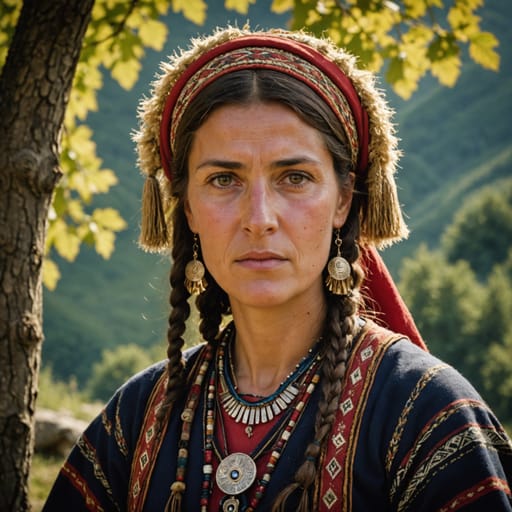
Dentheletae
same region (Eastern Europe)
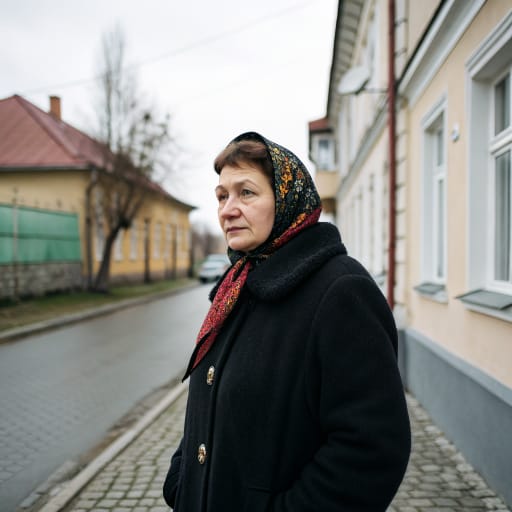
Crimean Karaites
same region (Eastern Europe)
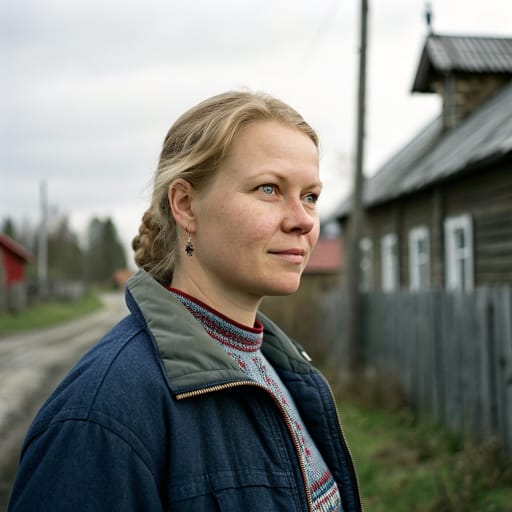
Ingrian Finns
same region (Eastern Europe)
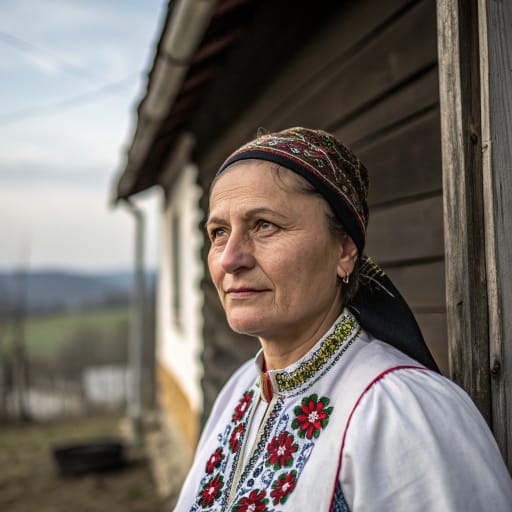
Matyó
same region (Eastern Europe)
Typical Ursari Phenotypes
Reference for AI generation: hair, eyes, skin, facial structure, build
Ursari Body & Anatomy Reference
Anatomy by feature, Eastern European / Slavic phenotype
Ursari Boobs & Breasts
Ursari tits and boobs run medium-to-large cup, full, moderate-to-high projection, the classic Eastern European / Slavic bust profile. Ursari nipples and areolas show light-pink to medium-brown areolar pigmentation against the fair-to-light-brown skin tone, with areolar diameter typically in the 30-44mm range and forward-set positioning rather than the smaller East Asian bust. Ursari breasts trend full and projecting, classic Eastern European curvy bust, a function of the mesomorph, full hip-and-bust deposition body habitus and the mean adult female BMI 23-26. For anatomically accurate AI-generated Ursari nudes the render preserves the medium-to-large cup, full, moderate-to-high projection shape, 30-44mm areolas with light-pink to medium-brown pigmentation, and the torso proportions of the Eastern European / Slavic phenotype.
Ursari Ass & Hips
Ursari hips and butt usually read as medium-to-full, moderate-to-high projection. The skeletal base is medium iliac crests, full gluteal-femoral fat deposition, the Eastern European / Slavic pattern. Set against the slim narrow-hip East Asian profile, the difference is easy to see, and the hip-to-waist ratio is often what identifies Ursari women in photos.
Ursari Vagina & Pussy
Expect light-pink to medium-brown labial pigmentation, varied labia minora on Ursari women, in keeping with Eastern European / Slavic ancestry. The pubic hair is wavy medium texture, blond to dark-brown. Coloring should run evenly from the fair to light skin of the thighs to the labia, and Ursari nude imagery should keep the hair's wavy medium texture.
Ursari Dicks & Penis
Ursari dick and penile anatomy in adult AI generation should anchor on the regional reference data: regional mean ~13-14cm erect, moderate girth, and light-pink to medium-brown shaft pigmentation. The Ursari cock profile reflects the Eastern European / Slavic population's anthropometric measurements. The shaft pigmentation should track the surrounding fair to light skin tone, and the pubic hair should keep its wavy medium texture in the typical inverted-V escutcheon.
Ursari Body, Curves & Build
Ursari body type: mesomorph, full hip-and-bust deposition, with mean adult female BMI 23-26. This is the typical Eastern European / Slavic build. Height range, shoulder-to-hip ratio and fat distribution all follow from it, which is what an accurate Ursari nude body should show.
Ursari Skin Tone & Hair Texture
Ursari skin tone falls in the fair to light (Fitzpatrick II-III) band, the surface signal most often miscalibrated by generic AI nude generators. Ursari hair texture is typically straight-to-wavy 1A-2B, light-blond to dark-brown, characteristic of the Eastern European / Slavic phenotype. In Ursari nude renders the skin should hold that band consistently across the body.
Explore phenotype categories
Structured taxonomy with peer-reviewed scales · 22 anatomical categories
Erotic Poses & Sex Positions
From the pose catalog: 219 named positions with reference skeletons
Frequently asked questions about Ursari people
Where is the Ursari homeland?
The Ursari homeland is Romania and Moldova, with related communities in Bulgaria, Serbia and other parts of the Balkans in Eastern Europe.
What language do Ursari people speak?
Ursari people primarily speak Vlax Romani (Indo-Aryan); also Romanian (Romance), Bulgarian or Serbian (South Slavic) as local languages.
What religion do Ursari people practice?
The predominant religion among Ursari people is Mainly Eastern Orthodox Christian, with growing Pentecostal congregations.






Make your own Ursari images
Five a day, free, no credits to buy. The studio starts from this group's phenotype data, so you can set body type, pose and style and keep the traits accurate.
Start with Ursari