Help us get this right
Does this portrait look right for Norwegians?
One tap. It takes a second and it is recorded.
1 says it looks right, 0 say it looks off.
Norwegians Erotic
Also known as: Norwegian
Christianity / Protestantism
Significant populations in the United States, and Norwegian Canadians
About Norwegians People
Norwegians are the people of a long, narrow country that is mostly coastline. Almost everything that has shaped them — settlement patterns, dialect spread, economy, temperament — traces back to fjords cutting deep into the mountains and to a sea that was easier to travel than the land behind it. For most of Norwegian history, you reached the next valley by boat. That geography is why a country of barely five and a half million people carries dozens of mutually intelligible but stubbornly distinct dialects, and why Norwegian itself comes in two written standards: Bokmål, the Dano-Norwegian compromise inherited from four centuries of union with Denmark, and Nynorsk, assembled in the nineteenth century by Ivar Aasen from rural west-coast speech as a deliberate counter to that inheritance. Both are official. Schoolchildren learn both. Which one a town uses on its road signs is a real local decision.
The language sits inside the North Germanic branch alongside Swedish and Danish, close enough that the three are often described as a dialect continuum politely treated as separate languages. Icelandic and Faroese, the Atlantic offshoots of the same Old Norse stock, drifted further and stayed more conservative; Norwegian on the mainland kept changing. Religiously, Norway is Lutheran by inheritance — the Reformation arrived top-down in the 1530s under Danish rule and the Church of Norway was the state church until the constitutional separation completed in 2017. Practising Lutheranism is now a minority habit, but the cultural scaffolding (confirmation, Christmas services, the parish register) remains widely observed even by the secular majority. In the far north, the Sámi are a separate indigenous people with their own languages and a distinct legal status, and Norwegians are clear about not conflating the two.
Modern Norway is shaped by two twentieth-century shocks: the German occupation from 1940 to 1945, which is still a live moral reference point, and the discovery of North Sea oil in 1969, which turned a modest fishing-and-shipping economy into one of the wealthiest states in Europe within a generation. The sovereign wealth fund built from that oil is now a national institution in its own right. Beyond the borders, the largest Norwegian diaspora is in the American Upper Midwest — Minnesota, the Dakotas, Wisconsin — descended from the great emigration wave between roughly 1825 and 1925, when something close to a third of the country left. A smaller but parallel community settled across the Canadian prairies.
Related ethnic groups
Groups that share Norwegians's homeland, region, language, or religious tradition. These are likely candidates for comparative phenotype reference.
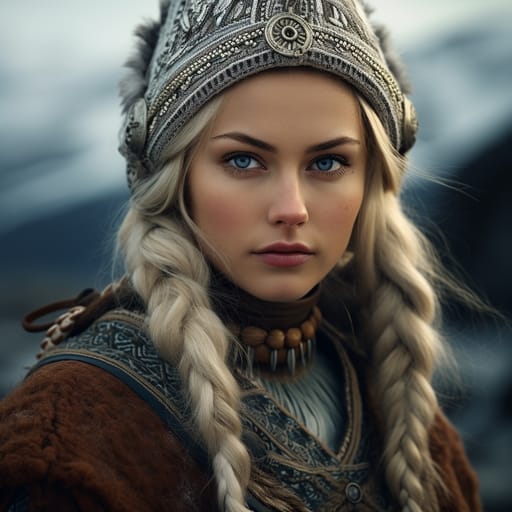
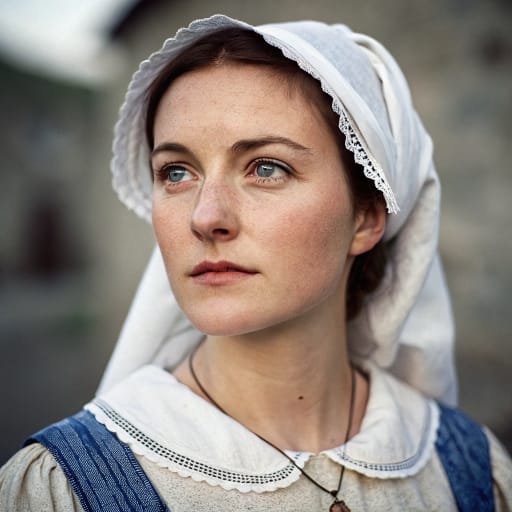
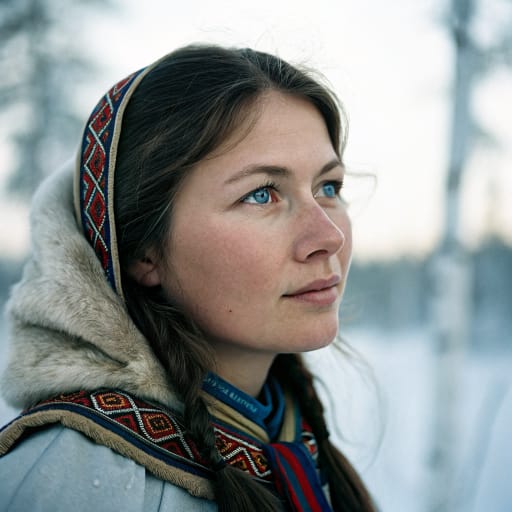
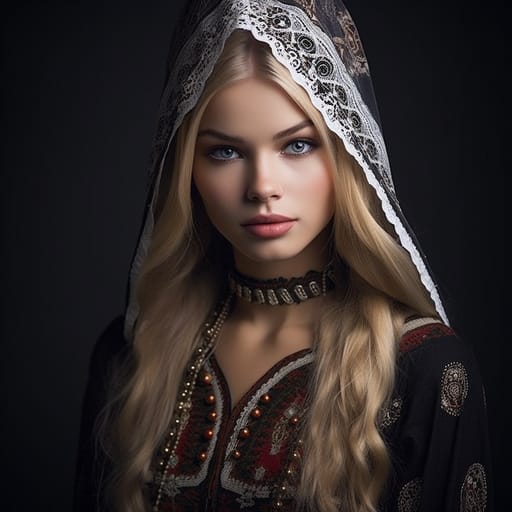
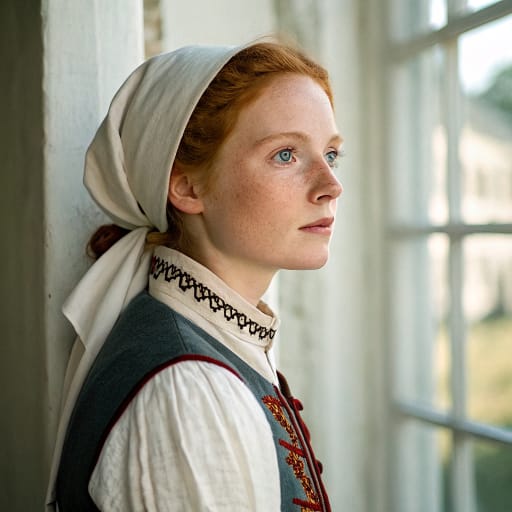
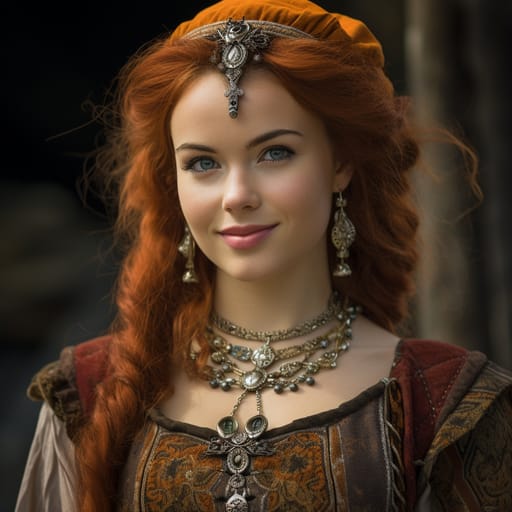
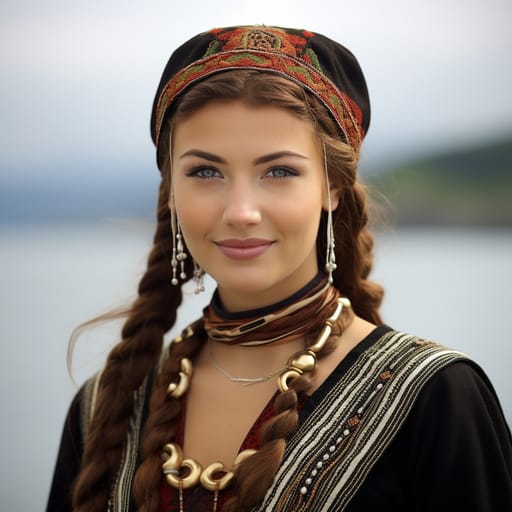
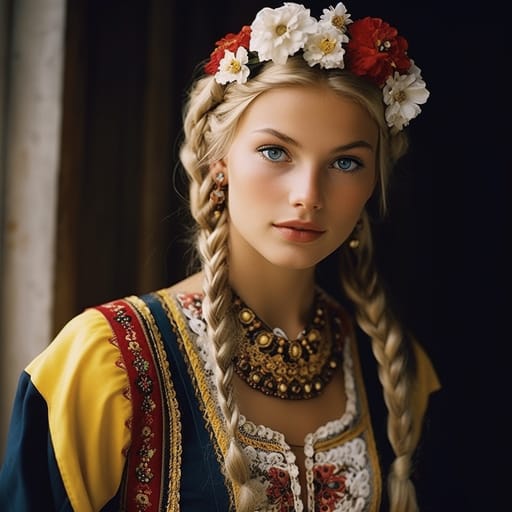
Typical Norwegians Phenotypes
Reference for AI generation: hair, eyes, skin, facial structure, build
Norwegians sit at the pale, light-pigmented end of the European phenotype range, with a population structurally shaped by long winters, high latitudes, and millennia of relative genetic continuity along the coast and inland valleys. Hair runs predominantly from ash blond and dark blond through light brown, with a meaningful share of natural medium browns; true platinum is more common in childhood and tends to darken into the teens. Red hair sits around 4–6%, often as a strawberry-blond or copper rather than the deep auburn seen in Ireland or Scotland. Texture is overwhelmingly straight to loosely wavy; tight curl is rare and usually points to admixture.
Eye color skews heavily blue — Norway has one of the highest blue-eyed frequencies on earth, well above 50% — with grey, grey-green, and pale green next, and brown a distinct minority. Eye shape is typically wide-set with a defined upper lid crease and no epicanthic fold. Skin is Fitzpatrick I–II for most: very fair, often with visible vasculature at the temples and chest, freckling in coastal and red-haired subsets, and a tendency to burn before tanning. Undertones lean cool-pink to neutral; warm olive cast is uncommon and usually concentrated in the south.
Facial structure tends toward a long, narrow face with a high, straight nose bridge and narrow alar base, a relatively flat midface, and a defined jaw. Lips are generally thin to medium, lower-lip-dominant. Cheekbones are present but not prominent in the way they are further east in Sápmi. Build is tall — Norwegian men average around 180 cm, women around 167 cm, placing them among the taller populations globally — with long limbs, narrow hips, and a tendency toward lean-rangy framing that fills out broader in middle age. Sámi-descended Norwegians in the north often diverge visibly: shorter stature, darker hair, browner eyes, broader cheekbones, and a flatter nasal bridge. Diaspora Norwegian-Americans and Norwegian-Canadians retain the core phenotype but show more admixture-driven variation in hair and eye color.
Norwegians Body & Anatomy Reference
Per-feature anatomical profile for AI nude generation: Northern European / Germanic-Scandinavian phenotype
Norwegians Boobs & Breasts
Bust reference for Norwegians women: medium-to-large cup, full, high projection, which is typical of Northern European / Germanic-Scandinavian ancestry. Areolas measure about 32-48mm across, with light-pink to medium-pink pigmentation. Body type (mesomorph with taller stature; ectomorph-to-mesomorph split) shapes the bust as well, so Norwegians tits are usually full and projecting, often the largest cup-size band in regional comparisons. In AI imagery, keep the forward-set shape rather than drifting toward the smaller East Asian bust.
Norwegians Ass & Hips
The Norwegians ass is typically medium-to-full, moderate-to-high projection, which sets it apart from the slim East Asian narrow-hip profile. Underneath, the pelvis shows medium-to-wide iliac crests, part of the Northern European / Germanic-Scandinavian skeletal pattern. For Norwegians butt pics and AI renders, match that silhouette and the overall build (mesomorph with taller stature; ectomorph-to-mesomorph split).
Norwegians Vagina & Pussy
Norwegians pussy and vulvar anatomy presents light-pink to medium-pink labial pigmentation, varied labia minora projection, consistent with the Northern European / Germanic-Scandinavian phenotype's pigmentation pattern. Norwegians pubic hair is typically fine-to-medium wavy texture, often lighter-pigmented (blond to dark-brown), in the inverted-triangle pattern. For anatomically accurate Norwegians pussy renders the labial coloration should match the surrounding fair skin tone with a continuous gradient, and the hair should keep its fine-to-medium wavy texture.
Norwegians Dicks & Penis
Norwegians dicks follow the Northern European / Germanic-Scandinavian reference data: regional mean ~13-14cm erect; moderate-to-above-average girth; light-pink to light-brown shaft pigmentation. Shaft color should track the fair skin tone with a smooth change toward the glans, and Norwegians pubic hair keeps its fine-to-medium wavy texture.
Norwegians Body, Curves & Build
Norwegians body type and overall build presents as mesomorph with taller stature; ectomorph-to-mesomorph split, with mean adult female BMI 24-27: the characteristic Northern European / Germanic-Scandinavian habitus. Norwegians curves and proportions should keep the regional skeletal frame (height, shoulder-to-hip ratio, limb proportions) rather than a generic mesomorph default.
Norwegians Skin Tone & Hair Texture
Norwegians skin sits in the fair (Fitzpatrick I-III) band. Hair is typically straight-to-wavy 1A-2B, blond to medium-brown common, in keeping with the Northern European / Germanic-Scandinavian phenotype. In nude renders the skin should stay one even tone from face to body, and body, pubic and head hair should match.
Data depth
72/100Coverage of image-grounded phenotype observations · drives AI generation diversity
- Sample size
- 40/40· 81 images
- Image quality
- 22/30· 44% high
- Confidence
- 10/20· mean 0.66
- Source diversity
- 0/10· wikipedia
- ·Wikipedia-only source, not population-representative
Observed Distribution: Image Sample
Empirical observations from analyzed photographs · supplementary signal, not population truth
Sample: 81 images analyzed (81 wikipedia). Quality: 36 high, 34 medium, 10 low, 1 very_low. Avg analyzer confidence: 0.66.
Skin tone (Fitzpatrick): II (90%), III (5%), unclear (5%)
Hair color: gray/white (40%), black (32%), light/medium brown (12%), dark brown (7%), blonde (5%), other (2%), red/auburn (1%)
Hair texture: straight (41%), wavy (48%), curly (4%), bald (6%), covered (1%)
Eye color: blue (25%), dark brown (12%), brown (7%), hazel (2%), light brown / amber (1%), unclear (52%)
Epicanthic fold: 0% present, 89% absent, 11% unclear
Caveats: Sample is 100% Wikipedia notable people, which skews toward male, public-life, and modern figures, not population-representative.
Last aggregated: May 7, 2026
Explore phenotype categories
Structured taxonomy with peer-reviewed scales · 22 anatomical categories
- SkinFitzpatrick I to VI, undertone, pigmentation
- EyesColor, shape, eyelid, epicanthic fold
- Head hairColor, Andre Walker texture, hairline
- Body shapeHeath-Carter somatotype, WHR, frame
- NoseBridge, tip, nostril, alar width
- Lips & mouthVolume, Cupid’s bow, philtrum
Measured in Norwegians portraits
Notable Norwegians People
100 reference figures, sourced from Wikipedia
- Ingvar Ambjørnsen, writer
- Tryggve Andersen, novelist, poet
- Peter Christen Asbjørnsen, writer, folklorist
- Kjell Aukrust, author and illustrator
- Ari Behn, author; ex-husband of Princess Märtha Louise of Norway
- André Bjerke, poet and author
- Jens Bjørneboe, author and poet
- Bjørnstjerne Bjørnson, poet and author, Nobel Prize in Literature winner
- Ketil Bjørnstad, author, composer, musician
- Johan Bojer, novelist and dramatist
- Christian Braunmann Tullin, ; businessman and poet
- Johan Nordahl Brun, ; author, poet, dramatist, politician
- Lars Saabye Christensen, author and poet
- Camilla Collett, writer, feminist
- Peter Egge, author, journalist, playwright
- Thorbjørn Egner, playwright, songwriter and illustrator
- Kristian Elster, novelist, journalist, literary critic
- Sven Elvestad, journalist and author
- Carl Fredrik Engelstad, writer, playwright, journalist, translator
- Jon Fosse, author, poet and playwright
- Arne Garborg, author and poet
- Hulda Garborg, poet and author
- Inger Hagerup, author, playwright and poet
- Knut Hamsun, author of Hunger, Nobel Prize in Literature winner
- Erik Fosnes Hansen, author and poet
- Jørgen Haugan, author and lecturer
- Olav H. Hauge, horticulturist, translator and poet
- Ludvig Holberg, historian and playwright
- Henrik Ibsen, playwright and poet, author of A Doll's House
- Sigurd Ibsen, author and politician
- Karl Ove Knausgård, novelist, author of My Struggle
- Thomas Krag, novelist, playwright
- Bernt Lie, novelist
- Jørgen Moe, folklorist
- Lise Myhre, cartoonist
- Dagne Groven Myhren, literature researcher
- Christopher Nielsen, cartoonist
- Sigbjørn Obstfelder, writer and poet
- Alf Prøysen, author, poet, folk singer and entertainer
- Nini Roll Anker, novelist, playwright
- Gabriel Scott, poet, novelist, playwright and children's writer
- Amalie Skram, writer, feminist
- Edvard Storm, poet, songwriter, educator
- Jens Tvedt, novelist, writer
- Sigrid Undset, author of Kristin Lavransdatter, Nobel Prize in Literature winner
- Halldis Moren Vesaas, poet and author
- Tarjei Vesaas, author and poet
- Jan Erik Vold, lyric poet
- Aasmund Olavsson Vinje, poet and author
- Peter Wessel Zapffe, writer and philosopher
- Frode Øverli, cartoonist
- Kyle Alessandro, singer-songwriter
- Morten Abel, musician (Mods, Peltz, The September When, Solo)
- Ivar F. Andresen, basso profundo opera singer
- Astrid S, singer-songwriter
- Savant, musician (edm, real name Aleksander Vinter)
- Svein Berge, musician (Röyksopp)
- Margaret Berger, singer-songwriter
- Jarle Bernhoft, singer-songwriter
- Ole Bull, violinist, composer
- Thomas Dybdahl, singer-songwriter
- Euronymous, musician (Mayhem)
- Fenriz, musician, metal guru (Darkthrone)
- Magne Furuholmen, keyboardist and songwriter (a-ha)
- Gaahl, singer (Gorgoroth)
- Anja Garbarek, singer-songwriter
- Jan Garbarek, musician
- Håvard Gimse, classical pianist
- Ernst Glaser, violinist
- Gottfried von der Goltz, violinist, conductor
- Edvard Grieg, composer
- Eivind Groven, composer
- Sigmund Groven, harmonica virtuoso, composer
- Lona Gyldenkrone, opera singer
- Johan Halvorsen, composer
- Björn Haugan, opera singer
- Dag-Are Haugan, electronic musician
- Ian Haugland, drummer (Europe)
- Kate Havnevik, singer-songwriter, composer, musician, pianist, guitarist, melodica player
- Hank von Helvete, singer (Turbonegro)
- Tone Groven Holmboe, composer
- Wilhelmine Holmboe-Schenström, opera singer
- Carl Høgset, conductor (Grex Vocalis)
- Ihsahn, musician (Emperor)
- Christian Ingebrigtsen, singer-songwriter for A1
- David Monrad Johansen, composer
- Deeyah Khan, singer, film director, music producer, composer, and human rights defender
- Roy Khan, singer (Kamelot)
- Olav Kielland, conductor, composer
- Henning Kraggerud, violinist
- Trond Kverno, composer
- Girl in Red, singer, songwriter
- Marit Larsen, singer-songwriter
- Ronni Le Tekrø, musician and guitarist
- Sondre Lerche, singer-songwriter
- Herman Severin Løvenskiold, composer of La Sylphide ballet
- Rolf Løvland, musician (Secret Garden)
- Anni-Frid Lyngstad, lead singer (ABBA)
- Lene Marlin, singer-songwriter
- Tom Mathisen, humorist singer
Erotic Poses & Sex Positions
From the pose catalog: 219 named positions with reference skeletons
Frequently asked questions about Norwegians people
Where is the Norwegians homeland?
The Norwegians homeland is Norway in Northern Europe.
What language do Norwegians people speak?
Norwegians people primarily speak Indo-European / Germanic / Nordic / Norwegian.
What religion do Norwegians people practice?
The predominant religion among Norwegians people is Christianity / Protestantism.
What are other names for Norwegians people?
Norwegians people are also known as Norwegian.






Make your own Norwegians images
Five a day, free, no credits to buy. The studio starts from this group's phenotype data, so you can set body type, pose and style and keep the traits accurate.
Start with Norwegians