Help us get this right
Does this portrait look right for Linones?
Nobody has judged this one yet. You would be the first.
Linones Erotic
The right bank of the lower Elbe around Lenzen, in the Prignitz, between present-day Brandenburg and eastern Lower Saxony, Germany.
Polabian, unattested for the Linones themselves (Lechitic branch of West Slavic, Indo-European)
Slavic polytheism; the region was Christianized only after the German conquest and settlement of the twelfth century.
Polabian or Elbe Slavs, known collectively to their German neighbors as Wends; a tributary member of the Obotrite orbit alongside the Smeldingi.
About Linones People
The Linones were a small West Slavic people of the ninth century, living on the right bank of the lower Elbe in what is now the Prignitz, on the modern border of Brandenburg and Lower Saxony. No one carries the name today; their line ran into the general Wendish population of the Elbe country and from there into the Germans of the region. They enter the record the way most frontier peoples do, as a name in someone else's war report. The Royal Frankish Annals put them on the page in 808, when the Danish king Godfrid came south against the Obotrites and the Linones, with their neighbors the Smeldingi, took the chance to shake off Obotrite overlordship. Charlemagne's answer arrived within two years: Frankish and Saxon columns across the Elbe, hostages taken, tribute imposed. After that they appear only in passing, and within a few generations the name drops out of the sources altogether.
Their country was sandy, low, and wet, pine and oak on the higher ground, marsh and old river channels below, with the Elbe working as road, larder, and border at once. Like the other Elbe Slavs they organized around fortified ring works rather than towns, and their main one is generally identified with Lenzen, whose name is taken to preserve theirs. If they are the Linaa of the ninth-century Bavarian Geographer, credited with seven strongholds, they were a people counted in thousands rather than tens of thousands, which is the ordinary scale for these polities. Their speech is unrecorded but would have been Polabian, the westernmost form of Lechitic Slavic, close kin to Kashubian and Polish. Their religion was the pre-Christian Slavic cult of the region, tied to groves, springs, and hilltop sanctuaries. Christianity reached them as an instrument of conquest and did not hold; the real conversion of this stretch of the Elbe waited for the German campaigns and settlement of the twelfth century.
What they left is mostly in the ground and on the map. Lenzen keeps the name. Village names ending in -itz, -ow, and -in run for miles on both banks, and the round hamlet plans of the Wendland, houses set in a ring around a green with a single way in, preserve the settlement habit of these Slav farmers. Just across the river, Polabian itself survived in farmhouse use until about 1750. One of its last speakers, a Wustrow farmer named Johann Parum Schultze, wrote down what he could of it and noted that he expected to be among the last who knew it. He was right.
Related ethnic groups
Groups that share Linones's homeland, region, language, or religious tradition. These are likely candidates for comparative phenotype reference.
Estonians
same region (Western Europe)
Austrians
same region (Western Europe)
Corsicans
same region (Western Europe)
Frisians
same region (Western Europe)
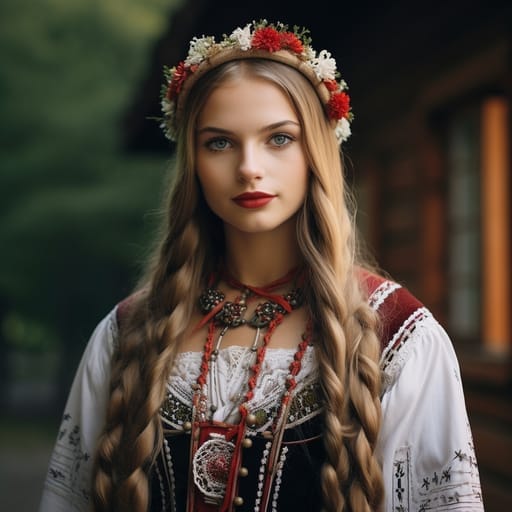
Latvians
same region (Western Europe)
Romands
same region (Western Europe)
Ripuarian Franks
same region (Western Europe)
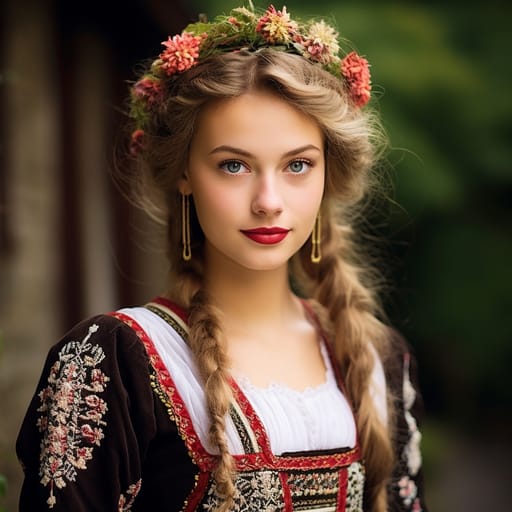
Luxembourgers
same region (Western Europe)
Typical Linones Phenotypes
Reference for AI generation: hair, eyes, skin, facial structure, build
Linones Body & Anatomy Reference
Anatomy by feature, Western European / Celtic-Germanic phenotype
Linones Boobs & Breasts
Linones boobs follow the Western European / Celtic-Germanic profile: medium-to-large cup, full, moderate-to-high projection. Areolar diameter is usually 30-46mm, and the coloring is light-pink to medium-pink areolar pigmentation against the fair-to-light skin tone. Breast shape tracks body composition (ectomorph-to-mesomorph, mean adult female BMI 24-27), so Linones breasts tend to be full and projecting. Expect a forward-set shape, not the smaller East Asian bust.
Linones Ass & Hips
Linones ass and hip morphology presents as medium, moderate projection, distinctly different from the broader hip profile of Mediterranean phenotypes. The Linones pelvic profile shows medium iliac crests, anchored in the Western European / Celtic-Germanic skeletal pattern. Linones butt shots in adult AI imagery should render the medium, moderate projection silhouette with the overall build (ectomorph-to-mesomorph) and the fat distribution typical of the Western European / Celtic-Germanic phenotype.
Linones Vagina & Pussy
Linones pussy anatomy typically shows light-pink labial pigmentation, varied labia minora. Pubic hair is usually wavy fine-to-medium texture, blond to dark-brown. In AI-generated Linones nudes, labial color should blend into the fair to light skin with a gradual transition, and the hair should keep its wavy fine-to-medium texture.
Linones Dicks & Penis
Penis reference for Linones men: regional mean ~13-14cm erect, moderate girth. Coloring: light-pink to light-brown shaft pigmentation. An accurate Linones cock in AI imagery matches the surrounding fair to light skin rather than a generic porn default. Circumcision depends on religion and custom, not ancestry.
Linones Body, Curves & Build
The Linones figure is generally ectomorph-to-mesomorph, with mean adult female BMI 24-27, characteristic of Western European / Celtic-Germanic ancestry. AI image tools tend to flatten regional body types into a few stock shapes; here the Linones build is kept as its own reference.
Linones Skin Tone & Hair Texture
Skin: fair to light (Fitzpatrick I-III). Hair: straight-to-wavy 1A-2B, blond to dark-brown. Both are typical of Western European / Celtic-Germanic ancestry. The most common mistake in AI nudes of Linones women is a body rendered lighter than the face.
Explore phenotype categories
Structured taxonomy with peer-reviewed scales · 22 anatomical categories
Erotic Poses & Sex Positions
From the pose catalog: 219 named positions with reference skeletons
Frequently asked questions about Linones people
Where is the Linones homeland?
The Linones homeland is The right bank of the lower Elbe around Lenzen, in the Prignitz, between present-day Brandenburg and eastern Lower Saxony, Germany. in Western Europe.
What language do Linones people speak?
Linones people primarily speak Polabian, unattested for the Linones themselves (Lechitic branch of West Slavic, Indo-European).
What religion do Linones people practice?
The predominant religion among Linones people is Slavic polytheism; the region was Christianized only after the German conquest and settlement of the twelfth century..






Make your own Linones images
Five a day, free, no credits to buy. The studio starts from this group's phenotype data, so you can set body type, pose and style and keep the traits accurate.
Start with Linones