Help us get this right
Does this portrait look right for Jamaican Maroons?
Nobody has judged this one yet. You would be the first.
Jamaican Maroons Erotic
The mountain interior of Jamaica: Cockpit Country in the west, the Blue Mountains and John Crow Mountains in the east. A deported branch settled in Freetown, Sierra Leone, by way of Nova Scotia.
Jamaican Patois (English-lexifier creole) in daily life; Kromanti, a ceremonial register carrying Akan-derived vocabulary (Niger-Congo, Kwa), in ritual
Mostly Christian, largely Baptist, Anglican and Revival Zion, alongside Kromanti ancestral practice that runs parallel to church life rather than inside it
Two historic divisions: Leeward Maroons (Accompong, formerly Trelawny Town) and Windward Maroons (Moore Town, Charles Town, Scott's Hall). Part of the wider Afro-Jamaican population, with kin among the Sierra Leone Krio and parallels in the Maroon peoples
About Jamaican Maroons People
The Maroons are the people who were never freed because they never waited to be. When England took Jamaica from Spain in 1655, Africans held on Spanish estates walked into the interior instead of transferring to new owners, and for the next seventy years the runaway population of the island's mountains grew into something with its own military command, its own diplomacy, and its own idea of where Jamaica's borders actually ran. A large share came from the Gold Coast, shipped out through the fort at Kormantine, and the planters called them Coromantee. Akan habits stuck: day names like Cudjoe, Quao and Accompong, and an organization of war that the planters found unnervingly professional.
Geography did half the work. The Leeward Maroons held Cockpit Country in the west, a limestone landscape of sinkholes and steep conical hills where a column of soldiers can be ambushed from three sides by people who know which hole leads where. The Windward Maroons held the Blue Mountains and John Crow Mountains in the east, and produced Nanny, now one of Jamaica's national heroes. The First Maroon War ended in the treaties of 1739 and 1740, which granted land and self-government in exchange for a clause the Maroons still get asked about: they agreed to return future runaways and to help put down slave rebellions. It bought them a century and a half of autonomy, and it cost them something in the judgment of other Jamaicans that has never fully settled. The Second Maroon War in 1795 ended with the Trelawny Town people deported to Nova Scotia, then shipped on to Sierra Leone in 1800, where their descendants remain in Freetown.
Four communities hold on: Accompong in St Elizabeth, and Moore Town, Charles Town and Scott's Hall in the east. Each elects a Colonel. Everyday speech is Jamaican Patois, but Kromanti, the ritual register, is still used in the Kromanti Play, where drumming calls the ancestors to speak through the living. The abeng, a cow horn once used to relay messages across valleys faster than a British patrol could march, is still blown. Accompong keeps January 6, the treaty date, as the year's fixed point. The current fight is not with soldiers: it is over bauxite mining and logging in Cockpit Country, argued on the grounds that a treaty from 1739 said the land was theirs.
Related ethnic groups
Groups that share Jamaican Maroons's homeland, region, language, or religious tradition. These are likely candidates for comparative phenotype reference.
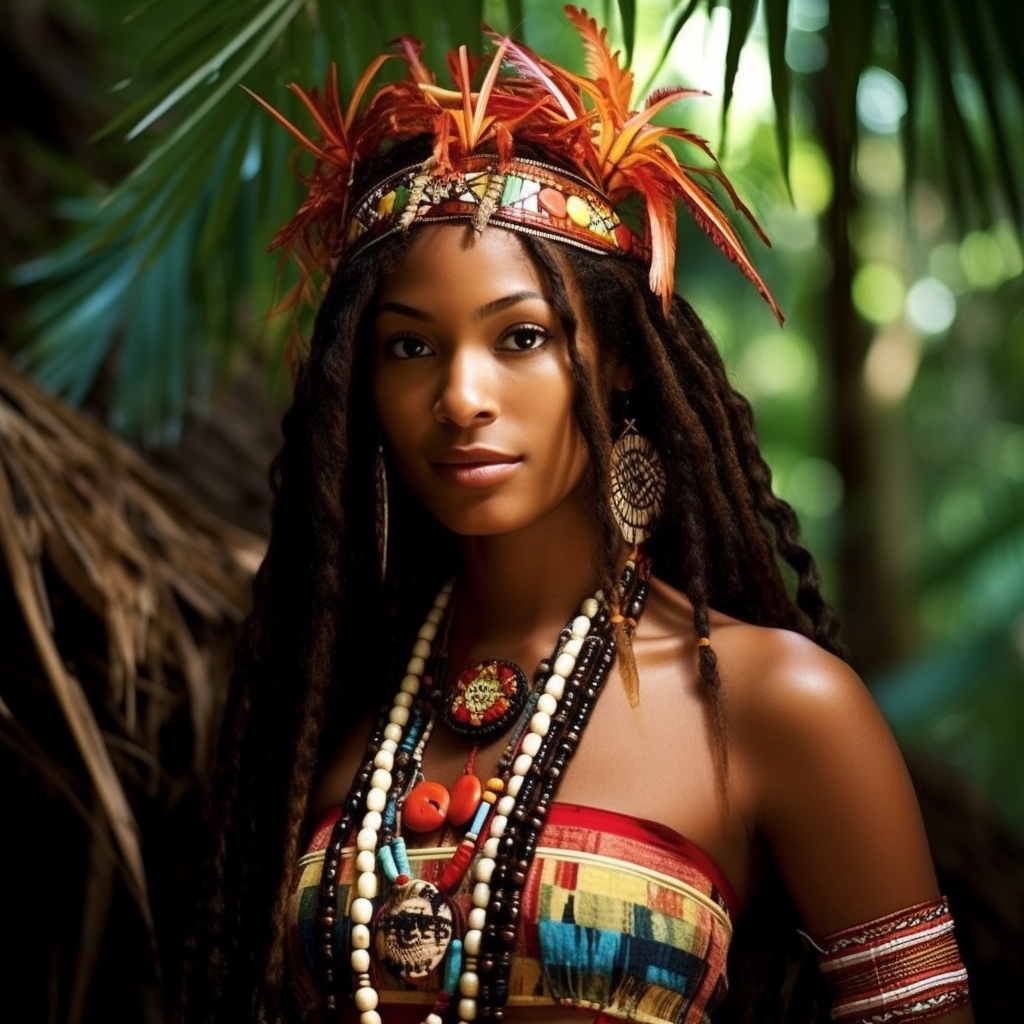
Taíno
same region (Caribbean)
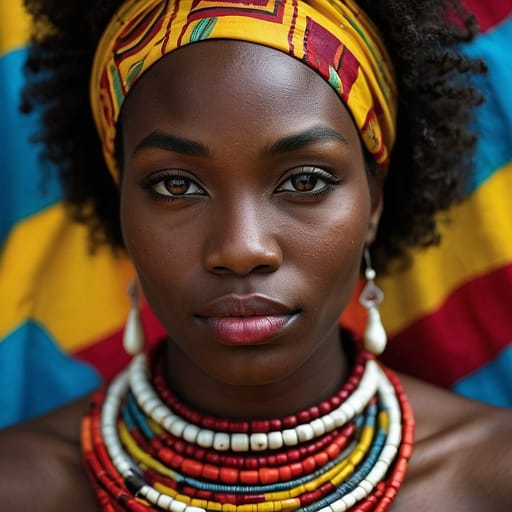
Afro-Antiguan Barbudan
same region (Caribbean)
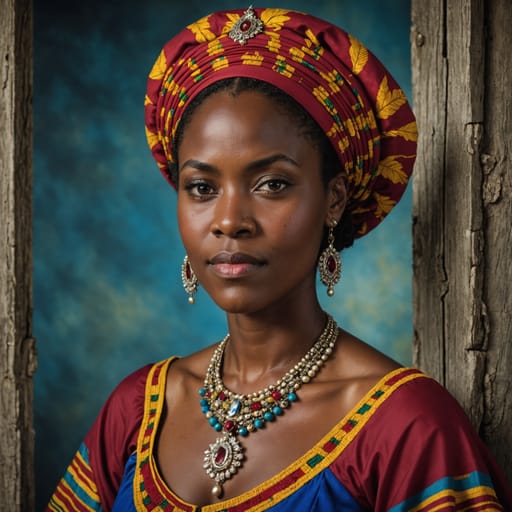
Mixed Antiguan
same region (Caribbean)
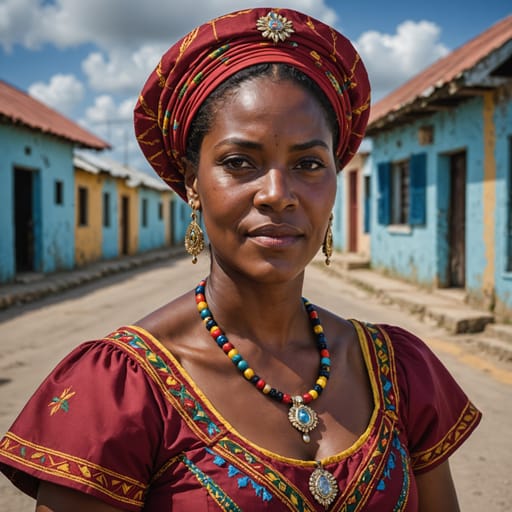
Hispanic Antiguan
same region (Caribbean)

Afro-Dominican
same region (Caribbean)

White Dominican
same region (Caribbean)

Mixed Trinidadian
same region (Caribbean)

Indo-Grenadian
same region (Caribbean)
Typical Jamaican Maroons Phenotypes
Reference for AI generation: hair, eyes, skin, facial structure, build
Jamaican Maroons Body & Anatomy Reference
Per-feature anatomical profile for AI nude generation: Afro-Caribbean / Indo-Caribbean / Creole phenotype
Jamaican Maroons Boobs & Breasts
Bust reference for Jamaican Maroons women: medium-to-large cup, full, high projection, which is typical of Afro-Caribbean / Indo-Caribbean / Creole ancestry. Areolas measure about 34-50mm across, with medium-brown to deep-brown pigmentation. Body type (mesomorph with strong gluteal-femoral deposition) shapes the bust as well, so Jamaican Maroons tits are usually full and projecting. In AI imagery, keep the forward-set shape rather than drifting toward the smaller East Asian bust.
Jamaican Maroons Ass & Hips
The Jamaican Maroons ass is typically full, high projection, wide-set glutes, which sets it apart from the slim narrow-hip East Asian profile. Underneath, the pelvis shows wide iliac crests, full gluteal-femoral fat deposition, part of the Afro-Caribbean / Indo-Caribbean / Creole skeletal pattern. For Jamaican Maroons butt pics and AI renders, match that silhouette and the overall build (mesomorph with strong gluteal-femoral deposition).
Jamaican Maroons Vagina & Pussy
Jamaican Maroons pussy and vulvar anatomy presents medium-brown to deep-brown labial pigmentation, fuller labia minora, consistent with the Afro-Caribbean / Indo-Caribbean / Creole phenotype's pigmentation pattern. Jamaican Maroons pubic hair is typically tightly-coiled to wavy coarse texture, in the inverted-triangle pattern. For anatomically accurate Jamaican Maroons pussy renders the labial coloration should match the surrounding medium-to-deep brown skin tone with a continuous gradient, and the hair should keep its tightly-coiled to wavy coarse texture.
Jamaican Maroons Dicks & Penis
Jamaican Maroons dicks follow the Afro-Caribbean / Indo-Caribbean / Creole reference data: regional mean ~14cm erect; above-average girth; deep-brown shaft pigmentation. Shaft color should track the medium-to-deep brown skin tone with a smooth change toward the glans, and Jamaican Maroons pubic hair keeps its tightly-coiled to wavy coarse texture.
Jamaican Maroons Body, Curves & Build
Jamaican Maroons body type and overall build presents as mesomorph with strong gluteal-femoral deposition, with mean adult female BMI 26-29: the characteristic Afro-Caribbean / Indo-Caribbean / Creole habitus. Jamaican Maroons curves and proportions should keep the regional skeletal frame (height, shoulder-to-hip ratio, limb proportions) rather than a generic mesomorph default.
Jamaican Maroons Skin Tone & Hair Texture
Jamaican Maroons skin sits in the medium-to-deep brown (Fitzpatrick IV-VI) band. Hair is typically tight 4A-4C coil predominant in Afro-Caribbean; 1A-2B straight-to-wavy in Indo-Caribbean, in keeping with the Afro-Caribbean / Indo-Caribbean / Creole phenotype. In nude renders the skin should stay one even tone from face to body, and body, pubic and head hair should match.
Explore phenotype categories
Structured taxonomy with peer-reviewed scales · 22 anatomical categories
Erotic Poses & Sex Positions
From the pose catalog: 219 named positions with reference skeletons
Frequently asked questions about Jamaican Maroons people
Where is the Jamaican Maroons homeland?
The Jamaican Maroons homeland is The mountain interior of Jamaica: Cockpit Country in the west, the Blue Mountains and John Crow Mountains in the east. A deported branch settled in Freetown, Sierra Leone, by way of Nova Scotia. in Caribbean.
What language do Jamaican Maroons people speak?
Jamaican Maroons people primarily speak Jamaican Patois (English-lexifier creole) in daily life; Kromanti, a ceremonial register carrying Akan-derived vocabulary (Niger-Congo, Kwa), in ritual.
What religion do Jamaican Maroons people practice?
The predominant religion among Jamaican Maroons people is Mostly Christian, largely Baptist, Anglican and Revival Zion, alongside Kromanti ancestral practice that runs parallel to church life rather than inside it.






Make your own Jamaican Maroons images
Five a day, free, no credits to buy. The studio starts from this group's phenotype data, so you can set body type, pose and style and keep the traits accurate.
Start with Jamaican Maroons