Help us get this right
Does this portrait look right for Drevani?
Nobody has judged this one yet. You would be the first.
Drevani Erotic
The Hanoverian Wendland, in the bend of the lower Elbe, now the district of Lüchow-Dannenberg in Lower Saxony, Germany.
Drevanian Polabian (West Slavic, Lechitic), extinct by about 1750; then Low German and standard German.
Slavic polytheism until conversion under Frankish and Saxon pressure; Latin Christianity through the Middle Ages, Lutheran after the Reformation.
One of the Polabian or Elbe Slavs, usually counted with the Obotrite group of tribes; westernmost of the Lechitic speakers, neighbors of the Linones.
About Drevani People
The Drevani were a West Slavic people who lived inside the bend of the lower Elbe, in what is now the Lüchow-Dannenberg district of Lower Saxony, from around the seventh century until they were absorbed into the German-speaking population in the middle of the eighteenth. Their descendants are the ordinary Germans of that region, and no separate Slavic identity outlived the language. Their distinction is stubbornness: they were the westernmost Slavs in Europe, settled on the near bank of the Elbe with Saxons on every side, and they were the last of the Elbe Slavs to keep speaking Slavic, holding on for centuries after the tribes across the river had gone over to German. Their name comes from the Slavic word for wood or tree, and the low sandy ridge at the heart of their country still carries it: the Drawehn. It was never good land. Bog, heath and thin soil made the Wendland a corner nobody fought hard over, which is probably why the speech lasted. Politically they were taken early: Frankish and Saxon pressure brought them inside the empire long before the Wendish Crusade of 1147 turned on the Slavs east of the river, and by the High Middle Ages the Drevani were a subject peasantry holding their fields, their Christianity and their own tongue.
That tongue, Drevanian Polabian, belonged to the Lechitic branch, a close cousin of Polish and Kashubian, and it held on to things its neighbors had dropped, among them nasal vowels and the dual number for pairs. By the end it was full of German loanwords and German stress habits, spoken by farmers who were bilingual and knew which of the two languages paid. Guild statutes and local ordinances in the Lüneburg lands penalized Wendish descent; speaking Wendish marked you as the wrong sort of neighbor, and dropping it was a rational thing to do. Nearly everything known about the language was written down at the last minute, mostly by Lutheran pastors curious about their own parishioners: Christian Hennig von Jessen at Wustrow assembled a vocabulary around 1700. The best witness is a farmer, Johann Parum Schultze, who kept a chronicle and observed in the 1720s that once he and three other men in his village were dead, nobody would know what a Wend had been. He was close to right; the last speakers died around 1750. What is left sits on the map and in the ground plan of the villages: hundreds of place names in -ow and -itz, Slavic family names, and the Rundlinge, horseshoe hamlets facing a common green, whose origins are still argued over and which the Wendland has claimed as its Slavic inheritance.
Related ethnic groups
Groups that share Drevani's homeland, region, language, or religious tradition. These are likely candidates for comparative phenotype reference.
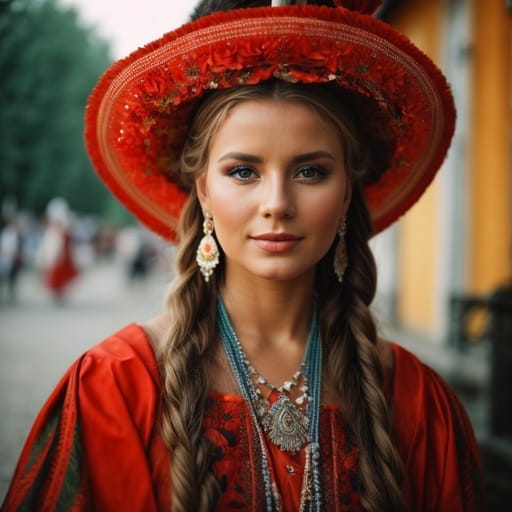
Estonians
same region (Western Europe)
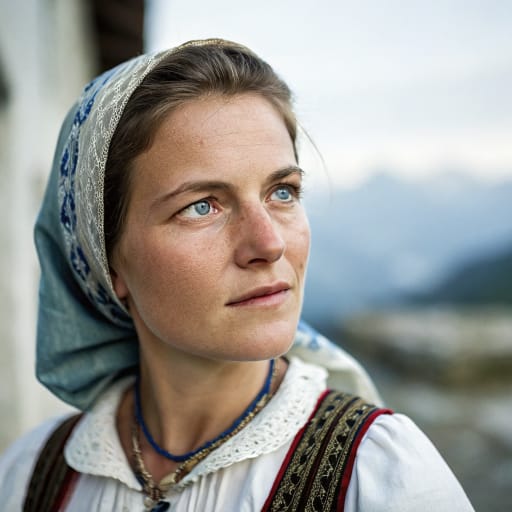
Austrians
same region (Western Europe)
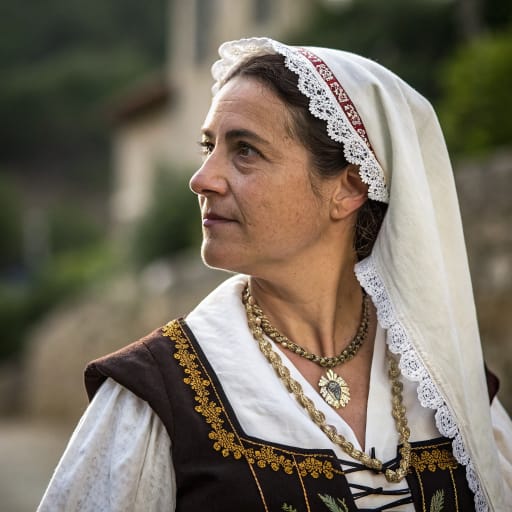
Corsicans
same region (Western Europe)
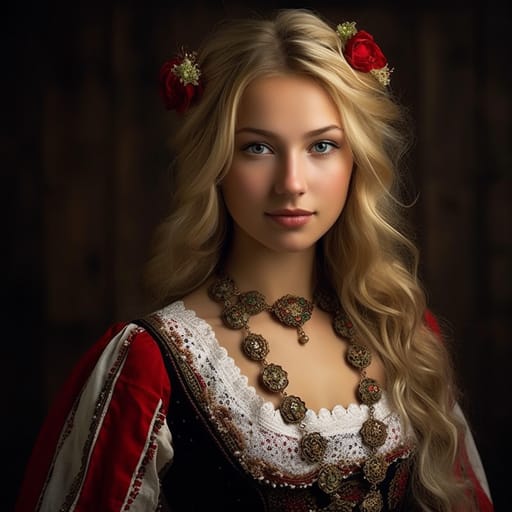
Frisians
same region (Western Europe)
French
same region (Western Europe)
Picards
same region (Western Europe)

Russian German Aussiedler
same region (Western Europe)
Dutch Indonesian
same region (Western Europe)
Typical Drevani Phenotypes
Reference for AI generation: hair, eyes, skin, facial structure, build
Drevani Body & Anatomy Reference
Anatomy by feature, Western European / Celtic-Germanic phenotype
Drevani Boobs & Breasts
The typical Drevani bust is medium-to-large cup, full, moderate-to-high projection, in line with the wider Western European / Celtic-Germanic pattern. Areolas usually fall in the 30-46mm range, with light-pink to medium-pink areolar pigmentation against the fair-to-light skin tone. Compared with the smaller East Asian bust, Drevani breasts sit forward and are generally full and projecting. A faithful AI render of Drevani tits keeps that shape and areola size.
Drevani Ass & Hips
Butt shape among Drevani women: medium, moderate projection, over medium iliac crests. This follows Western European / Celtic-Germanic ancestry and looks quite unlike the broader hip profile of Mediterranean phenotypes. An accurate Drevani ass in adult AI imagery keeps both the silhouette and the overall build (ectomorph-to-mesomorph) instead of a generic average.
Drevani Vagina & Pussy
Vulvar anatomy among Drevani women: light-pink labial pigmentation, varied labia minora. Pubic hair tends to be wavy fine-to-medium texture, blond to dark-brown, in the usual inverted-triangle pattern. Both follow Western European / Celtic-Germanic pigmentation, which is why Drevani pussy renders should not fall back on a pale, sparse Western template.
Drevani Dicks & Penis
The Drevani cock profile, from Western European / Celtic-Germanic anthropometric data: regional mean ~13-14cm erect; moderate girth; light-pink to light-brown shaft pigmentation. Pubic hair has a wavy fine-to-medium texture and forms the usual inverted-V pattern. Whether Drevani men are circumcised follows religious and cultural practice rather than phenotype.
Drevani Body, Curves & Build
Build and curves among Drevani women follow the Western European / Celtic-Germanic pattern: ectomorph-to-mesomorph, mean adult female BMI 24-27. Proportions matter as much as skin tone, so Drevani figures should keep their regional height and limb ratios.
Drevani Skin Tone & Hair Texture
The Drevani skin range is fair to light (Fitzpatrick I-III), and hair tends to be straight-to-wavy 1A-2B, blond to dark-brown. That combination marks the Western European / Celtic-Germanic phenotype, and skin tone is the trait AI generators most often get wrong for Drevani women.
Explore phenotype categories
Structured taxonomy with peer-reviewed scales · 22 anatomical categories
Erotic Poses & Sex Positions
From the pose catalog: 219 named positions with reference skeletons
Frequently asked questions about Drevani people
Where is the Drevani homeland?
The Drevani homeland is The Hanoverian Wendland, in the bend of the lower Elbe, now the district of Lüchow-Dannenberg in Lower Saxony, Germany. in Western Europe.
What language do Drevani people speak?
Drevani people primarily speak Drevanian Polabian (West Slavic, Lechitic), extinct by about 1750; then Low German and standard German..
What religion do Drevani people practice?
The predominant religion among Drevani people is Slavic polytheism until conversion under Frankish and Saxon pressure; Latin Christianity through the Middle Ages, Lutheran after the Reformation..






Make your own Drevani images
Five a day, free, no credits to buy. The studio starts from this group's phenotype data, so you can set body type, pose and style and keep the traits accurate.
Start with Drevani