Help us get this right
Does this portrait look right for Manx?
Nobody has judged this one yet. You would be the first.
Manx Erotic
Isle of Man (Crown dependency)
Christianity / Protestantism
About Manx People
The Manx are the people of a single island sitting in the middle of the Irish Sea, equidistant from England, Scotland, Ireland, and Wales — and visibly shaped by all four without belonging to any of them. The Isle of Man is roughly thirty miles long, treeless across its uplands, ringed by cliffs and small fishing harbours, and politically a Crown dependency rather than part of the United Kingdom. That constitutional oddity is not a footnote. It defines the place. The island runs its own parliament, Tynwald, which the Manx insist on calling the world's oldest continuous legislature, tracing back to Norse settlement in the ninth and tenth centuries when Viking colonists arrived, intermarried with the Gaelic population already there, and left behind both place names and the open-air assembly tradition still performed each July at Tynwald Hill.
The Manx language is Goidelic Celtic, a sister to Irish and Scottish Gaelic rather than to Welsh or Cornish, and it would be intelligible to a medieval Ulsterman with some patience. Its spelling, though, was set down by English-speaking clergy in the seventeenth and eighteenth centuries, which gave it an idiosyncratic orthography unlike anything else in the Celtic family. The last fully native speaker, Ned Maddrell, died in 1974, and Manx was officially declared extinct by UNESCO — a verdict the islanders rejected so thoroughly that there is now a Manx-medium primary school, a generation of fluent young speakers, and the language has been formally reclassified as critically endangered rather than dead. Revival here is unusually advanced.
Religiously the island is Protestant, predominantly Anglican through the Diocese of Sodor and Man, with strong historical Methodist roots from the Wesleyan revivals that swept through the fishing villages in the eighteenth century. Religion sits lightly on most Manx people now in practice, but it shaped the island's social grain — sober, self-reliant, suspicious of grand gestures. Older customs survive at the edges: the practice of saying moghrey mie rather than good morning, the deference paid to the fairies on the Fairy Bridge, the refusal to say the word "rat" aloud aboard a fishing boat. The Manx are not Irish, not British, not Scottish, and they will correct you on each count. They are something narrower and older — an island people with their own parliament, their own tailless cat, their own Gaelic tongue pulled back from the brink, and a quiet conviction that none of it is owed to anyone else.
Related ethnic groups
Groups that share Manx's homeland, region, language, or religious tradition. These are likely candidates for comparative phenotype reference.
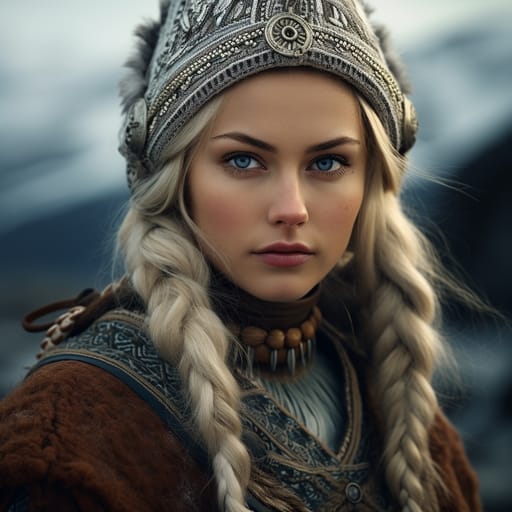
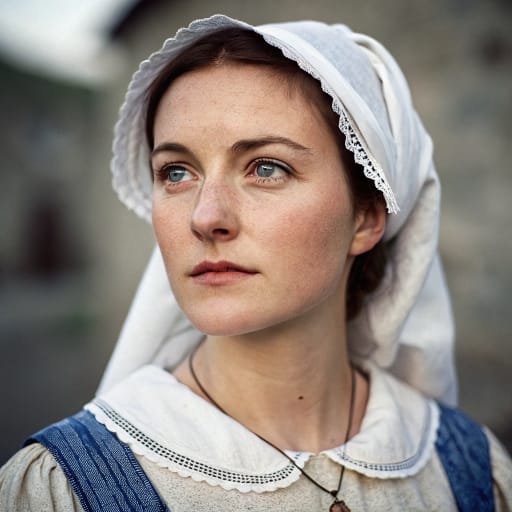
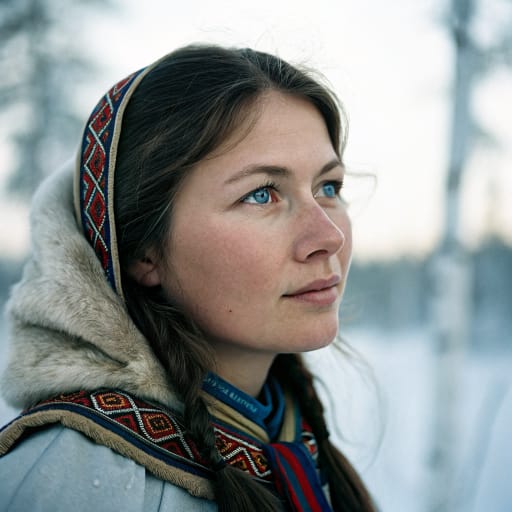
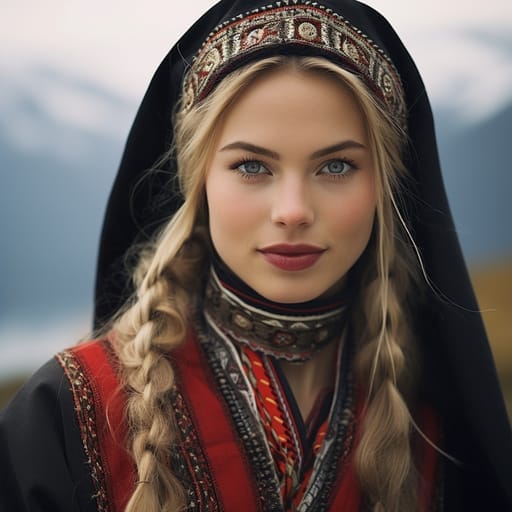
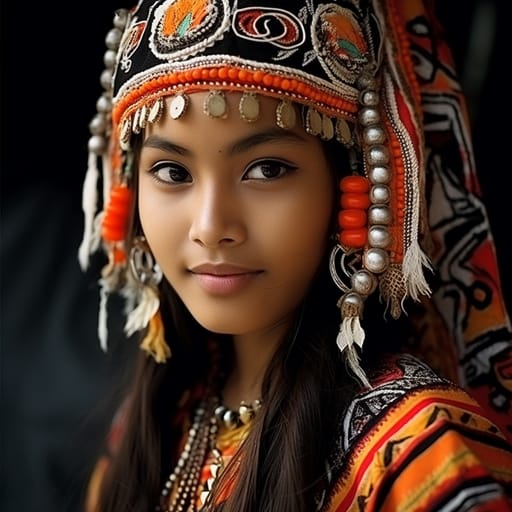
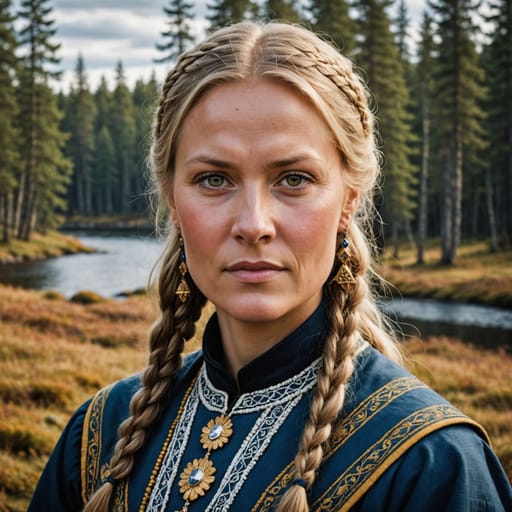
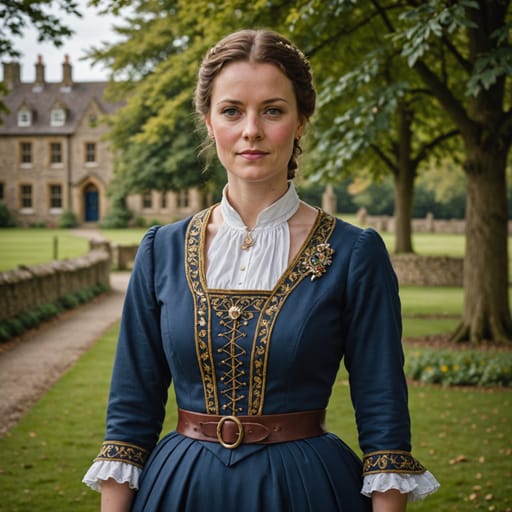
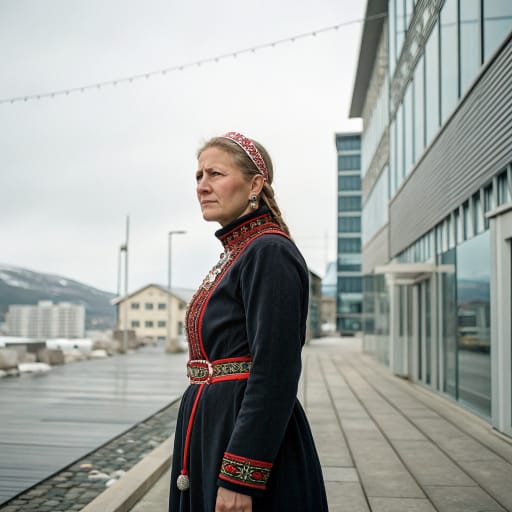
Typical Manx Phenotypes
Reference for AI generation: hair, eyes, skin, facial structure, build
Manx phenotype sits within the Insular Celtic cluster — closest to Northwest Irish and Scottish Lowland populations, with a measurable Norse genetic layer from the Viking-era settlement that still surfaces in lighter pigmentation and broader stature among some islanders. Hair runs predominantly brown across the full mid-range, from medium ash to dark chestnut, with a strong minority of dark blonde and a notable redhead/auburn fraction estimated around 8–10% — high by global standards but below Scottish or Irish peaks. Texture is typically straight to loosely wavy; tight curl is rare. Childhood blonde that darkens to mousy or mid-brown by adolescence is common, as it is across the Celtic fringe.
Eye color skews cool: blue and grey-blue dominate, with green and hazel forming a substantial second tier. True dark brown is uncommon and usually signals non-Manx admixture. Eyelids are flat-set and Northern European in morphology — no epicanthic fold, often a visible upper crease, lashes that read pale unless darkened. The eye shape tends toward a level or slightly downturned outer corner rather than the lifted almond seen further east.
Skin is overwhelmingly Fitzpatrick I–II — pale, pink-to-neutral undertone, freckling under sun exposure rather than tanning cleanly. Cheek flush is structural, not transient. Facial bones lean long rather than wide: a straight or slightly aquiline nose with a narrow alar base, a defined but not heavy jaw, and lips of moderate fullness with a clearly drawn cupid's bow. Cheekbones sit higher and more sculpted than in the South English average — visible in actors like Samantha Barks and Joe Locke, both of whom carry recognisable Manx facial geometry.
Build is mid-height and lean-framed for women (around 162–168 cm), taller and rangier for men (175–183 cm), with the wiry endurance physique that produces a disproportionate share of the island's competitive cyclists and road racers. Heavy-set, broad-shouldered builds appear but are the minority.
Manx Body & Anatomy Reference
Anatomy by feature, Northern European / Germanic-Scandinavian phenotype
Manx Boobs & Breasts
Manx boobs follow the Northern European / Germanic-Scandinavian profile: medium-to-large cup, full, high projection. Areolar diameter is usually 32-48mm, and the coloring is light-pink to medium-pink areolar pigmentation against the fair skin tone. Breast shape tracks body composition (mesomorph with taller stature; ectomorph-to-mesomorph split, mean adult female BMI 24-27), so Manx breasts tend to be full and projecting, often the largest cup-size band in regional comparisons. Expect a forward-set shape, not the smaller East Asian bust.
Manx Ass & Hips
Manx ass and hip morphology presents as medium-to-full, moderate-to-high projection, distinctly different from the slim East Asian narrow-hip profile. The Manx pelvic profile shows medium-to-wide iliac crests, anchored in the Northern European / Germanic-Scandinavian skeletal pattern. Manx butt shots in adult AI imagery should render the medium-to-full, moderate-to-high projection silhouette with the overall build (mesomorph with taller stature; ectomorph-to-mesomorph split) and the fat distribution typical of the Northern European / Germanic-Scandinavian phenotype.
Manx Vagina & Pussy
Manx pussy anatomy typically shows light-pink to medium-pink labial pigmentation, varied labia minora projection. Pubic hair is usually fine-to-medium wavy texture, often lighter-pigmented (blond to dark-brown). In AI-generated Manx nudes, labial color should blend into the fair skin with a gradual transition, and the hair should keep its fine-to-medium wavy texture.
Manx Dicks & Penis
Penis reference for Manx men: regional mean ~13-14cm erect, moderate-to-above-average girth. Coloring: light-pink to light-brown shaft pigmentation. An accurate Manx cock in AI imagery matches the surrounding fair skin rather than a generic porn default. Circumcision depends on religion and custom, not ancestry.
Manx Body, Curves & Build
The Manx figure is generally mesomorph with taller stature; ectomorph-to-mesomorph split, with mean adult female BMI 24-27, characteristic of Northern European / Germanic-Scandinavian ancestry. AI image tools tend to flatten regional body types into a few stock shapes; here the Manx build is kept as its own reference.
Manx Skin Tone & Hair Texture
Skin: fair (Fitzpatrick I-III). Hair: straight-to-wavy 1A-2B, blond to medium-brown common. Both are typical of Northern European / Germanic-Scandinavian ancestry. The most common mistake in AI nudes of Manx women is a body rendered lighter than the face.
Data depth
0/100Coverage of image-grounded phenotype observations · drives AI generation diversity
- Sample size
- 0/40· 0 images
- Image quality
- 0/30· 0% high
- Confidence
- 0/20
- Source diversity
- 0/10
- ·No image observations yet
Explore phenotype categories
Structured taxonomy with peer-reviewed scales · 22 anatomical categories
Notable Manx People
75 reference figures, sourced from Wikipedia
- Samantha Barks, born 1990), actor and musician
- Jamie Blackley, born 1991), actor
- Tom Holland, born 1996), actor
- Amy Jackson, born 1992), actress known for work in Indian films
- Evie Killip, born 1992), actor, BBC radio actor, voiceover
- Joe Locke, born 2003), actor of Manx ancestry
- Dursley McLinden, 1965-1995) actor, dancer, and singer
- Anthony Quayle, 1913-1989), actor of Manx ancestry
- Robert Henry Cain, 1909-1974), army major and Victoria Cross recipient
- Fletcher Christian, 1764-1793), naval officer and mutineer on HMS Bounty
- William Garrett, 1842-1916), Medal of Honor recipient in American Civil War
- Peter Heywood, 1772-1831), naval officer and mutineer on HMS Bounty
- Rayner Hoff, 1894-1937), Manx-born Australian sculptor
- Bryan Kneale, 1930-2025), sculptor
- Archibald Knox, 1864-1933), designer
- Paul Lewthwaite, born 1969), sculptor
- Chris Killip, 1946-2020), photographer and Harvard professor
- Dan Auerbach, born 1979), US musician of Manx descent
- Isla Callister, Manx folk musician and fiddle player
- Barry Gibb, born 1946), musician: Bee Gees
- Maurice Gibb, 1949-2003), musician: Bee Gees
- Robin Gibb, 1949-2012), musician: Bee Gees
- Ruth Keggin, born 1989), Manx Gaelic singer-songwriter
- Davy Knowles, born 1987), musician: Back Door Slam
- Harry Manx, born 1955), Manx-born Canadian musician
- Illiam Dhone, William Christian, 1608-1663), nationalist and politician
- Robert Quayle Kermode, 1812-1870), Manx-born Tasmanian politician
- Dan Quayle, born 1947), Indiana Senator and Vice President of the United States, of Manx …
- Sir Miles Walker, born 1940), politician: first Chief Minister of the Isle of Man
- Martin Bridson, born 1964), mathematician
- Jennifer Kewley Draskau, died 2024), historian, linguist, teacher and political candidate
- Edward Forbes, 1815-1854), naturalist and botany professor
- John Kelly, 1750-1809), lexicographer and Bible translator into Manx
- Sir Frank Kermode, 1919-2010), professor of English
- Randolph Quirk, Lord Quirk, 1920-2017), linguistics professor and life peer
- Jonathan Bellis, born 1988), cyclist
- Mark Cavendish, born 1985), cyclist, winner of 35 Tour de France stages
- Mark Christian, born 1990), cyclist
- Conor Cummins, born 1986), motorcycle road racer
- Tara Donnelly, born 1998), gymnast
- Zoe Gillings, born 1985), snowboarder
- David Higgins, born 1972), rally car driver
- Mark Higgins, born 1971), rally car driver
- Darryl Hill, born 1996), snooker player
- Peter Kennaugh, born 1989), cyclist
- Tim Kennaugh, born 1991), cyclist
- Dan Kneen, 1987-2018), motorcycle racer
- David Knight, born 1978), enduro motorcyclist
- David Lyon, born 1943), cricketer
- Keith McQuillan, 1944-2022), footballer
- Dave Molyneux, born 1963), sidecar racer
- Millie Robinson, 1924-1994), cyclist, winner of the first Tour de France Féminin in 1955
- Kieran Tierney, born 1997), Manx-born footballer, Scottish international
- T. E. Brown, 1830-1897), poet, scholar and theologian
- Hall Caine, 1853-1931), novelist and playwright
- Cyril Clague, c. 1880-1946), poet and dramatist
- Mona Douglas, 1898-1987), poet and folklorist
- Eliza S. Craven Green, 1803-1866), poet
- Jane Holland, born 1966), poet, performer and novelist brought up on Man
- Sarah Holland, born 1961), writer, actress and singer
- Josephine Kermode, pseudonym Cushag, 1852-1937), poet and playwright
- Nigel Kneale, 1922-2006), screenwriter
- Charlotte Lamb, Sheila Holland née Coates, 1937-2000), romantic novelist
- Sophia Morrison, 1859-1917), folklorist
- Esther Nelson, 1810-1843), poet
- Hilary Robinson, born 1972), children's author
- Christopher R. Shimmin, 1870-1933), playwright and politician
- Thomas Shimmin, 1800 to c. 1876-1879), poet and rag-gatherer
- Brian Stowell, 1936-2019), writer, broadcaster and translator into Manx language
- George Waldron, 1690 to c. 1730), topographer and poet
- George Q. Cannon, 1827-1901), Mormon apostle
- Richard Costain, 1839-1902), founder of Costain Group
- Colonel Routh Goshen, Arthur Caley, 1824-1889), giant and circus performer
- Nina Hunt, 1932-1995), Latin American dance coach and choreographer
- Abdullah Quilliam, 1856-1932), Victorian Muslim brought up on Man
Erotic Poses & Sex Positions
From the pose catalog: 219 named positions with reference skeletons
Frequently asked questions about Manx people
Where is the Manx homeland?
The Manx homeland is Isle of Man (Crown dependency) in Northern Europe.
What language do Manx people speak?
Manx people primarily speak Indo-European / Celtic / Manx.
What religion do Manx people practice?
The predominant religion among Manx people is Christianity / Protestantism.






Make your own Manx images
Five a day, free, no credits to buy. The studio starts from this group's phenotype data, so you can set body type, pose and style and keep the traits accurate.
Start with Manx