Help us get this right
Does this portrait look right for Lucayans?
Nobody has judged this one yet. You would be the first.
Lucayans Erotic
The Bahamas and the Turks and Caicos Islands (the Lucayan Archipelago), north of Cuba and Hispaniola
Lucayan, a dialect of Taíno (Arawakan family), now extinct
Taíno-style zemí worship led by caciques, with carved spirit figures, ceremonial duho seats, and cave shrines
Generally treated as a northern branch of the Taíno; part of the wider Arawakan-speaking peoples of the Caribbean
About Lucayans People
The Lucayans were the people of the Bahamas and the Turks and Caicos from roughly the eighth century until the early 1500s, when Spanish slave raids emptied every island and ended them as a community. They were an Arawakan-speaking people, close kin to the Taíno of Hispaniola and Cuba, who had paddled north from those larger islands and worked out how to live on low limestone islands with thin soil, no rivers, and a great deal of sea. Their own name for themselves, Lukku-Cairi, meant island people, and the Spanish turned it into Lucayos for both the people and the archipelago. Whether they count as a branch of the Taíno or as a distinct people is still argued among archaeologists, but the language, the chiefs called caciques, the carved zemí spirit figures and the ceremonial wooden seats called duhos found in Bahamian caves all place them squarely in the Taíno world.
Island life shaped everything. Villages sat on sheltered coasts within reach of reefs and shallow banks, and the diet leaned hard on conch, fish, sea turtle, and the hutia, a small native rodent, alongside cassava and sweet potato from garden plots. They gathered salt from the flats and traded it, with dried fish and conch, to Hispaniola for finer pottery than their own coarse, shell-tempered Palmetto ware. Infants had their foreheads flattened by binding, a Taíno practice that left a distinctive skull shape still visible in burials. People slept in hammocks, a Taíno word and invention that the Spanish carried into the languages of Europe. They were the first Indigenous Americans Columbus met, on October 12, 1492, at an island they called Guanahani, and his journal remarks on their openness and, in the same breath, on how easily they might be made to serve. That second thought became policy. Once the Taíno labor force on Hispaniola began collapsing, Spanish ships worked through the Bahamas island by island, carrying people off to the mines and to the pearl beds off Venezuela. When Ponce de León passed through in 1513 his crew reportedly found a single old man. By about 1520 the islands were empty, and they stayed that way until English settlers arrived in 1648. No continuous descendant community exists. What remains is in the ground and in the words: village sites and cave shrines across the islands, the Palmetto ware sherds, the duhos now in museums, place names like Guanahani and Bimini, and the everyday vocabulary of hammock, canoe, hurricane, and barbecue that the wider Taíno world left behind.
Related ethnic groups
Groups that share Lucayans's homeland, region, language, or religious tradition. These are likely candidates for comparative phenotype reference.
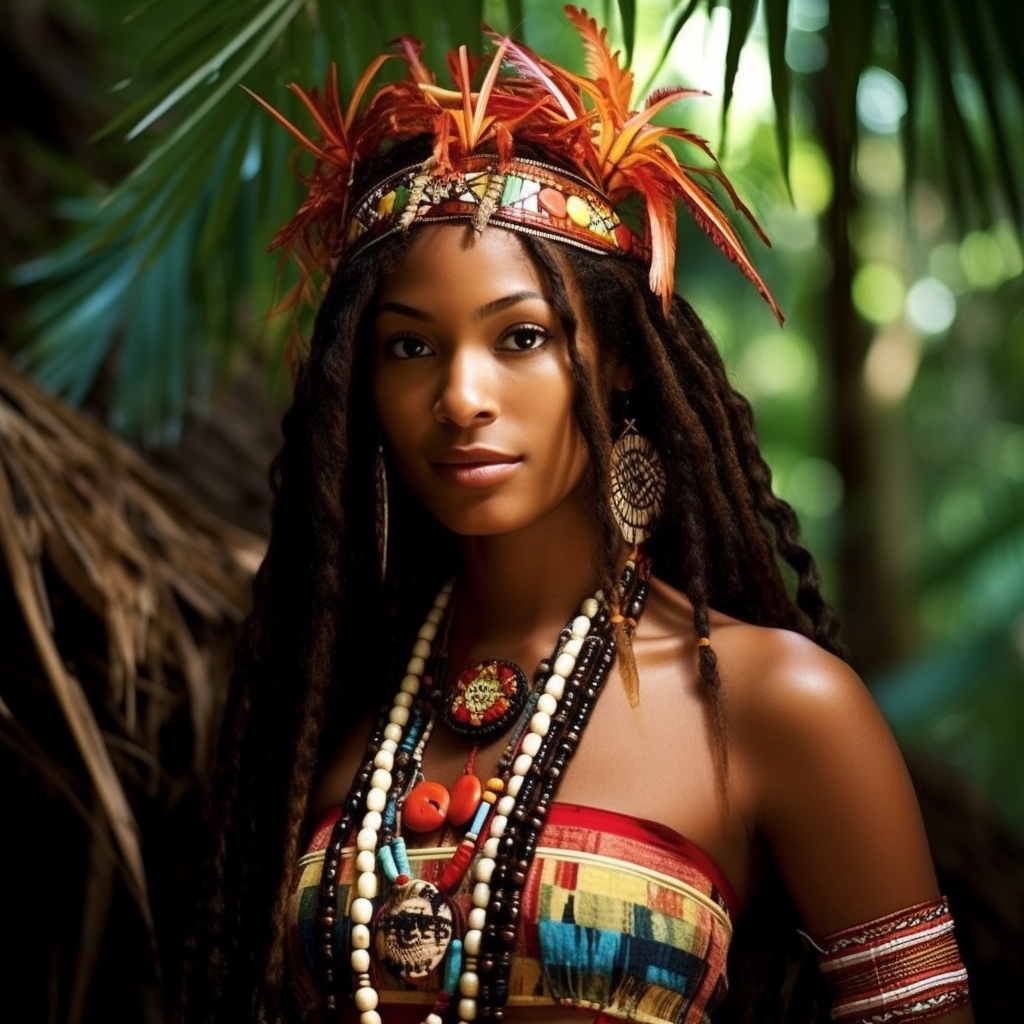
Taíno
same region (Caribbean)
Afro-Antiguan Barbudan
same region (Caribbean)
Mixed Antiguan
same region (Caribbean)
Hispanic Antiguan
same region (Caribbean)
White Antiguan
same region (Caribbean)
Mixed Grenadian
same region (Caribbean)
Mixed Barbadian
same region (Caribbean)

Afro-Saint Lucian
same region (Caribbean)
Typical Lucayans Phenotypes
Reference for AI generation: hair, eyes, skin, facial structure, build
Lucayans Body & Anatomy Reference
Per-feature anatomical profile for AI nude generation: Afro-Caribbean / Indo-Caribbean / Creole phenotype
Lucayans Boobs & Breasts
Lucayans tits and boobs run medium-to-large cup, full, high projection, the classic Afro-Caribbean / Indo-Caribbean / Creole bust profile. Lucayans nipples and areolas show medium-brown to deep-brown areolar pigmentation against the medium-to-deep-brown skin tone, with areolar diameter typically in the 34-50mm range and forward-set positioning rather than the smaller East Asian bust. Lucayans breasts trend full and projecting, a function of the mesomorph with strong gluteal-femoral deposition body habitus and the mean adult female BMI 26-29. For anatomically accurate AI-generated Lucayans nudes the render preserves the medium-to-large cup, full, high projection shape, 34-50mm areolas with medium-brown to deep-brown pigmentation, and the torso proportions of the Afro-Caribbean / Indo-Caribbean / Creole phenotype.
Lucayans Ass & Hips
Lucayans hips and butt usually read as full, high projection, wide-set glutes. The skeletal base is wide iliac crests, full gluteal-femoral fat deposition, the Afro-Caribbean / Indo-Caribbean / Creole pattern. Set against the slim narrow-hip East Asian profile, the difference is easy to see, and the hip-to-waist ratio is often what identifies Lucayans women in photos.
Lucayans Vagina & Pussy
Expect medium-brown to deep-brown labial pigmentation, fuller labia minora on Lucayans women, in keeping with Afro-Caribbean / Indo-Caribbean / Creole ancestry. The pubic hair is tightly-coiled to wavy coarse texture. Coloring should run evenly from the medium-to-deep brown skin of the thighs to the labia, and Lucayans nude imagery should keep the hair's tightly-coiled to wavy coarse texture.
Lucayans Dicks & Penis
Lucayans dick and penile anatomy in adult AI generation should anchor on the regional reference data: regional mean ~14cm erect, above-average girth, and deep-brown shaft pigmentation. The Lucayans cock profile reflects the Afro-Caribbean / Indo-Caribbean / Creole population's anthropometric measurements. The shaft pigmentation should track the surrounding medium-to-deep brown skin tone, and the pubic hair should keep its tightly-coiled to wavy coarse texture in the typical inverted-V escutcheon.
Lucayans Body, Curves & Build
Lucayans body type: mesomorph with strong gluteal-femoral deposition, with mean adult female BMI 26-29. This is the typical Afro-Caribbean / Indo-Caribbean / Creole build. Height range, shoulder-to-hip ratio and fat distribution all follow from it, which is what an accurate Lucayans nude body should show.
Lucayans Skin Tone & Hair Texture
Lucayans skin tone falls in the medium-to-deep brown (Fitzpatrick IV-VI) band, the surface signal most often miscalibrated by generic AI nude generators. Lucayans hair texture is typically tight 4A-4C coil predominant in Afro-Caribbean; 1A-2B straight-to-wavy in Indo-Caribbean, characteristic of the Afro-Caribbean / Indo-Caribbean / Creole phenotype. In Lucayans nude renders the skin should hold that band consistently across the body.
Explore phenotype categories
Structured taxonomy with peer-reviewed scales · 22 anatomical categories
Erotic Poses & Sex Positions
From the pose catalog: 219 named positions with reference skeletons
Frequently asked questions about Lucayans people
Where is the Lucayans homeland?
The Lucayans homeland is The Bahamas and the Turks and Caicos Islands (the Lucayan Archipelago), north of Cuba and Hispaniola in Caribbean.
What language do Lucayans people speak?
Lucayans people primarily speak Lucayan, a dialect of Taíno (Arawakan family), now extinct.
What religion do Lucayans people practice?
The predominant religion among Lucayans people is Taíno-style zemí worship led by caciques, with carved spirit figures, ceremonial duho seats, and cave shrines.






Make your own Lucayans images
Five a day, free, no credits to buy. The studio starts from this group's phenotype data, so you can set body type, pose and style and keep the traits accurate.
Start with Lucayans