Help us get this right
Does this portrait look right for Kashmiris?
One tap. It takes a second and it is recorded.
1 says it looks right, 0 say it looks off.
Kashmiris Erotic
Also known as: Kashmiri
Kashmir (India, Pakistan)
Islam / Sunni Islam, Hinduism, Sikhism
Kashmiri Pandits, Kashmiris of Punjab
About Kashmiris People
The Kashmiris are the people of the Vale of Kashmir, a high valley wrapped by the Pir Panjal and the greater Himalaya, where the Jhelum runs slow through wetlands and the climate splits the year cleanly into four seasons — a rarity at this latitude in South Asia. That geography has shaped almost everything about them: the terraced rice and saffron fields of Pampore, the houseboats and shikaras of Dal Lake, the wool trade that produced pashmina and the kani shawl, the sealed-in winters spent under a pheran with a kangri firepot tucked against the chest. The valley is fertile and bounded, and the culture inside it is correspondingly distinct — closer in feel to itself than to either of the larger countries that now claim it.
Kashmiri belongs to the Dardic branch of Indo-Aryan, a small and slightly anomalous cluster sitting between the Indo-Aryan mainstream of the plains and the Iranian languages further west. It is written in a modified Perso-Arabic script (Nastaliq) by Muslim Kashmiris and historically in Sharada and Devanagari by Kashmiri Pandits, and it carries heavy Persian vocabulary as a residue of centuries of Mughal and Sultanate rule. The majority of Kashmiris today are Sunni Muslims, with a minority Shia population, and Islam in the valley is strongly inflected by the Rishi tradition — an indigenous Sufi order founded by Sheikh Noor-ud-din Wali in the fourteenth century that drew openly on the older Hindu Shaiva mysticism of Lalleshwari. The shrines of saints, not just mosques, are the religious centre of gravity for many.
The Kashmiri Pandits are the Hindu Brahmin community native to the valley, historically literate, administrative, and culturally dominant in proportion far beyond their numbers; the exodus of most Pandits during the insurgency that began in 1989 is one of the defining wounds of recent Kashmiri history and is not a settled story. The Kashmiris of Punjab — descendants of weavers and labourers who migrated south during nineteenth-century famines and Dogra-era hardship — are now thoroughly Punjabi in language but retain the surname and the memory. Politics aside, what travels with Kashmiris wherever they go is the food: wazwan, the formal multi-course meat banquet served on a shared tarami, prepared by a hereditary guild of cooks called wazas, and treated with a seriousness that other cuisines reserve for ceremony.
Related ethnic groups
Groups that share Kashmiris's homeland, region, language, or religious tradition. These are likely candidates for comparative phenotype reference.
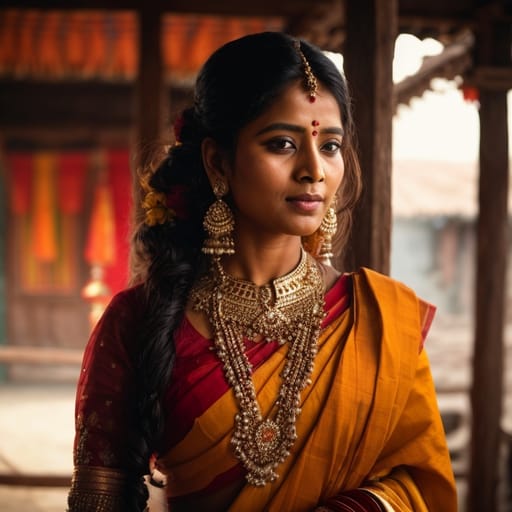
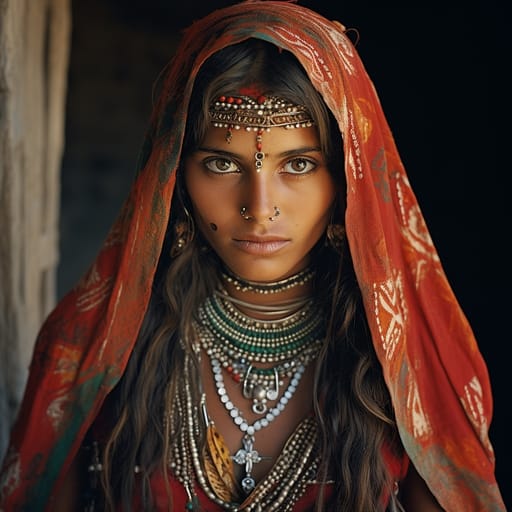
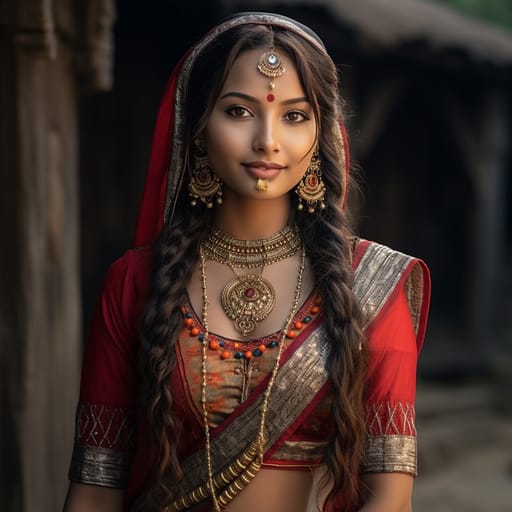
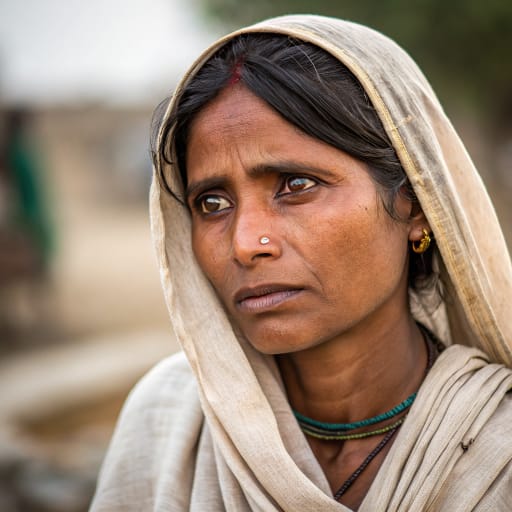
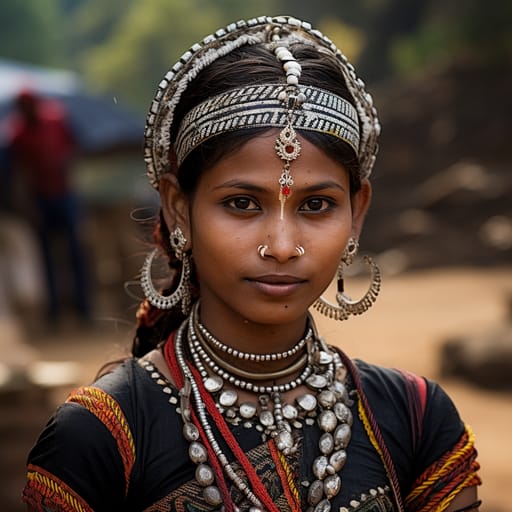
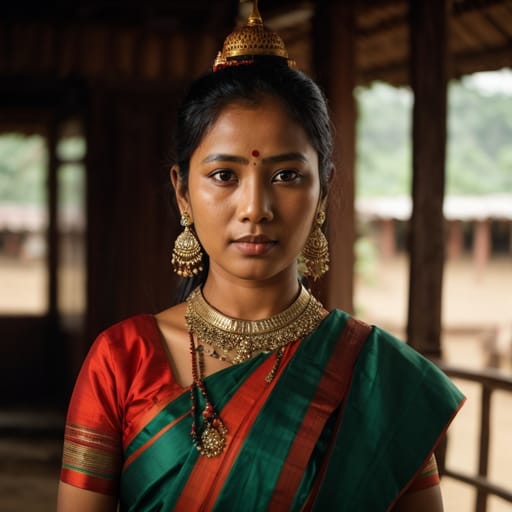
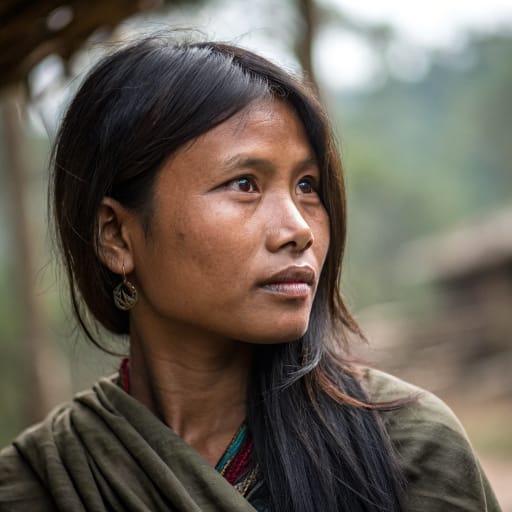
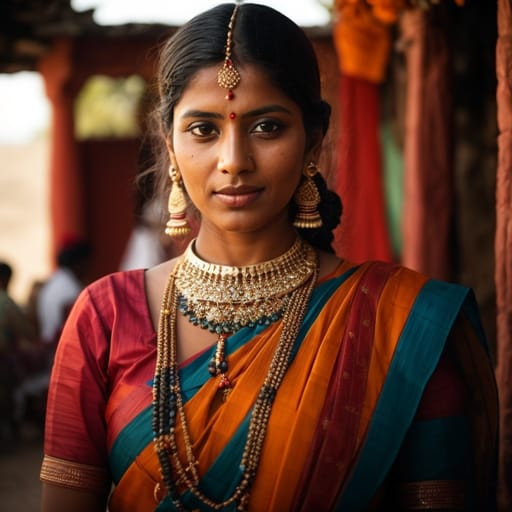
Typical Kashmiris Phenotypes
Reference for AI generation: hair, eyes, skin, facial structure, build
Kashmiris stand out within South Asia for a phenotype that runs noticeably lighter and more Caucasoid-leaning than the subcontinental average — a Dardic-speaking population whose Pamir-adjacent geography shows up directly in the face. The valley population sits closer to Northwest Iranian and Pamiri groups in pigmentation and feature set than to Indo-Gangetic plains populations just a few hundred kilometers south.
Hair is typically dark brown to black, but mid-brown and chestnut tones appear at frequencies you won't see in most other Indian groups, and outright auburn shows up occasionally in the Pandit population. Texture skews straight to loosely wavy, fine to medium in diameter, and recedes rather than coils. Beard growth on men is dense and full.
Eye color is overwhelmingly dark brown, but light eyes — hazel, green, and occasionally pale blue or gray — occur at meaningfully higher rates than elsewhere in South Asia, particularly among Pandits and the Bakarwal/Gujjar adjacent populations. The eye is almond-shaped with a deep-set upper orbit; the epicanthic fold is absent. Brows are heavy and well-defined.
Skin runs Fitzpatrick II–IV: from a true wheatish-fair that flushes pink on cold-weather cheeks, through olive, into warmer light-brown. Undertones lean neutral-to-warm rather than the yellow undertone common further south. The valley's long winters and limited UV exposure preserve unweathered tone into middle age in a way the plains do not.
Facial structure is the diagnostic feature: a tall, narrow nose with a prominent straight or aquiline bridge and modest alar width; high, defined cheekbones; a long oval face; and lips of moderate fullness — neither thin nor full. The jaw is angular without being heavy.
Build is medium-tall by South Asian standards — men commonly 170–178 cm — with lean-to-athletic frames and long limb proportions. Kashmiri Pandits trend slightly fairer and finer-featured on average, while Punjab-resident Kashmiris show some assimilation toward broader Punjabi build and slightly warmer skin tone, though the core facial signature persists.
Kashmiris Body & Anatomy Reference
Anatomy by feature, ancestral phenotype
Kashmiris Boobs & Breasts
The typical Kashmiris bust is medium cup, moderate projection, in line with the wider ancestral pattern. Areolas usually fall in the 30-42mm range, with regional-typical areolar pigmentation against the regional skin tone. Compared with the regional comparison phenotypes, Kashmiris breasts sit forward and are generally moderate fullness and projection. A faithful AI render of Kashmiris tits keeps that shape and areola size.
Kashmiris Ass & Hips
Butt shape among Kashmiris women: medium, moderate projection, over medium iliac crests. This follows ancestral ancestry and looks quite unlike the regional comparison phenotypes. An accurate Kashmiris ass in adult AI imagery keeps both the silhouette and the overall build (mesomorph) instead of a generic average.
Kashmiris Vagina & Pussy
Vulvar anatomy among Kashmiris women: regional-typical labial pigmentation. Pubic hair tends to be regional-typical texture and distribution, in the usual inverted-triangle pattern. Both follow ancestral pigmentation, which is why Kashmiris pussy renders should not fall back on a pale, sparse Western template.
Kashmiris Dicks & Penis
The Kashmiris cock profile, from ancestral anthropometric data: regional mean ~13cm erect; moderate girth; regional-typical shaft pigmentation. Pubic hair has a regional-typical texture and distribution and forms the usual inverted-V pattern. Whether Kashmiris men are circumcised follows religious and cultural practice rather than phenotype.
Kashmiris Body, Curves & Build
Build and curves among Kashmiris women follow the ancestral pattern: mesomorph, regional adult female BMI band. Proportions matter as much as skin tone, so Kashmiris figures should keep their regional height and limb ratios.
Kashmiris Skin Tone & Hair Texture
The Kashmiris skin range is regional-typical (Fitzpatrick III-V), and hair tends to be regional-typical. That combination marks the ancestral phenotype, and skin tone is the trait AI generators most often get wrong for Kashmiris women.
Data depth
71/100Coverage of image-grounded phenotype observations · drives AI generation diversity
- Sample size
- 40/40· 58 images
- Image quality
- 21/30· 41% high
- Confidence
- 10/20· mean 0.70
- Source diversity
- 0/10· wikipedia
- ·Wikipedia-only source, not population-representative
Observed Distribution: Image Sample
Empirical observations from analyzed photographs · supplementary signal, not population truth
Sample: 58 images analyzed (58 wikipedia). Quality: 24 high, 18 medium, 15 low, 1 very_low. Avg analyzer confidence: 0.70.
Skin tone (Fitzpatrick): II (5%), III (28%), IV (55%), V (9%), unclear (3%)
Hair color: gray/white (52%), black (36%), light/medium brown (3%), other (2%), unclear (7%)
Hair texture: straight (57%), wavy (12%), curly (7%), bald (7%), shaved (2%), covered (16%)
Eye color: dark brown (79%), hazel (2%), brown (2%), unclear (17%)
Epicanthic fold: 2% present, 95% absent, 3% unclear
Caveats: Sample is 100% Wikipedia notable people, which skews toward male, public-life, and modern figures, not population-representative.
Last aggregated: May 7, 2026
Explore phenotype categories
Structured taxonomy with peer-reviewed scales · 22 anatomical categories
- SkinFitzpatrick I to VI, undertone, pigmentation
- EyesColor, shape, eyelid, epicanthic fold
- Head hairColor, Andre Walker texture, hairline
- Body shapeHeath-Carter somatotype, WHR, frame
- NoseBridge, tip, nostril, alar width
- Lips & mouthVolume, Cupid’s bow, philtrum
Measured in Kashmiris portraits
Notable Kashmiris People
100 reference figures, sourced from Wikipedia
- Ataullah Shah Bukhari, Indian freedom struggle activist.
- Parveena Ahanger, co-founder and chairman of the Association of Parents of Disappeared Persons …
- Parvez Imroz, Kashmiri human rights lawyer and a civil rights activist.
- Mohammad Subhan Hajam, 1910-1962), Kashmiri barber, social activist
- Mushtaq Pahalgami, Social Activist, Environmentalist, President Himalayan Welfare Organization, …
- Khurram Parvez, Kashmiri human rights activist.
- Sanaullah Amritsari, Indian freedom struggle activist and co-founder of Jamia Millia Islamia
- Shehla Rashid, Political and civil rights activist.
- Ayub Thakur, 1948 to 2004) Kashmiri political activist and founder of London-based World K…
- Amitabh Mattoo, 1962- ), Vice Chancellor, Jammu University, thinker & writer, Padma Shri awardee
- Bakshi Ghulam Mohammad, Prime Minister Jammu and Kashmir 1953 to 1964.
- Baseer Ahmad Khan, 1958- ), Advisor to Governor and Former Divisional Commissioner Kashmir.
- Birbal Dhar, early 19th century), invited Maharaja Ranjit Singh to Kashmir
- Braj Kumar Nehru, 1909-2001), ambassador of India to the United States (1961-1968) and Governor…
- Durga Prasad Dhar, 1918-1975), ambassador of India to the Soviet Union, and politician
- Farah Pandith, 1969- ), U.S. State Department Special Representative
- Farooq Abdullah, former Cabinet Minister and Former Chief Minister of Jammu and Kashmir
- Farooq Khan, ex IPS, credited with creating JKP SOG.
- Ghulam Nabi Azad, 1949 born), politician and former CM of Jammu and Kashmir.
- Haidar Malik, Kashmiri administrator of the Mughals
- Haji Gokool Meah, industrialist and businessman in Trinidad and Tobago
- M. L. Madan, Veterinarian, Scientist, Administrator.
- Masood Khan, Career Diplomat and President of Azad Jammu & Kashmir[
- Markandey Katju, 1946-), Former Judge at the Supreme Court of India
- Masud Choudhary, 1944-2022), Prominent educator, social reformer and former administrator vice…
- Mehraj Mattoo, 1961- ), British Investment Banker, Economist, Harvard Fellow
- Mirza Pandit Dhar, Kashmiri during the rule of Azim Khan
- Mohan Lal, 1812-1877), diplomat in the First Anglo-Afghan War, and writer
- Neel Kashkari, 1973- ), Interim Assistant Secretary of the Treasury for Financial Stability …
- P. K. Kaul, 1929-2007), ambassador of India to the United States (1986-1989)
- Purushottam Narayan Haksar, 1913-1998), political strategist
- Rafiq Ahmad Pampori, born 1956), Islamic scholar, author and the former Principal of the Governmen…
- Rameshwar Nath Kao, 1918-2002), first chief of the Research and Analysis Wing, India's intelligen…
- Sameera Fazili, Kashmiri American attorney and community development finance expert who is a …
- Satish Dhawan, ISRO chief
- Shah Faesal, IAS topper (2009), youth icon, politician
- Sheikh Abdullah, 5 December 1905 to 8 September 1982), Leader of the National Conference, Prim…
- T.N. Kaul, 1913-2000), ambassador of India to USA (1973-1976), Soviet Union & Iran. Fore…
- V. N. Kaul, Comptroller and Auditor General of India (2002-2008).
- Tej Bahadur Sapru, 1875-1949), lawyer, political and social leader during the British Raj
- Triloki Nath Khoshoo, 1927-2002), secretary of the Department of Environment in the Indira Gandhi G…
- Vijaya Lakshmi Pandit, 1900-1990), ambassador of India to the United States (1949-1952), President o…
- Zafar Choudhary, Journalist, author, policy analyst, and practitioner of peace-building.
- Zaffar Iqbal Manhas, writer, poet, social activist and Pahari politician hailing from Jammu and Ka…
- Brij Mohan Kaul, commanded the Indian forces in the Sino-Indian War
- Colonel, Anil Kaul, VrC, Indian Army
- Mohammed Amin Naik, Major General Indian Army
- Mushaf Ali Mir, Air Chief Marshal (1947-2003) Chief of the Air Staff of the Pakistan Air Forc…
- S. K. Kaul, 1934- ), Air Chief Marshal of the Indian Air Force, former Chief of Air Staff…
- Tahir Rafique Butt, Air Chief Marshal is the current Chief of the Air Staff of Pakistan Air Force…
- Tapishwar Narain Raina, 1921-1980), [Chief of Army Staff of the Indian Army (1975-1978)
- Abdul Ahad Azad, Kashmiri poet
- Agha Shahid Ali, 1949-2001) Poet
- Amin Kamil, 1924-2014), Kashmiri poet & short story writer
- Ata ul Haq Qasmi, Urdu-language Poet, playwright and columnist.
- Basharat Peer, 1977- ), author
- Bhamaha, Poet of kavyalankara
- Bilhana, 11th century poet
- Chandrakanta, 1938- ), novelist and short story writer
- Dina Nath Walli, alias Al-mast Kashmiri (1908-2006), poet as well as renowned water color artist
- Fazil Kashmiri, 1916-2004) poet and lyricist, involved in Arabic, English, Persian, Urdu and …
- Gani Kashmiri, c. 1630 to c. 1669), 17th-century Persian-language poet
- Ghulam Ahmad Mahjoor, 1885-1952), poet, better known by the pen name Mahjoor
- Ghulam Nabi Firaq, 1922-), poet, writer and educationist
- Habba Khatun, 16th century poet, known as Zoon (the Moon) because of her immense beauty
- Hakeem Manzoor, 1937-2006) an Urdu writer, poet & administrator. He has written more than 15 …
- Hanifa Deen, Australian writer winner of New South Wales Premier's Literary Awards, Ethnic…
- Hari Kunzru, 1969- ), British novelist of Kashmiri descent
- Javaid Rahi, 1970) Tribal researcher of national repute working on tribal Gujjar culture.
- Khalid Bashir Ahmad, Writer and poet
- Khalid Hasan, 1935-2009) writer, senior Pakistani journalist and diplomat.
- Krishna Hutheesing, 1907-1967), author, and sister of Jawaharlal Nehru
- Madhosh Balhami, 1966-), poet known for his elegies for dead militants
- Mahmud Gami, 1765-1855), composed a version of the story of Yusuf and Zulaikha
- Manju Kak, short story writer
- Maqbool Shah Kralawari, 1820-1876), lyricist
- Marghoob Banihali, Kashmiri poet from Banihal, Kashmir.
- Meeraji, 1912-1949) Urdu poet, lived the life of a bohemian and worked only intermitte…
- Mirza Waheed, British Novelist born and raised in Kashmir.
- Mohi ud-Din Miskin, d.1921), poet and writer, wrote a history of Kashmir 'Tarikh-i-Kabir'
- Mohiuddin Hajni, 1917-1993) writer, critic, political activist and teacher.
- Momin Khan Momin, 1800-1851) poet known for his Urdu ghazals
- Moti Lal Kemmu, 1933- ), playwright
- Muhammad Din Fauq, 1877-1945) writer and first journalist of Kashmir.
- Muhammad Iqbal, 1877-1938) Muslim poet and philosopher. Commonly referred to as Allama Iqbal
- Mullah Nadiri, fl.1420 CE) Kashmiri poet of Persian-language, known for writing Tarikh-i-Kas…
- Naseem Shafaie, b.1952), Kashmiri-language poet.
- Nayantara Sahgal, 1927- ), Indo-Anglian writer, novelist
- Nyla Ali Khan, Professor, writer, granddaughter of Sheikh Abdullah.
- Pamposh Bhat, 1958- ), author and environmentalist.
- Predhuman K Joseph Dhar, author, social worker and a writer
- Rahul Pandita, Kashmiri author and journalist.
- Rasul Mir, also known as the John Keats of Kashmir.
- Rehman Rahi, Kashmiri poet
- S.L. Sadhu, 1917-2012), Scholar, Professor, poet, writer, folklorist and Historian
- Saadat Hasan Manto, 1912-1955), short story writer, member Progressive Writers' Movement
- Salman Rushdie, 1947- ), British-Indian novelist and essayist
- Santha Rama Rau, 1923- 2009), travel writer
- Sheikh Showkat Hussain, 1954- ), author and political analyst
- Tanha Ansari, 1914 to 1969), poet
Erotic Poses & Sex Positions
From the pose catalog: 219 named positions with reference skeletons
Frequently asked questions about Kashmiris people
Where is the Kashmiris homeland?
The Kashmiris homeland is Kashmir (India, Pakistan) in Southern Asian.
What language do Kashmiris people speak?
Kashmiris people primarily speak Indo-European / Indo-Aryan / Dardic / Kashmiri.
What religion do Kashmiris people practice?
The predominant religion among Kashmiris people is Islam / Sunni Islam, Hinduism, Sikhism.
What are other names for Kashmiris people?
Kashmiris people are also known as Kashmiri.






Make your own Kashmiris images
Five a day, free, no credits to buy. The studio starts from this group's phenotype data, so you can set body type, pose and style and keep the traits accurate.
Start with Kashmiris