Help us get this right
Does this portrait look right for Bhils?
One tap. It takes a second and it is recorded.
1 says it looks right, 0 say it looks off.
Bhils Erotic
India (Madhya Pradesh, Gujarat, Rajasthan, Maharashtra)
Hinduism
Barda, Bhagalia, Bhilala, Bhil Gametia, Bhil Garasia, Bhil Kataria, Bhil Mama, Bhil Mavchi, Dholi Bhil, Dungri Bhil, Damor, Dungri Garasia, Mewasi Bhil, Nirdhi Bhil, Rawal Bhil, Tadvi Bhil, Vasava, Bhil Meena, Chaudhri
About Bhils People
The Bhils are one of the largest tribal populations in India, scattered across the hill country where Madhya Pradesh, Gujarat, Rajasthan, and Maharashtra meet. They are an upland people by long habit — their territory is the Vindhya, Satpura, and Aravalli ranges, the broken forested zones that armies historically struggled to control and that left the Bhils a measure of autonomy long after the surrounding plains had been absorbed by one empire or another. Their name appears in Sanskrit and Mughal-era records, and they figure in the early Rajput chronicles as forest-dwellers whose cooperation a new ruler had to secure before he could claim the land — a political fact that shaped centuries of accommodation between Bhil chiefs and Rajput courts.
They speak Bhili, an Indo-Aryan language sitting between Gujarati and Rajasthani rather than belonging neatly to either, and in practice it fragments into a wide spread of dialects that track the sub-groups: Bhilala, Vasava, Tadvi, Garasia, Damor, and many others, some of them shading into distinct ethnic identities of their own. The Bhilalas, for instance, trace descent from intermarriage with Rajput houses and have historically held land rights closer to those of the dominant castes around them; the Tadvi are largely Muslim by affiliation; the Meena-adjacent and Garasia branches each carry their own social weight. This is not a single people in any tight sense but a federation of related communities held together by language, geography, and a shared sense of being adivasi — original inhabitants — in regions where that status carries real political meaning.
Religion is Hindu in the census sense, though the practice on the ground is layered. Village gods, ancestor shrines, and possession-mediums sit alongside the broader Hindu pantheon, and major figures like the goddess at the Bhil shrine of Kalika or the local devs of the Satpura villages are propitiated in forms that predate any temple Hinduism a visitor would recognize. The bow has long been a Bhil emblem — Eklavya, the archer of the Mahabharata, is claimed as one of theirs — and archery still surfaces at festivals like Bhagoria, the spring fair where young people choose partners through a courtship ritual that has stubbornly outlasted attempts to formalize it. Pithora wall paintings, made by ritual specialists for household occasions, are the visual tradition the Bhils are best known for outside their own region.
Related ethnic groups
Groups that share Bhils's homeland, region, language, or religious tradition. These are likely candidates for comparative phenotype reference.
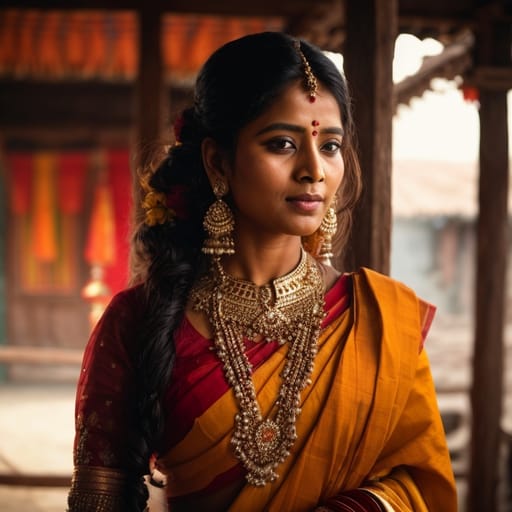
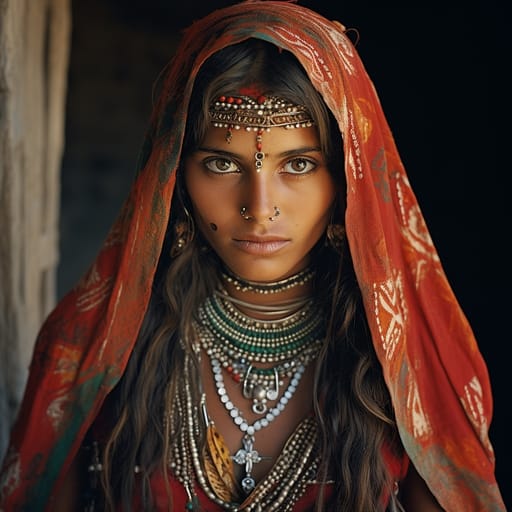
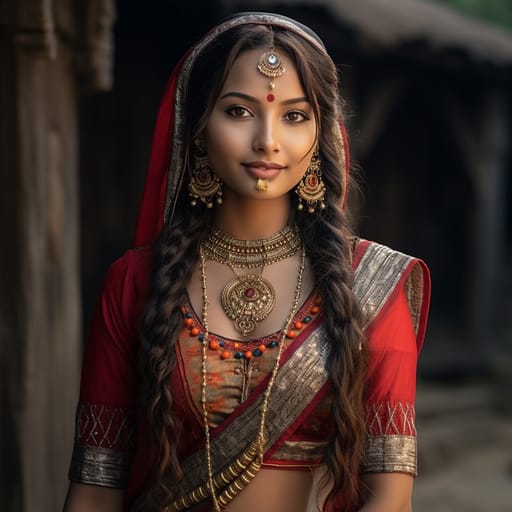
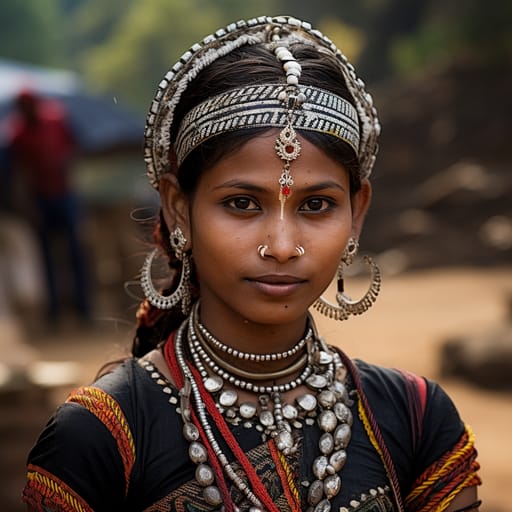
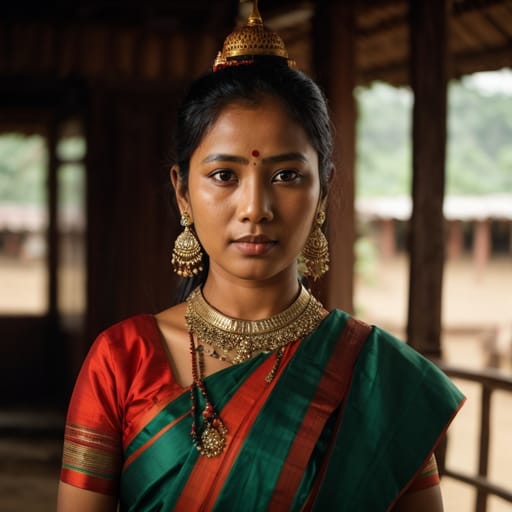
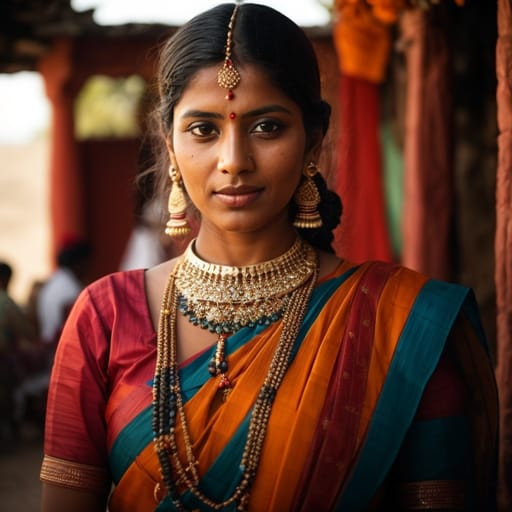
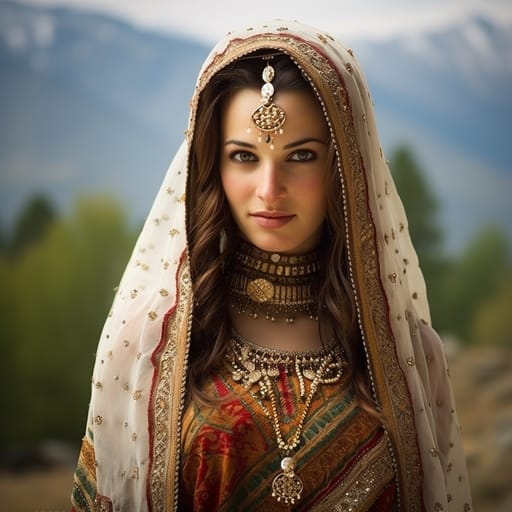
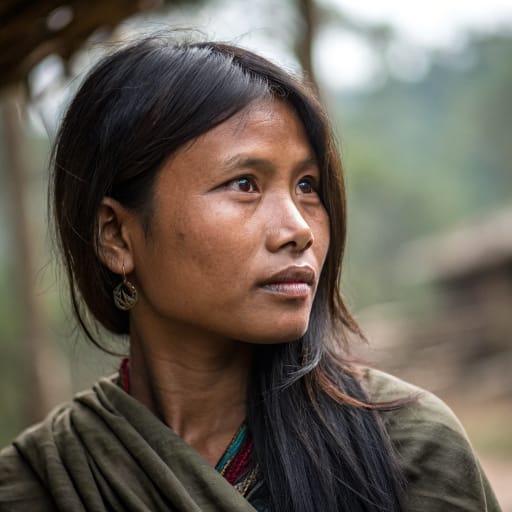
Typical Bhils Phenotypes
Reference for AI generation: hair, eyes, skin, facial structure, build
The Bhils are one of India's largest Adivasi (tribal) populations, and their phenotype reflects a long-isolated indigenous lineage that predates the Indo-Aryan migrations into the subcontinent. The dominant impression is darker, more austere features than surrounding caste-Hindu Gujarati or Rajasthani populations — the Bhils were historically forest-dwelling and intermarried within the community, which preserved an older Dravidian-affiliated genetic profile beneath an Indo-Aryan linguistic overlay.
Hair is almost uniformly black, occasionally shading to very dark brown in sun-bleached ends. Texture runs straight to loosely wavy, generally fine to medium in diameter, and men commonly carry full beards and moustaches — a visible point of pride, frequently styled in older photographs of figures like Tantia Bhīl. Eyes are dark brown to near-black; the epicanthic fold is absent, and eye shape is almond to slightly deep-set under prominent brow ridges.
Skin tone clusters in Fitzpatrick IV–V, with a meaningful share of darker V–VI complexions, especially among the Madhya Pradesh and southern Rajasthan branches who live in higher-UV terrain. Undertones run warm — bronze and reddish-brown rather than the olive-yellow common in northern Indo-Aryan populations.
Facial structure tends toward broader, lower-bridged noses with moderately flared alae, fuller lips than typical north-Indian profiles, and strong zygomatic (cheekbone) projection that gives the face an angular, sculpted look in lean individuals. Jaws are squared rather than tapered.
Build is characteristically wiry — stature is short by Indian averages, men commonly 5'2"–5'5" and women 4'10"–5'1", with low body fat and dense, sinewy musculature shaped by generations of hill agriculture and hunting. The Bhilala and Garasia subgroups, who absorbed more Rajput admixture, trend slightly taller and lighter-skinned with sharper noses; the Vasava, Tadvi and Dungri Bhil of the Sahyadri foothills retain the darker, more compact phenotype most associated with the community.
Bhils Body & Anatomy Reference
Per-feature anatomical profile for AI nude generation: ancestral phenotype
Bhils Boobs & Breasts
Bhils tits and boobs run medium cup, moderate projection, the classic ancestral bust profile. Bhils nipples and areolas show regional-typical areolar pigmentation against the regional skin tone, with areolar diameter typically in the 30-42mm range and forward-set positioning rather than the regional comparison phenotypes. Bhils breasts trend moderate fullness and projection, a function of the mesomorph body habitus and the regional adult female BMI band. For anatomically accurate AI-generated Bhils nudes the render preserves the medium cup, moderate projection shape, 30-42mm areolas with regional-typical pigmentation, and the torso proportions of the ancestral phenotype.
Bhils Ass & Hips
Bhils hips and butt usually read as medium, moderate projection. The skeletal base is medium iliac crests, the ancestral pattern. Set against the regional comparison phenotypes, the difference is easy to see, and the hip-to-waist ratio is often what identifies Bhils women in photos.
Bhils Vagina & Pussy
Expect regional-typical labial pigmentation on Bhils women, in keeping with ancestral ancestry. The pubic hair is regional-typical texture and distribution. Coloring should run evenly from the regional-typical skin of the thighs to the labia, and Bhils nude imagery should keep the hair's regional-typical texture and distribution.
Bhils Dicks & Penis
Bhils dick and penile anatomy in adult AI generation should anchor on the regional reference data: regional mean ~13cm erect, moderate girth, and regional-typical shaft pigmentation. The Bhils cock profile reflects the ancestral population's anthropometric measurements. The shaft pigmentation should track the surrounding regional-typical skin tone, and the pubic hair should keep its regional-typical texture and distribution in the typical inverted-V escutcheon.
Bhils Body, Curves & Build
Bhils body type: mesomorph, with regional adult female BMI band. This is the typical ancestral build. Height range, shoulder-to-hip ratio and fat distribution all follow from it, which is what an accurate Bhils nude body should show.
Bhils Skin Tone & Hair Texture
Bhils skin tone falls in the regional-typical (Fitzpatrick III-V) band, the surface signal most often miscalibrated by generic AI nude generators. Bhils hair texture is typically regional-typical, characteristic of the ancestral phenotype. In Bhils nude renders the skin should hold that band consistently across the body.
Data depth
37/100Coverage of image-grounded phenotype observations · drives AI generation diversity
- Sample size
- 10/40· 3 images
- Image quality
- 17/30· 33% high
- Confidence
- 10/20· mean 0.67
- Source diversity
- 0/10· wikipedia
- ·Small sample (n<10)
- ·Wikipedia-only source, not population-representative
Observed Distribution: Image Sample
Empirical observations from analyzed photographs · supplementary signal, not population truth
Sample: 3 images analyzed (3 wikipedia). Quality: 1 high, 1 medium, 1 low, 0 very_low. Avg analyzer confidence: 0.67.
Skin tone (Fitzpatrick): V (100%)
Hair color: black (67%), gray/white (33%)
Hair texture: straight (67%), covered (33%)
Eye color: dark brown (100%)
Epicanthic fold: 0% present, 100% absent, 0% unclear
Caveats: Sample size 3 is small, so the observed distribution should be treated as suggestive, not definitive. Sample is 100% Wikipedia notable people, which skews toward male, public-life, and modern figures, not population-representative.
Last aggregated: May 7, 2026
Explore phenotype categories
Structured taxonomy with peer-reviewed scales · 22 anatomical categories
Notable Bhils People
5 reference figures, sourced from Wikipedia
- Tantia Bhīl, freedom fighter
- Bhima Nayak, Freedom fighter
- Chhotubhai Vasava, Politician
- Rajkumar Roat, Politician
- Nitin Bhille, Cricket player
Erotic Poses & Sex Positions
From the pose catalog: 219 named positions with reference skeletons
Frequently asked questions about Bhils people
Where is the Bhils homeland?
The Bhils homeland is India (Madhya Pradesh, Gujarat, Rajasthan, Maharashtra) in Southern Asian.
What language do Bhils people speak?
Bhils people primarily speak Indo-European / Indo-Aryan / Bhil.
What religion do Bhils people practice?
The predominant religion among Bhils people is Hinduism.






Make your own Bhils images
Five a day, free, no credits to buy. The studio starts from this group's phenotype data, so you can set body type, pose and style and keep the traits accurate.
Start with Bhils