Help us get this right
Does this portrait look right for Sambal?
Nobody has judged this one yet. You would be the first.
Sambal Erotic
Zambales (Philippines)
Christianity / Catholicism
Bolinao, Botolan (including Banguingui)
About Sambal People
The Sambal are an indigenous people of the western Luzon coast, concentrated in Zambales and the adjacent stretches of Pangasinan and Bataan. Their homeland is a narrow lowland pinned between the South China Sea and the Zambales Mountains — a geography that shaped them as a coastal and foothill people rather than a riverine or highland one, and that pushed their settlements into a long ribbon along the shore. The 1991 eruption of Mount Pinatubo, which sits squarely in their territory, displaced thousands of Sambal villages and reshaped both the land and the community in ways that are still working themselves out a generation later.
Linguistically, the Sambal sit slightly apart from their neighbors. Their tongues belong to the Sambalic branch of the Central Luzon languages, a small cluster that does not slot neatly into the larger Tagalog or Ilocano zones pressing in from either side. The branch splits internally: Botolan Sambal in the south, Tina (Bolinao) Sambal up the coast in Pangasinan, with smaller varieties in between. A speaker of Botolan and a speaker of Bolinao can usually follow each other, but not without effort — the distance between them is real, not cosmetic. Centuries of contact have layered Spanish and, more heavily, Tagalog and Ilocano vocabulary on top, and younger Sambal today are typically trilingual, with the home language increasingly the most fragile of the three.
Catholicism arrived with the Spanish in the sixteenth century and has long since become the working religion of Sambal communities, observed through the standard cycle of fiesta, patron saint, and parish life. Underneath that, older practices persist in softer forms — beliefs about anito spirits, herbal healers, and rituals tied to fishing and planting that coexist with the church calendar rather than competing with it openly. The Aeta peoples of the Zambales highlands are a separate group, but centuries of proximity mean Sambal lowland culture carries clear traces of that exchange.
Historically the Sambal were known to the Spanish as skilled fighters and reluctant subjects; colonial records describe repeated friction during the early pacification of Zambales, and Sambal contingents later appeared on both sides of the conflicts that swept Luzon. Today they are a comparatively small group by Philippine standards — outnumbered in their own province by Tagalog and Ilocano migrants — and much of the contemporary work around Sambal identity is quietly defensive: language documentation, local-history projects, and the slow rebuilding of communities that Pinatubo scattered.
Related ethnic groups
Groups that share Sambal's homeland, region, language, or religious tradition. These are likely candidates for comparative phenotype reference.
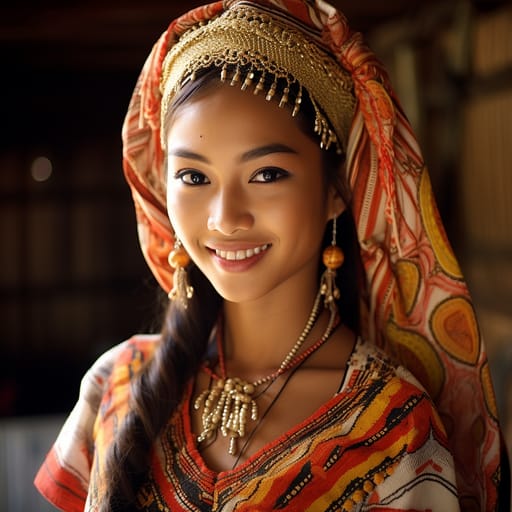
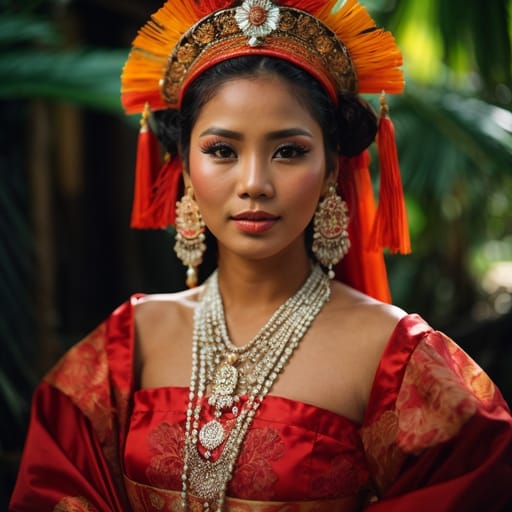
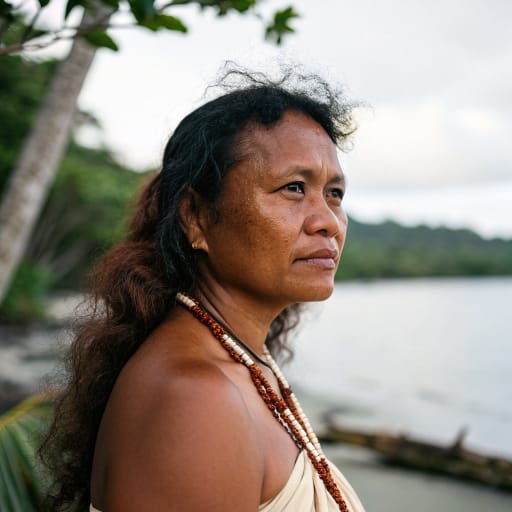
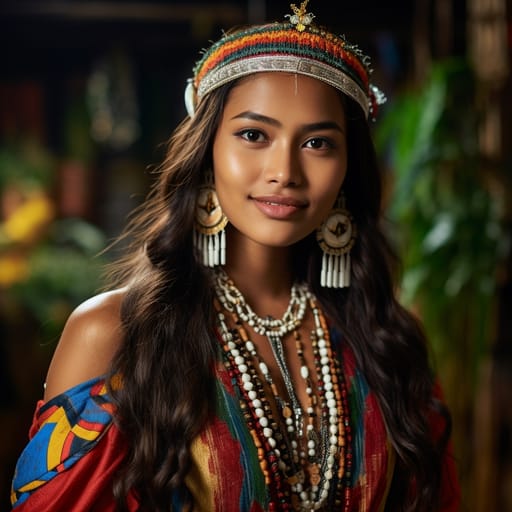
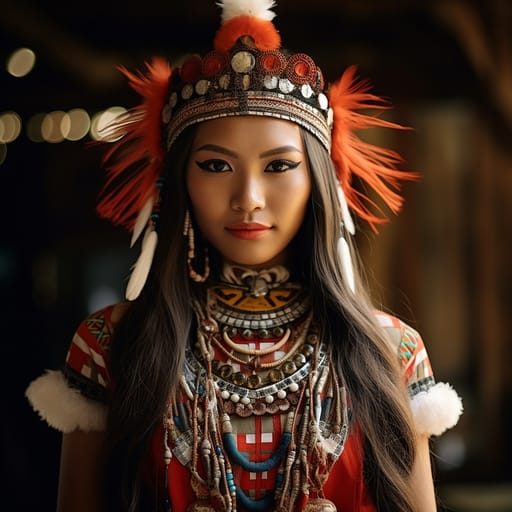
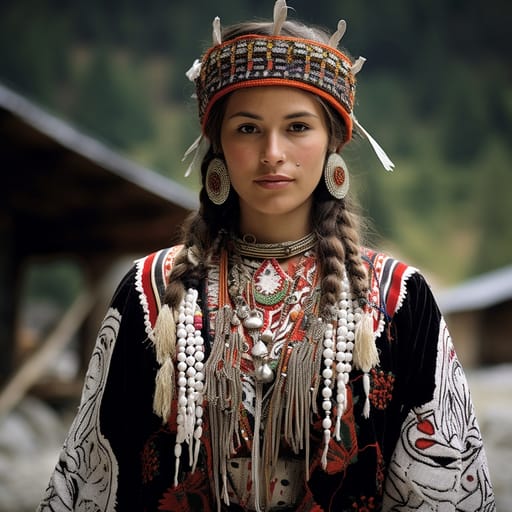
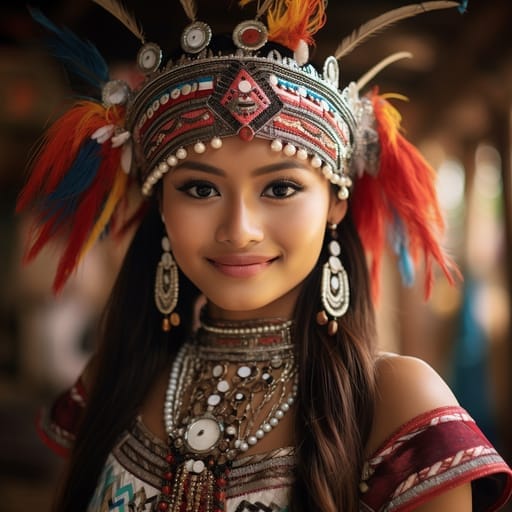
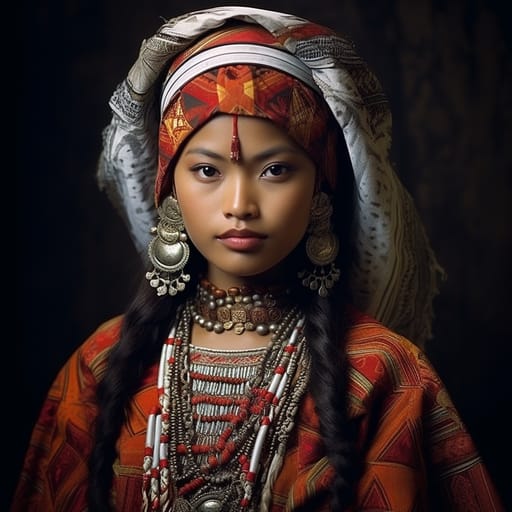
Typical Sambal Phenotypes
Reference for AI generation: hair, eyes, skin, facial structure, build
The Sambal are a coastal Austronesian people of Zambales province on Luzon's western shore, and their phenotype sits within the broader Filipino lowlander range with a few consistent local markers. Hair runs almost uniformly black or near-black, straight to gently wavy, with the heavy, glossy texture typical of Southeast Asian Austronesians; soft natural waves are more common in the Botolan interior, where Aeta admixture from the Zambales mountains has shaped some lineages, while Bolinao coastal communities trend toward the sleekest straight hair. True curl is uncommon outside of partially Negrito-descended individuals.
Eyes are dark brown to near-black, almond-shaped, with a moderate epicanthic fold — present in most adults but generally lighter than in northern East Asian populations, so the lid often shows a faint crease rather than a fully covered tarsal plate. Skin tone spans Fitzpatrick III to V, with warm golden-brown and olive undertones; fishermen and farmers weather to a deep bronze, while sheltered urban Sambal often photograph noticeably lighter. The Banguingui-linked Botolan branch, with its sea-raiding Sulu connections, sometimes carries a slightly darker baseline.
Facial structure is rounded to softly oval, with broad but low-bridged noses, moderately wide alae, and full but not everted lips. Cheekbones are present and wide-set without being sharply prominent; jawlines tend toward soft squareness in men and a tapered point in women. Foreheads are typically modest in height.
Build is compact. Adult male stature commonly falls in the 160–168 cm range and female 148–156 cm, with shorter averages in interior Botolan communities where Aeta ancestry pulls the mean down further. Body composition is naturally lean-muscular through the shoulders and back — a legacy of generations of net-fishing and boat work — with shorter limbs relative to torso and a tendency toward central weight gain in middle age rather than peripheral. The defining Sambal look is a coastal Austronesian phenotype with a faint highland undertow from centuries of contact with the Aeta of the Zambales range.
Sambal Body & Anatomy Reference
Southeast Asian Austronesian / Austroasiatic phenotype: anatomy reference for AI nude generation
Sambal Boobs & Breasts
Sambal tits and boobs run small-to-medium cup, modest projection, the classic Southeast Asian Austronesian / Austroasiatic bust profile. Sambal nipples and areolas show medium-brown to dark-brown areolar pigmentation against the tan-to-medium-brown skin tone, with areolar diameter typically in the 26-38mm range and forward-set positioning rather than the fuller South Asian or Polynesian bust. Sambal breasts trend firm, modest projection, a function of the ectomorph, petite frame body habitus and the mean adult female BMI 20-23. For anatomically accurate AI-generated Sambal nudes the render preserves the small-to-medium cup, modest projection shape, 26-38mm areolas with medium-brown to dark-brown pigmentation, and the torso proportions of the Southeast Asian Austronesian / Austroasiatic phenotype.
Sambal Ass & Hips
Sambal hips and butt usually read as small-to-medium, modest projection, narrower hip profile. The skeletal base is narrow-to-medium iliac crests, the Southeast Asian Austronesian / Austroasiatic pattern. Set against the fuller glutes of the Pacific Islander phenotype, the difference is easy to see, and the hip-to-waist ratio is often what identifies Sambal women in photos.
Sambal Vagina & Pussy
Expect medium-brown to dark-brown labial pigmentation on Sambal women, in keeping with Southeast Asian Austronesian / Austroasiatic ancestry. The pubic hair is straight-to-wavy fine-to-medium texture. Coloring should run evenly from the tan to medium-brown skin of the thighs to the labia, and Sambal nude imagery should keep the hair's straight-to-wavy fine-to-medium texture.
Sambal Dicks & Penis
Sambal dick and penile anatomy in adult AI generation should anchor on the regional reference data: regional mean ~11cm erect, moderate girth, and medium-brown shaft pigmentation. The Sambal cock profile reflects the Southeast Asian Austronesian / Austroasiatic population's anthropometric measurements. The shaft pigmentation should track the surrounding tan to medium-brown skin tone, and the pubic hair should keep its straight-to-wavy fine-to-medium texture in the typical inverted-V escutcheon.
Sambal Body, Curves & Build
Sambal body type: ectomorph, petite frame, with mean adult female BMI 20-23. This is the typical Southeast Asian Austronesian / Austroasiatic build. Height range, shoulder-to-hip ratio and fat distribution all follow from it, which is what an accurate Sambal nude body should show.
Sambal Skin Tone & Hair Texture
Sambal skin tone falls in the tan to medium-brown (Fitzpatrick III-V) band, the surface signal most often miscalibrated by generic AI nude generators. Sambal hair texture is typically straight-to-wavy 1A-2A, dark-brown to black, characteristic of the Southeast Asian Austronesian / Austroasiatic phenotype. In Sambal nude renders the skin should hold that band consistently across the body.
Data depth
0/100Coverage of image-grounded phenotype observations · drives AI generation diversity
- Sample size
- 0/40· 0 images
- Image quality
- 0/30· 0% high
- Confidence
- 0/20
- Source diversity
- 0/10
- ·No image observations yet
Explore phenotype categories
Structured taxonomy with peer-reviewed scales · 22 anatomical categories
Erotic Poses & Sex Positions
From the pose catalog: 219 named positions with reference skeletons
Frequently asked questions about Sambal people
Where is the Sambal homeland?
The Sambal homeland is Zambales (Philippines) in Southeast Asia.
What language do Sambal people speak?
Sambal people primarily speak Austronesian / Philippine / Sambalic.
What religion do Sambal people practice?
The predominant religion among Sambal people is Christianity / Catholicism.






Make your own Sambal images
Five a day, free, no credits to buy. The studio starts from this group's phenotype data, so you can set body type, pose and style and keep the traits accurate.
Start with Sambal