Help us get this right
Does this portrait look right for Banaban?
Nobody has judged this one yet. You would be the first.
Banaban Erotic
Banaba (Ocean Island), Kiribati; and Rabi Island, Fiji
Banaban dialect of Gilbertese (Austronesian, Micronesian)
Christianity (Methodist and Roman Catholic)
About Banaban People
The Banabans are the indigenous people of Banaba (formerly Ocean Island), a raised coral island in the western Pacific that is today part of the Republic of Kiribati. Their modern history was reshaped by large-scale phosphate mining that began in the early twentieth century and progressively rendered much of their homeland uninhabitable. In the 1940s the British colonial administration resettled most of the community on Rabi Island in Fiji, where the majority of Banabans live today. They speak a distinct dialect of Gilbertese, an Austronesian language of the Micronesian group. The community numbers several thousand, on the order of 5,000 to 6,000.
History and displacement
Banaba's rich phosphate deposits were mined for decades by the British Phosphate Commissioners, stripping the island's surface and displacing its people. On Rabi, land purchased in part with Banaban phosphate royalties, the community rebuilt village life while maintaining a cultural and legal claim to Banaba itself, including a long compensation struggle heard in British courts. The Banabans retain a special status within Kiribati, including reserved representation in its legislature, even as their population remains split between Fiji and their ancestral island. This experience of loss and diaspora is central to how Banabans describe their identity.
Society and appearance
Traditional Banaban life combined reef and deep-sea fishing, pandanus and coconut cultivation, and the careful management of cave water and wells on a nearly riverless island. Kinship, inherited land plots, and dance traditions structured community life. Micronesian in appearance, Banabans typically have brown skin and dark hair. Traditional festive adornment includes woven pandanus garments, coconut-fiber ornaments, and flower garlands worn for te mwaie, the seated and standing dances that remain a proud marker of Banaban and wider Kiribati identity. Everyday dress today follows Fijian and Western styles, and Christianity, in Methodist and Catholic forms, is central to community life.
Related ethnic groups
Groups that share Banaban's homeland, region, language, or religious tradition. These are likely candidates for comparative phenotype reference.
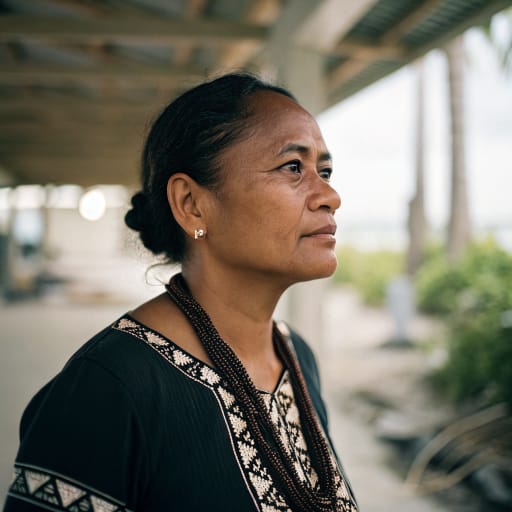
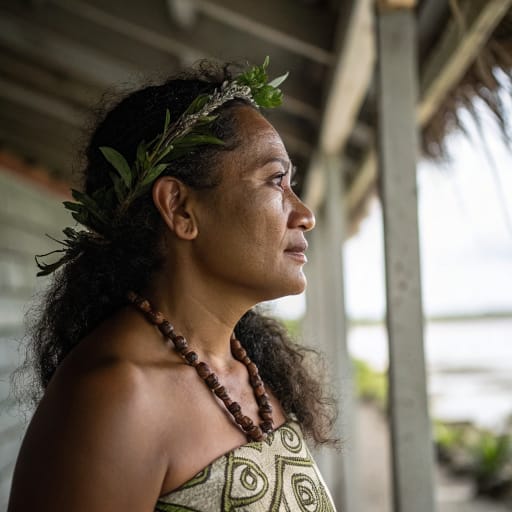
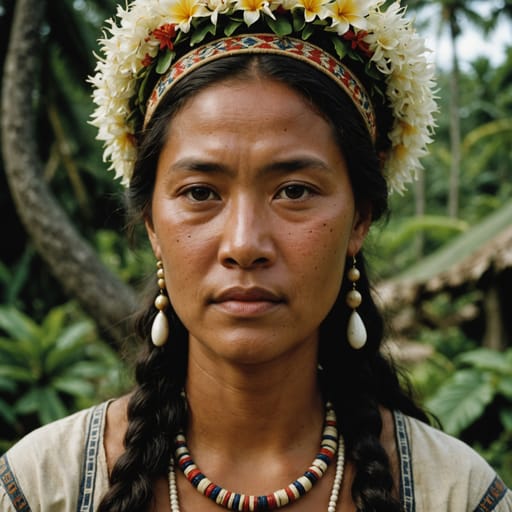
Typical Banaban Phenotypes
Reference for AI generation: hair, eyes, skin, facial structure, build
Banaban Body & Anatomy Reference
Anatomy by feature, Micronesian Pacific Islander phenotype
Banaban Boobs & Breasts
The typical Banaban bust is medium-to-large cup, full, moderate projection, in line with the wider Micronesian Pacific Islander pattern. Areolas usually fall in the 32-46mm range, with medium-brown to dark-brown areolar pigmentation against the tan-to-medium-brown skin tone. Compared with the smaller Southeast Asian bust, Banaban breasts sit forward and are generally full, moderate projection. A faithful AI render of Banaban tits keeps that shape and areola size.
Banaban Ass & Hips
Butt shape among Banaban women: medium-to-full, moderate-to-high projection, over medium-to-wide iliac crests. This follows Micronesian Pacific Islander ancestry and looks quite unlike the slim Southeast Asian narrow-hip profile. An accurate Banaban ass in adult AI imagery keeps both the silhouette and the overall build (mesomorph with broader frame) instead of a generic average.
Banaban Vagina & Pussy
Vulvar anatomy among Banaban women: medium-brown to dark-brown labial pigmentation. Pubic hair tends to be wavy medium-coarse texture, in the usual inverted-triangle pattern. Both follow Micronesian Pacific Islander pigmentation, which is why Banaban pussy renders should not fall back on a pale, sparse Western template.
Banaban Dicks & Penis
The Banaban cock profile, from Micronesian Pacific Islander anthropometric data: regional mean ~13cm erect; moderate girth; medium-brown shaft pigmentation. Pubic hair has a wavy medium-coarse texture and forms the usual inverted-V pattern. Whether Banaban men are circumcised follows religious and cultural practice rather than phenotype.
Banaban Body, Curves & Build
Build and curves among Banaban women follow the Micronesian Pacific Islander pattern: mesomorph with broader frame, mean adult female BMI 27-31 (one of the highest regional means globally). Proportions matter as much as skin tone, so Banaban figures should keep their regional height and limb ratios.
Banaban Skin Tone & Hair Texture
The Banaban skin range is tan to medium-brown (Fitzpatrick IV-V), and hair tends to be wavy-to-curly 2B-3B, dark-brown to black. That combination marks the Micronesian Pacific Islander phenotype, and skin tone is the trait AI generators most often get wrong for Banaban women.
Explore phenotype categories
Structured taxonomy with peer-reviewed scales · 22 anatomical categories
Erotic Poses & Sex Positions
From the pose catalog: 219 named positions with reference skeletons
Frequently asked questions about Banaban people
Where is the Banaban homeland?
The Banaban homeland is Banaba (Ocean Island), Kiribati; and Rabi Island, Fiji in Micronesia.
What language do Banaban people speak?
Banaban people primarily speak Banaban dialect of Gilbertese (Austronesian, Micronesian).
What religion do Banaban people practice?
The predominant religion among Banaban people is Christianity (Methodist and Roman Catholic).






More from Micronesia
Make your own Banaban images
Five a day, free, no credits to buy. The studio starts from this group's phenotype data, so you can set body type, pose and style and keep the traits accurate.
Start with Banaban