Uzbeks face shape: proportions, cheekbones and jaw in 57 observed portraits
Uzbeks: overall face shape Round in 42% of 57; cheekbone (zygomatic) prominence Moderate in 98% of 57; cheekbone width (bizygomatic breadth) Balanced in 51% of 57; midface morphology Full / youthful in 54% of 57; forehead shape (sagittal) Rounded / convex in 69% of 55; jaw width (bigonial) Wide in 56% of 57; mandibular angle (gonial angle) Soft / obtuse in 51% of 57; chin shape (frontal) Rounded in 89% of 56; chin projection (sagittal) Balanced in 100% of 57.
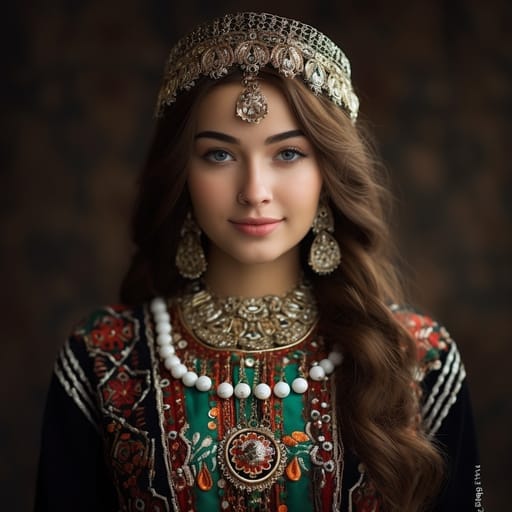
Catalog portraits for Uzbeks are AI-generated adult subjects; the measurements on this page come from documented photographs of real people, not from these images.
Overall face shape
n = 57 assessableMacro-level shape of the face derived from facial outline (forehead width, cheekbone width, jaw width, face length).
| Value | Share | n | |
|---|---|---|---|
| RoundLength and width approximately equal; soft jaw and forehead curves. | 42% | 24 | |
| OvalLength approximately 1.5x width; balanced forehead and jaw with widest point at cheekbones. | 28% | 16 | |
| Oblong / longLength substantially greater than width; balanced forehead and jaw. | 16% | 9 | |
| SquareLength and width approximately equal; angular jaw and forehead. | 14% | 8 |
Vocabulary: Overall face shape (face_shape_qualitative)
Cheekbone (zygomatic) prominence
n = 57 assessableAnterior projection of the zygomatic prominence.
| Value | Share | n | |
|---|---|---|---|
| ModerateCheekbones visible but not prominent. | 98% | 56 | |
| High / prominentPronounced anterior projection; defined cheekbone landmarks. Common in some East Asian, indigenous American, and Slavic populations. | 2% | 1 |
Vocabulary: Cheekbone (zygomatic) prominence (zygomatic_prominence_qualitative)
Cheekbone width (bizygomatic breadth)
n = 57 assessableWidth of the face at the cheekbones, proportional to face height.
| Value | Share | n | |
|---|---|---|---|
| BalancedBizygomatic breadth in proportional reference range. | 51% | 29 | |
| WideBizygomatic breadth substantially wide; common in East Asian and indigenous populations. | 49% | 28 |
Vocabulary: Cheekbone width (bizygomatic breadth) (bizygomatic_breadth_qualitative)
Midface morphology
n = 57 assessableSoft-tissue contour of the midface (the region between the lower eyelid and the upper lip).
| Value | Share | n | |
|---|---|---|---|
| Full / youthfulAnterior midface fullness; smooth nasolabial fold; defined cheek apple. | 54% | 31 | |
| BalancedAverage midface fullness. | 40% | 23 | |
| Flattened / agedReduced midface fullness; deepened nasolabial fold; visible tear-trough; mid-cheek descent. | 4% | 2 | |
| Very fullPronounced anterior midface fullness — constitutional or augmented. | 2% | 1 |
Vocabulary: Midface morphology (midface_qualitative)
Forehead shape (sagittal)
n = 55 assessableProfile shape of the forehead in lateral view.
| Value | Share | n | |
|---|---|---|---|
| Rounded / convexSmoothly rounded forehead profile; soft slope. | 69% | 38 | |
| Flat / verticalForehead nearly vertical in profile; minimal anterior curvature. | 31% | 17 |
Vocabulary: Forehead shape (sagittal) (forehead_shape_qualitative)
Jaw width (bigonial)
n = 57 assessableWidth of the lower jaw at the gonial angles (bigonial breadth) relative to the cheekbones (bizygomatic breadth).
| Value | Share | n | |
|---|---|---|---|
| Narrow (tapered)Bigonial breadth substantially less than bizygomatic; tapered lower face. | 5% | 3 | |
| BalancedBigonial breadth approximately 75-85% of bizygomatic; aesthetic reference range. | 39% | 22 | |
| WideBigonial breadth approaches or exceeds bizygomatic; squared or wider-than-cheekbones lower face. Common in East Asian populations. | 56% | 32 |
Vocabulary: Jaw width (bigonial) (bigonial_breadth_qualitative)
Mandibular angle (gonial angle)
n = 57 assessableSharpness of the gonial angle.
| Value | Share | n | |
|---|---|---|---|
| Soft / obtuseSmooth, rounded transition with no distinct angle. More common in female physiognomy and with subcutaneous fat coverage. | 51% | 29 | |
| ModerateStandard 120-130° angle; defined but rounded gonial transition. | 42% | 24 | |
| Sharp / angularVisible 90°-leaning angle at the gonial point; defined jawline. More common in male physiognomy and in East Asian populations. | 7% | 4 |
Vocabulary: Mandibular angle (gonial angle) (gonial_angle_qualitative)
Chin shape (frontal)
n = 56 assessableShape of the chin in frontal view.
| Value | Share | n | |
|---|---|---|---|
| RoundedSmooth U-shape; no distinct point or angle. | 89% | 50 | |
| SquareWide, flat chin with sharp lateral angles. | 11% | 6 |
Vocabulary: Chin shape (frontal) (chin_shape_qualitative)
Chin projection (sagittal)
n = 57 assessableAnterior projection of the chin (pogonion) in lateral view.
| Value | Share | n | |
|---|---|---|---|
| BalancedPogonion approximately at the Riedel reference plane. | 100% | 57 |
Vocabulary: Chin projection (sagittal) (riedel_pogonion_qualitative)
Where these numbers come from
57 publicly documented portraits of notable Uzbeks people were assessed by a vision model against the full 22-vocabulary schema, one value per dimension. Values are what the photographs show, read by a model, not population measurements. Each table counts only portraits where the value could be assessed; covered, obscured and unclear portraits are reported separately.
Notable-people corpora skew older, so hair color over-represents gray and white, and image quality varies. Treat shares as a description of this sample.
These rows are not yet in the published catalog dataset, which currently carries the earlier single-row analysis; see the methodology. A family page exists only when at least 10 portraits carry an assessable value.