What do Fula people look like? Hair, eyes, skin, nose, lips and face in 46 observed portraits
6 trait families measured across 46 documented portraits of Fula people. Each family links to its full distribution.
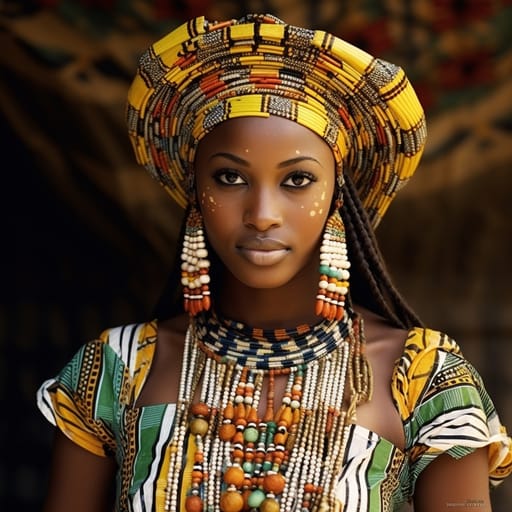
Catalog portraits for Fula are AI-generated adult subjects; the measurements on this page come from documented photographs of real people, not from these images.
Fula hair
n = 16Fula: hair texture (andre walker) 4C — coily, tightly packed in 25% of 16; hair color Black in 79% of 28; hair density Thin in 50% of 16; hairline shape M-shape (temporal recession) in 57% of 14; graying pattern None in 63% of 27.
Fula eyes
n = 40Fula: iris color Very dark brown / black-appearing in 89% of 38; eye shape Almond in 83% of 40; upper eyelid crease type Double, low (~3-5mm above lash line) in 94% of 36; epicanthic fold Absent in 100% of 40; palpebral fissure slant Horizontal in 45% of 40; eyebrow shape Soft arch in 95% of 41.
Fula skin tone
n = 40Fula: fitzpatrick skin type Type V — brown in 65% of 40; skin undertone Warm (yellow / golden) in 63% of 35; pigmentation pattern Uniform in 100% of 40; freckling density None in 100% of 41.
Fula nose
n = 41Fula: bridge profile (sagittal) Straight in 85% of 41; bridge height Medium in 78% of 41; bridge width Wide in 95% of 41; tip shape and definition Bulbous / round in 100% of 41; nostril shape Oval, horizontal in 56% of 41; alar base width Wide in 100% of 41; nasal length (proportional) Balanced in 95% of 41.
Fula lips
n = 41Fula: overall lip volume Moderate in 71% of 41; upper-to-lower lip volume ratio Balanced (~1:1) in 59% of 41; cupid's bow morphology Soft / rounded in 100% of 41; philtrum definition Soft in 56% of 41; mouth width Balanced in 61% of 41.
Fula face shape
n = 41Fula: overall face shape Round in 39% of 41; cheekbone (zygomatic) prominence Moderate in 95% of 41; cheekbone width (bizygomatic breadth) Balanced in 59% of 41; midface morphology Balanced in 54% of 41; forehead shape (sagittal) Rounded / convex in 74% of 38; jaw width (bigonial) Wide in 41% of 41; mandibular angle (gonial angle) Soft / obtuse in 59% of 41; chin shape (frontal) Rounded in 100% of 41; chin projection (sagittal) Balanced in 100% of 41.
Where these numbers come from
46 publicly documented portraits of notable Fula people were assessed by a vision model against the full 22-vocabulary schema, one value per dimension. Values are what the photographs show, read by a model, not population measurements. Each table counts only portraits where the value could be assessed; covered, obscured and unclear portraits are reported separately.
Notable-people corpora skew older, so hair color over-represents gray and white, and image quality varies. Treat shares as a description of this sample.
These rows are not yet in the published catalog dataset, which currently carries the earlier single-row analysis; see the methodology. A family page exists only when at least 10 portraits carry an assessable value.