Help us get this right
Does this portrait look right for Jat?
Nobody has judged this one yet. You would be the first.
Jat Erotic
Punjab, Haryana, western Uttar Pradesh, Rajasthan, and Pakistani Punjab and Sindh
Indo-Aryan / Punjabi, Haryanvi, Hindi, Sindhi
Hinduism, Sikhism, Islam (regional split)
Hindu Jats, Sikh Jats, Muslim Jats (Mussalman Jat), Jatt Sikh, Bishnoi Jats
About Jat People
The Jats are an agriculturalist and pastoral community of the north Indian and Pakistani plain — one of the largest single named groups in South Asia, with a population estimated between 30 and 40 million across the two countries, concentrated in the Punjab, Haryana, western Uttar Pradesh, Rajasthan, Sindh, and the Pakistani districts of Bahawalpur, Multan, and Sahiwal. Unlike many South Asian groups whose identity is defined narrowly by religion or language, the Jat category cuts across all three of the region's dominant faiths and several of its major language zones, and is held together by a shared agrarian-warrior self-understanding, a recognisable phenotype, an extensive gotra (clan) genealogy, and a tightly bonded land-owning structure that has shaped the politics of north India and Pakistan for four centuries.
The community divides religiously into roughly three streams: Hindu Jats, concentrated in Haryana, western Uttar Pradesh, and eastern Rajasthan; Sikh Jats (also written Jatt), who form the demographic majority of the Sikh community in Indian Punjab and the bulk of the Sikh diaspora in Canada, the United Kingdom, and the United States; and Muslim Jats, the dominant rural community of Pakistani Punjab and parts of Sindh. The split is not adversarial in the way some communal cleavages in the subcontinent are — Jats of different religions across the Punjab border still recognise shared gotras, intermarry rarely but acknowledge a common ancestry, and produced parallel land-owning elites under different imperial dispensations.
History and political ascent
Jats appear in north Indian historiography as a distinct named group from the early medieval period, with references in Arab geographers' accounts (the Zatt of the early Caliphate-era Sindh expeditions) and in the medieval Persianate chronicles. Their decisive entry into the political record came in the seventeenth and eighteenth centuries under the dynasty of Bharatpur (1722–1947): Suraj Mal of Bharatpur (1707–1763) consolidated a Jat polity that briefly held Delhi after the collapse of central Mughal authority in 1761, and the Bharatpur fortress remained one of the few north Indian princely states that the East India Company siege could not reduce in 1805. The Jat military reputation in this period — disciplined infantry, heavy cavalry, fortified rural strongholds — established the warrior self-image that the modern community continues to draw on.
The Sikh Jat trajectory diverged in the same period: Jats who had adopted the Khalsa initiation in the early eighteenth century formed the demographic core of the misls — the federated cavalry bands that filled the political vacuum left by Mughal decline in the Punjab — and then of Ranjit Singh's consolidated Sikh Empire (1799–1849), which at its height controlled the Punjab from the Sutlej to the Khyber. Ranjit Singh himself was a Sansi Jat from the Sukerchakia misl; the post-1849 British Indian Army recruited the Sikh Jat as one of its three flagship "martial races," a category that persists in the recruitment patterns of the contemporary Indian Army's Sikh and Jat Regiments.
Social structure: gotra, khap, and land
The Jat social architecture is built on the gotra — the patrilineal clan, of which the community recognises several hundred named units (Sandhu, Sidhu, Gill, Cheema, Dhillon, Tomar, Malik, Dahiya, Hooda, Chahal, and a long tail of smaller gotras). Marriage is exogamous to the gotra and to the village of the four immediate ancestral gotras — a rule enforced by the khap panchayat system, a clan- and village-based council structure that is one of the most studied features of Jat social life and the source of much of the contemporary political controversy around the community. The khap is also a land-management institution: holdings within a khap's geography are mediated by clan rules, and disputes traditionally resolved by the council before being escalated to the formal court system.
The land-owning identity is the third leg of the social structure. Jats are not historically a landlord-and-tenant caste in the way several of their north Indian neighbours are; the community's dominant tenure form is the owner-cultivator holding of 5–25 acres, worked by family labour with seasonal hired help, planted in wheat, rice, sugarcane, cotton, or fodder according to the agro-climatic zone. The Green Revolution of the 1960s and 1970s, concentrated in Punjab and Haryana, was disproportionately a Jat revolution — the bulk of the high-yielding-variety wheat and rice land was Jat-owned — and the political and economic dividend it produced is one of the reasons the community moved into the dominant rural-and-state political bloc of north India in the post-Green-Revolution period.
Modern politics and the reservation question
The political prominence of the Jat community in independent India is out of proportion to its population share: prime ministers (Chaudhary Charan Singh), chief ministers across Haryana, Punjab, Rajasthan, and western UP, and a continuous presence in the agrarian-policy contests of the post-1991 economic-reform period. The 2014 grant of central Other Backward Classes (OBC) reservation to Jats — struck down by the Supreme Court in March 2015 on the ground that Jats are not socially or educationally backward in the constitutional sense — and the 2016 Jat reservation agitation in Haryana, which paralysed the state for a week and produced 30 deaths, mark the community's contemporary anxiety: politically dominant, agriculturally squeezed by falling commodity prices, and now demanding the affirmative-action category that its own historical land-owning dominance has been used to deny.
The 2020–2021 farmers' protest at the borders of Delhi was led, at the demographic level, by Punjabi Sikh Jat and Haryanvi Hindu Jat farmers in roughly equal measure — the first time in the post-Independence period that the two streams of the community had mobilised at scale around a shared agrarian-economic agenda. The repeal of the three farm laws in November 2021 was, among other things, a recognition that the rural Jat bloc could not be split.
Phenotype, visible markers, and diaspora
The visible phenotype of the Jat community is one of the more consistently identified in north Indian regional ethnography: tall stature relative to the South Asian mean (adult male height frequently cited in regional medical literature as 173–178 cm), a robust skeletal build with broad shoulders and large hands, lighter skin pigmentation than the South Asian mean (a function of the agro-pastoral north Indian gene pool's higher admixture from Central Asian and Iranian-Plateau ancestries documented in the recent ancient-DNA literature), and facial features that the regional anthropological literature characterises as a fair-skinned Indo-Aryan profile with frequent light-eye and brown-hair occurrence in the Punjab and Haryana populations.
The diaspora is heavily Sikh Jat: the Canadian Jat Sikh population concentrated in British Columbia (Surrey, Abbotsford) and the Greater Toronto Area; the United Kingdom Jat Sikh population in the West Midlands (Birmingham, Wolverhampton) and West London (Southall, Hounslow); and a smaller but growing California Sikh Jat population centred in the San Joaquin Valley. The Hindu Jat diaspora is more dispersed and concentrated in the engineering-technical migration streams of the 1990s and 2000s; the Muslim Jat diaspora is largely Pakistani-Gulf and Pakistani-UK.
Related ethnic groups
Groups that share Jat's homeland, region, language, or religious tradition. These are likely candidates for comparative phenotype reference.
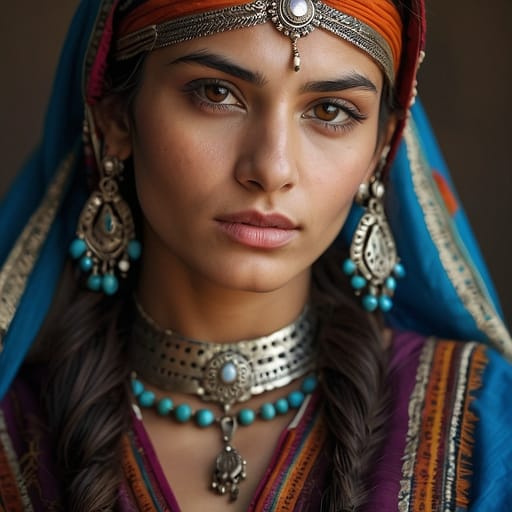
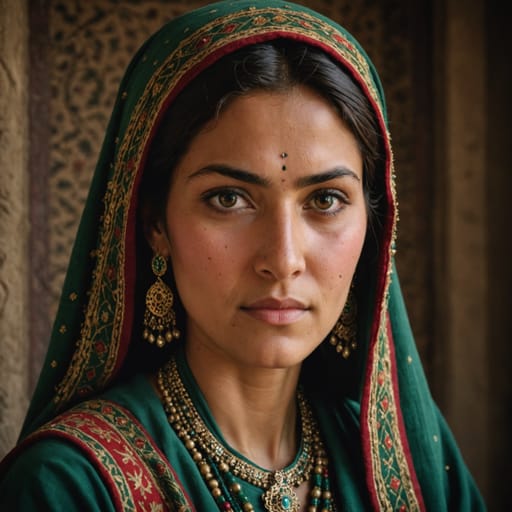
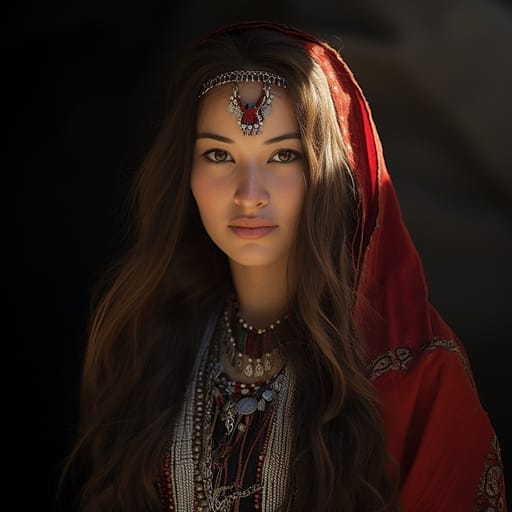
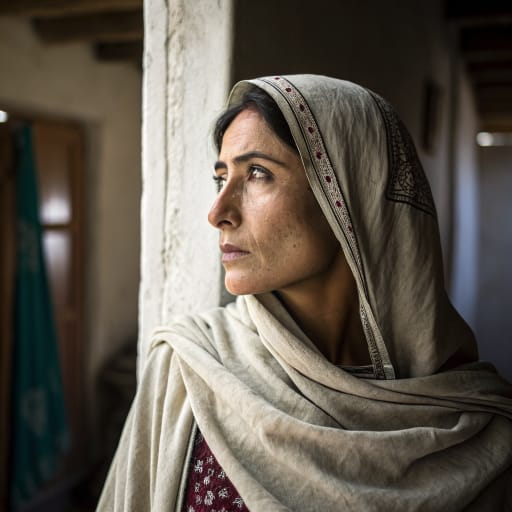
Jat Body & Anatomy Reference
Indo-Aryan / Dravidian South Asian phenotype: anatomy reference for AI nude generation
Jat Boobs & Breasts
Bust reference for Jat women: medium-to-large cup, moderate-to-full projection, which is typical of Indo-Aryan / Dravidian South Asian ancestry. Areolas measure about 32-46mm across, with medium-brown to dark-brown pigmentation. Body type (endomorph-to-mesomorph with fuller hip deposition) shapes the bust as well, so Jat tits are usually full and soft, generally fuller than the East Asian norm. In AI imagery, keep the forward-set shape rather than drifting toward the smaller East Asian bust profile.
Jat Ass & Hips
The Jat ass is typically medium-to-full, moderate-to-high projection, classic curvy hip profile, which sets it apart from the slim hip profile of East Asian women. Underneath, the pelvis shows medium-to-wide iliac crests, full gluteal-femoral fat distribution, part of the Indo-Aryan / Dravidian South Asian skeletal pattern. For Jat butt pics and AI renders, match that silhouette and the overall build (endomorph-to-mesomorph with fuller hip deposition).
Jat Vagina & Pussy
Jat pussy and vulvar anatomy presents medium-brown to dark-brown labial pigmentation, fuller labia minora projection, consistent with the Indo-Aryan / Dravidian South Asian phenotype's pigmentation pattern. Jat pubic hair is typically straight-to-wavy coarse texture, dense distribution, in the inverted-triangle pattern. For anatomically accurate Jat pussy renders the labial coloration should match the surrounding wheatish to brown skin tone with a continuous gradient, and the hair should keep its straight-to-wavy coarse texture.
Jat Dicks & Penis
Jat dicks follow the Indo-Aryan / Dravidian South Asian reference data: regional mean ~13cm erect; moderate girth; medium-brown shaft pigmentation. Shaft color should track the wheatish to brown skin tone with a smooth change toward the glans, and Jat pubic hair keeps its straight-to-wavy coarse texture.
Jat Body, Curves & Build
Jat body type and overall build presents as endomorph-to-mesomorph with fuller hip deposition, with mean adult female BMI 22-25: the characteristic Indo-Aryan / Dravidian South Asian habitus. Jat curves and proportions should keep the regional skeletal frame (height, shoulder-to-hip ratio, limb proportions) rather than a generic mesomorph default.
Jat Skin Tone & Hair Texture
Jat skin sits in the wheatish to brown (Fitzpatrick III-V) band. Hair is typically straight-to-wavy 1A-2B, dense, dark-brown to black, in keeping with the Indo-Aryan / Dravidian South Asian phenotype. In nude renders the skin should stay one even tone from face to body, and body, pubic and head hair should match.
Explore phenotype categories
Structured taxonomy with peer-reviewed scales · 22 anatomical categories
Notable Jat People
100 reference figures, sourced from Wikipedia
- Baba Gurdit Singh, leader of the Komagata Maru incident
- Bhagat Singh, Indian socialist revolutionary who was executed by the British colonialists i…
- Gurbaksh Singh Dhillon, he was as a close associate of Subhas Chandra Bose and played a key role in I…
- Kartar Singh Sarabha, Indian freedom fighter
- Nahar Singh, ruler of Ballabgarh who fought against the East India Company in the Indian R…
- Rai Ahmad Khan Kharal, freedom fighter in the Indian Rebellion of 1857
- Raja Mahendra Pratap Singh, Indian freedom fighter, president of the Provisional Government of India in K…
- Sah Mal, rebel who fought against the British in Indian Rebellion of 1857
- Sardar Ajit Singh, revolutionary and uncle of Bhagat Singh, best known for leading the Pagri Sam…
- Sohan Singh Bhakna, founding president of the Ghadar party
- Teja Singh Sutantar, freedom fighter and a member of Ghadar Party
- Arjan Singh, former Chief of the Indian Air Force
- Badlu Singh, recipient of Victoria Cross
- Chhelu Ram, recipient of Victoria Cross
- Gian Singh, recipient of Victoria Cross
- Lt Gen Harbaksh Singh, recipient of The Vir Chakra and The Padma Vibhushan
- Hoshiar Singh Dahiya, recipient of Param Vir Chakra
- Lt Gen Khem Karan Singh, recipient of Mahavir Chakra
- Mohan Singh, founder and General of the First Indian National Army
- Nirmal Jit Singh Sekhon, recipient of Param Vir Chakra
- Parkash Singh, recipient of Victoria Cross
- Ranjit Singh Dyal, recipient of Maha Vir Chakra
- Richhpal Ram, recipient of Victoria Cross
- Sant Singh, recipient of Mahavir Chakra
- Shabeg Singh, known for his involvement in the training of Mukti Bahini volunteers during t…
- Ved Prakash Malik, 19th Chief of Army Staff of the Indian Army
- Amir Sultan Tarar, the "Colonel Imam", SSG officer, ISI agent, trained Afghan Mujahideen and Tal…
- Qamar Javed Bajwa, 10th Chief of Army Staff of the Pakistani Armed Forces
- Zaheer Ahmad Babar Sidhu, 16th Chief of Air Staff of the Pakistani Air Force
- Chaudhary Raghvendra Singh, Indian real estate developer and founder of DLF.
- Dyal Singh Majithia, philanthropist and founder of The Tribune and Punjab National Bank
- Kushal Pal Singh, Indian billionaire real estate developer and retired military officer.
- Seth Chhaju Ram, Philanthropist
- Ajay Singh Chahar, former High Commissioner to Fiji Islands, and former Member of Parliament in …
- Gyan Prakash Pilania, former DGP of Rajasthan and former Member of the Rajya Sabha
- Kanwar Pal Singh Gill, former two term DGP of Punjab and recipient of Padma Shri
- M. S. Gill, former Indian Administrative Service officer who served as the Mnister of Spo…
- Arjan Bajwa, Indian film actor
- Darshan Kumar, Indian film actor
- Dharmendra, Indian film actor
- Jaideep Ahlawat, Indian actor
- Kabir Duhan Singh, Indian film actor
- Kirron Kher, Indian film actress
- Mahie Gill, Indian film actress
- Mallika Sherawat, Indian film actress
- Mohit Ahlawat, Indian film actor
- Parvin Dabas, Indian film actor
- Randeep Hooda, Indian film actor
- Simran Mundi, Indian film actress
- Sunny Deol, Indian film actor
- Sushant Singh, Indian film actor
- Taapsee Pannu, Indian film actress
- Meghna Malik, Indian TV actress
- Rajat Tokas, Indian TV actor
- Vivek Dahiya, Indian TV actor
- Anubhav Singh Bassi, Indian comedian
- Dhruv Rathee, Indian YouTuber
- Heer Ranjha, a tragic romance in Punjabi literature, popularised in the 18th century by th…
- Mirza Sahiban, a classic Punjabi folk romance, originally recorded in literary form by the 1…
- Badan Singh, founder and first Maharaja of Bharatpur
- Churaman, chieftain of Sinsini, Rajasthan. He established the rule mainly centred at Bh…
- Gokula Jat, rebel leader, who led one of the earliest organised revolts against the Mugha…
- Jawahar Singh, Maharaja of Bharatpur. Notable for capturing Delhi in 1764 and resistance aga…
- Kushal Singh Dahiya, sacrificed himself to protect the honour of Sikh Guru Tegh Bahadur
- Raja Maldeo, ruler of Sidhmukh State
- Rajaram Jat, rebel leader and successor of Gokula, who continued resistance against Mughal…
- Ranjit Singh, Maharaja of Bharatpur. He participated in the Second Anglo-Maratha War on the…
- Suraj Mal, Maharaja of Bharatpur. He is notably remembered for the plunder of Old Delhi …
- Akali Phula Singh, Sikh warrior and a Nihang leader
- Baba Deep Singh, founder of Shaheedan Misl
- Baghel Singh, ruler of Singh Krora Misl
- Bhuma Singh Dhillon, chieftain of Bhangi Misl
- Charat Singh, founder of Sukerchakia Misl
- Chhajja Singh Dhillon, founder and chieftain of Bhangi Misl
- Ganda Singh Dhillon, chieftain of Bhangi Misl
- Gujjar Singh Banghi, a Sikh warrior and one of the triumvirates who ruled over Lahore prior to the…
- Hari Singh Dhillon, ruler of Bhangi Misl
- Heera Singh Sandhu, founder of Nakai Misl
- Jai Singh Kanhaiya, founder of Kanhaiya Misl
- Jhanda Singh Dhillon, chieftain of Bhangi Misl
- Jind Kaur, Maharani of Sikh Empire who fought two wars against the British
- Mai Bhago, Sikh soldier and Guru Gobind Singh's bodyguard
- Nawab Kapur Singh, ruler of Singhpuria Misl
- Sada Kaur, chief of Kanhaiya Misl
- Sardar Tara Singh Ghaiba, chieftain of Dallewalia Misl
- Ali Mohammed Khan, founder of Kingdom of Rohilkhand, progenitor of Rohilla dynasty.
- Chitu Khan, a pindari general who played a prominent role in the Third Anglo-Maratha war.
- Nur Muhammad Chattha, a chieftain who was influential in the Gujrat region of Punjab and, along wit…
- Mutawassil Khan, Nawab of Bijapur.
- Muzaffar Jang Hidayat, third Nizam of Hyderabad State.
- Saadullah Khan, Grand Vizier of Mughal Empire
- Amrita Sher-Gil, one of the greatest avant-garde women artists of the early 20th century and a…
- Faiz Ahmed Faiz, Pakistani revolutionary poet
- Sant Singh Sekhon, Punjabi writer
- Fauji Kavi Mehar Singh, Haryanvi language poet and a freedom fighter
- Charan Singh, former Prime Minister of India
- Devi Lal, former Deputy Prime Minister of India
- Jagdeep Dhankhar, former Vice-President of India
- Bansi Lal, former Chief Minister of Haryana
- Beant Singh, former Chief Minister of Punjab
Erotic Poses & Sex Positions
From the pose catalog: 219 named positions with reference skeletons
Frequently asked questions about Jat people
Where is the Jat homeland?
The Jat homeland is Punjab, Haryana, western Uttar Pradesh, Rajasthan, and Pakistani Punjab and Sindh in South Asia.
What language do Jat people speak?
Jat people primarily speak Indo-Aryan / Punjabi, Haryanvi, Hindi, Sindhi.
What religion do Jat people practice?
The predominant religion among Jat people is Hinduism, Sikhism, Islam (regional split).






Make your own Jat images
Five a day, free, no credits to buy. The studio starts from this group's phenotype data, so you can set body type, pose and style and keep the traits accurate.
Start with Jat