Help us get this right
Does this portrait look right for Istro-Romanians?
Nobody has judged this one yet. You would be the first.
Istro-Romanians Erotic
Istria (Croatia)
Christianity / Catholicism
About Istro-Romanians People
The Istro-Romanians are one of Europe's smallest surviving language communities — a few hundred speakers, scattered across a handful of villages on the eastern slope of Mount Učka in Croatian Istria. Žejane sits on the northern side of the mountain; Šušnjevica and a cluster of smaller settlements — Nova Vas, Jesenovik, Letaj, Brdo — lie on the southern side. The two clusters speak noticeably different variants and have, for most of their history, thought of themselves as distinct. The umbrella term "Istro-Romanian" is largely a linguist's convenience.
Their language is the smallest and most isolated branch of Eastern Romance, separated from Romanian proper by roughly a thousand years and several hundred miles of Slavic-speaking territory. It is recognizably a sister to Romanian — the core vocabulary, the Latin grammatical bones — but heavily reshaped by centuries of contact with Croatian, which supplies much of the everyday lexicon and has pulled the grammar in unexpected directions. UNESCO classifies it as severely endangered, and the realistic speaker count keeps drifting downward; almost everyone under fifty is more comfortable in Croatian.
How they got to Istria is genuinely unsettled. The dominant theory traces them to transhumant shepherds from the Dinaric interior — Vlachs, in the older Balkan sense — who drifted west and were resettled on depopulated Istrian land sometime between the fifteenth and seventeenth centuries, after plague and Venetian-Ottoman warfare had emptied the peninsula. Local oral tradition and older surnames are consistent with this, but the chain of evidence is thin and competing reconstructions exist. They have called themselves Rumeri or Vlasi at various points; the label "Istro-Romanian" was attached from outside.
Religiously they are Roman Catholic, which has been the case long enough that it functions as an unmarked baseline rather than a distinguishing feature — the line that separates them from their neighbors is language, not faith. Žejane retains a carnival tradition, the zvončari bell-ringers, that is shared with surrounding Croatian villages and was inscribed on UNESCO's intangible heritage list in 2009; it is one of the few cultural practices that still draws outsiders to the village in any number.
What the community looks like now is mostly a story of emigration. Substantial Istro-Romanian populations live in New York, particularly Queens, and in Australia, sustained by family networks that have outlasted the villages themselves. Revitalization efforts — a small school program, dictionaries, recordings — exist, but the demographic arithmetic is difficult.
Related ethnic groups
Groups that share Istro-Romanians's homeland, region, language, or religious tradition. These are likely candidates for comparative phenotype reference.
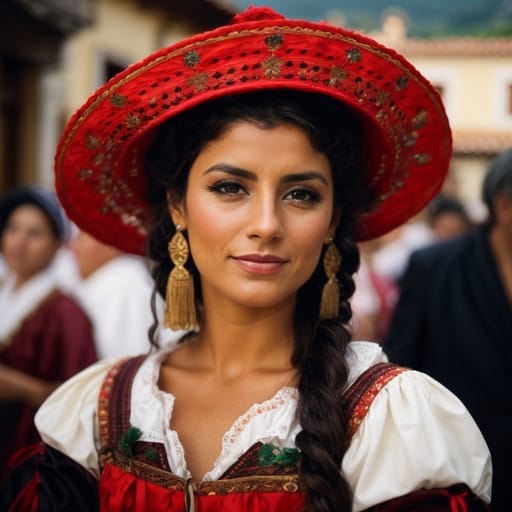
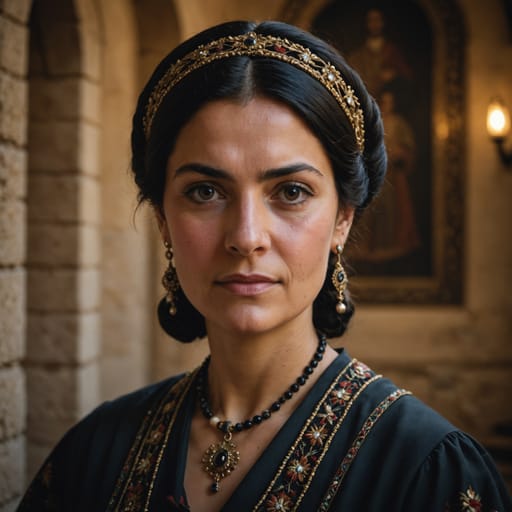
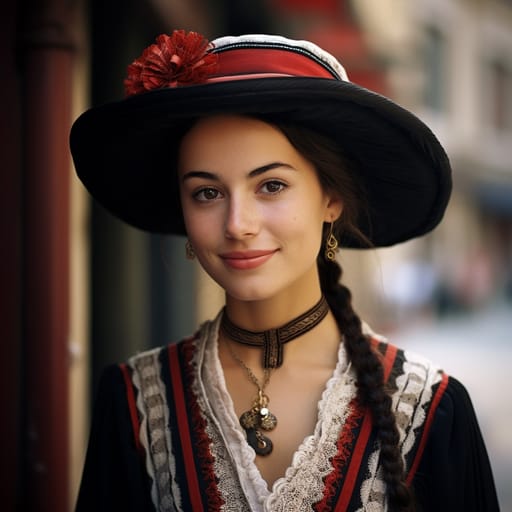
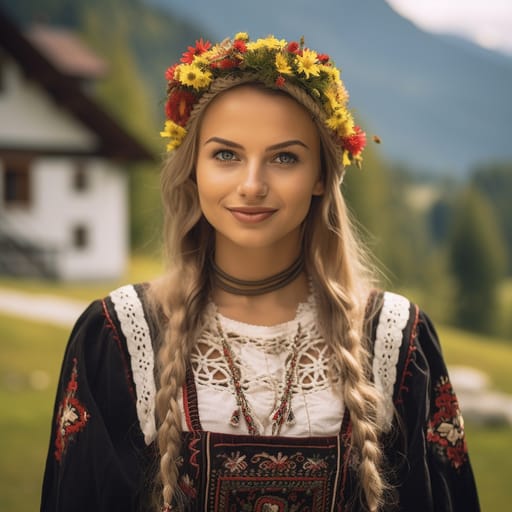
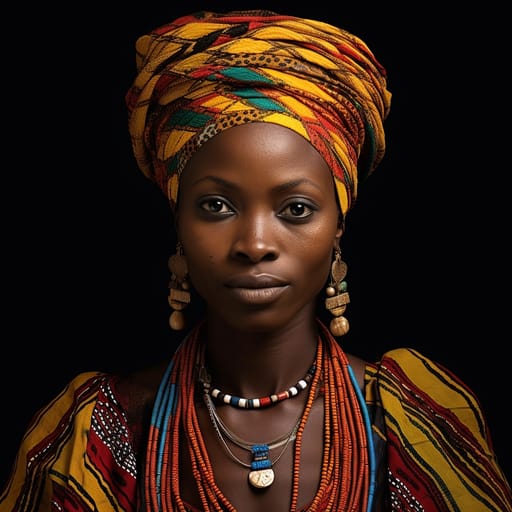
Typical Istro-Romanians Phenotypes
Reference for AI generation: hair, eyes, skin, facial structure, build
Istro-Romanians sit phenotypically inside the broader Northern Adriatic / Istrian gene pool — closer to coastal Croatians and northeastern Italians than to mainland Romanians, despite the linguistic link. The community is tiny (a few hundred speakers across Žejane and the Šušnjevica villages) and centuries of intermarriage with surrounding Croats and Italians mean the "look" overlaps heavily with Istria generally rather than carrying a distinct visual signature.
Hair runs medium to dark brown most often, with a meaningful share of chestnut and ash-brown shades and occasional dark blond in children that tends to darken by adulthood. Pure black hair is uncommon; true blondness is rare but present. Texture is overwhelmingly straight to loosely wavy — tight curl is unusual. Greying tends toward salt-and-pepper rather than uniform white.
Eyes show real variation: brown and hazel dominate, but green and mixed green-brown are common enough to be unremarkable, and clear blue or grey-blue turns up in maybe a fifth of the population, often paired with darker hair. The eye shape is standard European — almond, no epicanthic fold, moderate set, brow ridge usually soft rather than heavy.
Skin is Fitzpatrick II–III: light, with a warm olive or faintly golden undertone rather than the pink-cream of Northern Europeans. Tans readily to a Mediterranean bronze in summer, holds it through autumn. Freckling is occasional, not characteristic.
Facial structure leans toward a straight or slightly aquiline nose with a moderate bridge and narrow-to-medium alar width — the convex Roman profile shows up but isn't the rule. Lips are medium, jawlines tend to be defined in men and softer in women, and cheekbones are present but not high or wide in the Slavic-steppe sense.
Build is medium-tall — men commonly 175–183 cm, women 162–170 cm — with a lean-to-moderate frame typical of historically pastoral Adriatic populations. Žejane speakers (northern enclave) trend slightly taller and fairer than the southern Šušnjevica-area group, which skews a touch darker and more Mediterranean, though the difference is subtle and individual variation swamps it.
Istro-Romanians Body & Anatomy Reference
Anatomy by feature, Southern European / Mediterranean phenotype
Istro-Romanians Boobs & Breasts
Istro-Romanians boobs follow the Southern European / Mediterranean profile: medium-to-large cup, full, moderate-to-high projection. Areolar diameter is usually 32-46mm, and the coloring is medium-brown to dark-brown areolar pigmentation against the olive-to-light-brown skin tone. Breast shape tracks body composition (mesomorph with full hip-and-bust deposition, mean adult female BMI 24-28), so Istro-Romanians breasts tend to be full and projecting, generally the classic Mediterranean curvy bust profile. Expect a forward-set shape, not the lighter pigmentation of the Northern European bust.
Istro-Romanians Ass & Hips
Istro-Romanians ass and hip morphology presents as medium-to-full, moderate-to-high projection, broader hip profile, distinctly different from the slim Northern European narrow-hip pattern. The Istro-Romanians pelvic profile shows medium-to-wide iliac crests, full gluteal-femoral fat distribution, anchored in the Southern European / Mediterranean skeletal pattern. Istro-Romanians butt shots in adult AI imagery should render the medium-to-full, moderate-to-high projection, broader hip profile silhouette with the overall build (mesomorph with full hip-and-bust deposition) and the fat distribution typical of the Southern European / Mediterranean phenotype.
Istro-Romanians Vagina & Pussy
Istro-Romanians pussy anatomy typically shows medium-brown to dark-brown labial pigmentation, fuller labia minora. Pubic hair is usually wavy-to-curly medium-coarse dark texture, dense distribution. In AI-generated Istro-Romanians nudes, labial color should blend into the olive to medium skin with a gradual transition, and the hair should keep its wavy-to-curly medium-coarse dark texture.
Istro-Romanians Dicks & Penis
Penis reference for Istro-Romanians men: regional mean ~13-14cm erect, moderate girth. Coloring: medium-brown shaft pigmentation. An accurate Istro-Romanians cock in AI imagery matches the surrounding olive to medium skin rather than a generic porn default. Circumcision depends on religion and custom, not ancestry.
Istro-Romanians Body, Curves & Build
The Istro-Romanians figure is generally mesomorph with full hip-and-bust deposition, with mean adult female BMI 24-28, characteristic of Southern European / Mediterranean ancestry. AI image tools tend to flatten regional body types into a few stock shapes; here the Istro-Romanians build is kept as its own reference.
Istro-Romanians Skin Tone & Hair Texture
Skin: olive to medium (Fitzpatrick III-IV). Hair: wavy-to-curly 2B-3B, dark-brown to black. Both are typical of Southern European / Mediterranean ancestry. The most common mistake in AI nudes of Istro-Romanians women is a body rendered lighter than the face.
Data depth
32/100Coverage of image-grounded phenotype observations · drives AI generation diversity
- Sample size
- 10/40· 3 images
- Image quality
- 17/30· 33% high
- Confidence
- 5/20· mean 0.54
- Source diversity
- 0/10· wikipedia
- ·Small sample (n<10)
- ·Low overall confidence
- ·Wikipedia-only source, not population-representative
Observed Distribution: Image Sample
Empirical observations from analyzed photographs · supplementary signal, not population truth
Sample: 3 images analyzed (3 wikipedia). Quality: 1 high, 0 medium, 2 low, 0 very_low. Avg analyzer confidence: 0.54.
Skin tone (Fitzpatrick): II (100%)
Hair color: gray/white (67%), black (33%)
Hair texture: straight (33%), wavy (33%), covered (33%)
Eye color: blue (33%), unclear (67%)
Epicanthic fold: 0% present, 100% absent, 0% unclear
Caveats: Sample size 3 is small, so the observed distribution should be treated as suggestive, not definitive. Low average analyzer confidence: many photos partially obscured or historical. Sample is 100% Wikipedia notable people, which skews toward male, public-life, and modern figures, not population-representative.
Last aggregated: May 7, 2026
Explore phenotype categories
Structured taxonomy with peer-reviewed scales · 22 anatomical categories
Notable Istro-Romanians People
3 reference figures, sourced from Wikipedia
- Andrei Glavina, politician, professor and one of the writers of the first book in Istro-Roman…
- Giancarlo Pepeu, pharmacologist and professor. Potentially of distant Istro-Romanian descent. …
- Matthias Flacius Illyricus, Lutheran reformer and theologian. According to Emil Petru Rațiu, president of…
Erotic Poses & Sex Positions
From the pose catalog: 219 named positions with reference skeletons
Frequently asked questions about Istro-Romanians people
Where is the Istro-Romanians homeland?
The Istro-Romanians homeland is Istria (Croatia) in Southern Europe.
What language do Istro-Romanians people speak?
Istro-Romanians people primarily speak Indo-European / Romance / Istro-Romanian.
What religion do Istro-Romanians people practice?
The predominant religion among Istro-Romanians people is Christianity / Catholicism.






Make your own Istro-Romanians images
Five a day, free, no credits to buy. The studio starts from this group's phenotype data, so you can set body type, pose and style and keep the traits accurate.
Start with Istro-Romanians