Help us get this right
Does this portrait look right for Poles?
Nobody has judged this one yet. You would be the first.
Poles Erotic
Christianity / Catholicism
Significant populations in the United States, Brazil, Germany, Canada, Iceland, Sweden, France, the United Kingdom, Argentina, Belarus, Russia, Australia, Lithuania, Ukraine, Ireland, and Norway
About Poles People
Poles are a West Slavic people whose national identity formed against geography that offered no natural defenses. The country sits on the North European Plain — flat, fertile, walkable in every direction — which is why Polish history reads as a long argument with neighbors who could simply march in. The result is an unusually durable sense of nationhood that survived the partitions of the late 18th century, when the state itself disappeared from the map for 123 years, and the twin occupations of the Second World War. Polishness, during those stretches, lived in language, church, and household rather than in any institution.
The language belongs to the West Slavic branch alongside Czech and Slovak, but Polish kept features its cousins shed — nasal vowels written as ą and ę, a consonant inventory that intimidates outsiders, a stress that lands almost always on the penultimate syllable. It uses the Latin alphabet rather than Cyrillic, a reflection of the country's tilt toward Rome rather than Constantinople. That tilt is the other defining fact: Poland's adoption of Western Christianity in 966 placed it inside Latin Europe and, eventually, made Catholicism inseparable from national feeling. The Polish Catholic Church is not the Catholicism of Italy or Ireland — it is more austere, more political, shaped by centuries of being the institution that outlasted every occupier. The election of Karol Wojtyła as John Paul II in 1978 gave that history a global stage and contributed directly to the collapse of communist rule a decade later.
Regional sub-identities still register: Górale in the southern highlands, Kashubians along the Baltic coast (with their own recognized language), Silesians in the west whose dialect carries heavy German influence. The diaspora is enormous and old. Industrial-era migration sent Poles to Chicago, the Ruhr, Pennsylvania mining towns, and the pampas of Argentina; postwar displacement and the EU expansion of 2004 sent another wave to Britain, Ireland, and Iceland, where Poles are now the largest minority. Polonia — the term for Poles abroad — is treated as a real extension of the nation, not a footnote.
Daily customs carry the weight of all this. Wigilia, the Christmas Eve supper, is observed more seriously than Christmas Day itself, with twelve meatless dishes and an empty seat kept for an unexpected guest. Name-days often outrank birthdays. Hospitality runs heavy, with food that descends from a peasant kitchen — pierogi, żurek, bigos — rather than a court one.
Related ethnic groups
Groups that share Poles's homeland, region, language, or religious tradition. These are likely candidates for comparative phenotype reference.
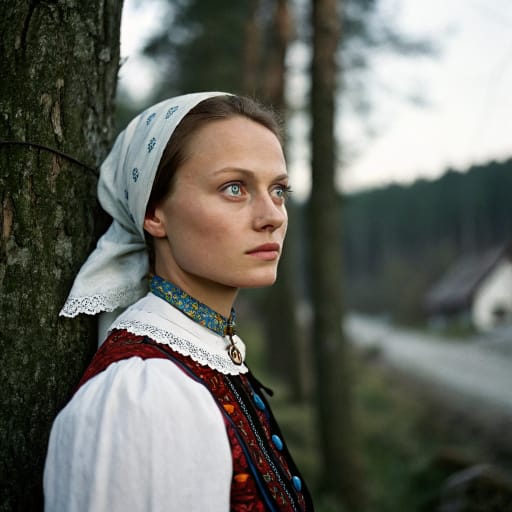
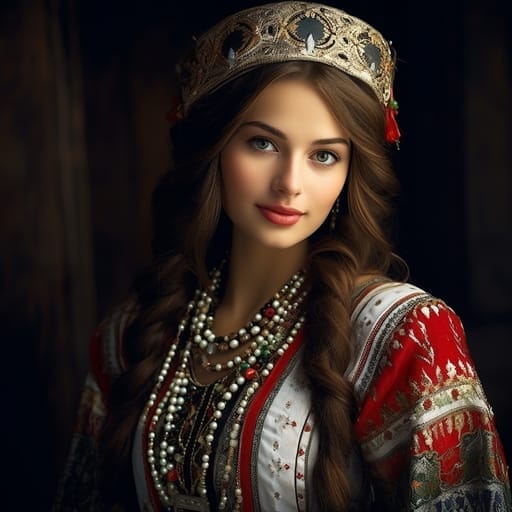
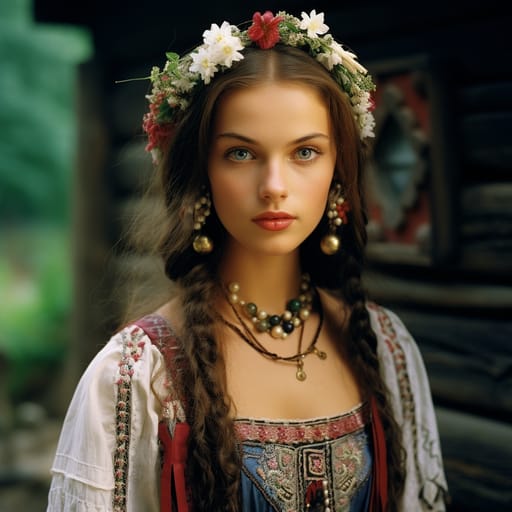
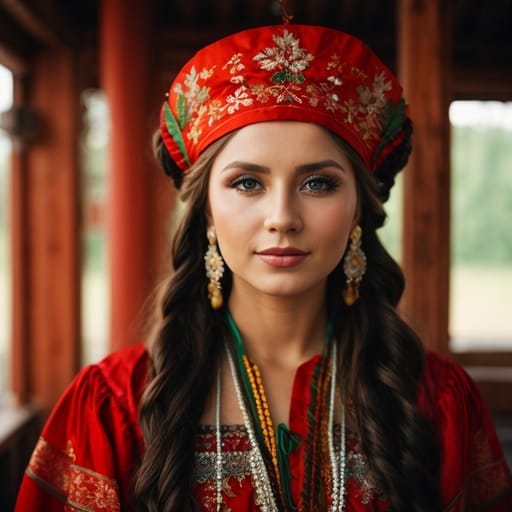
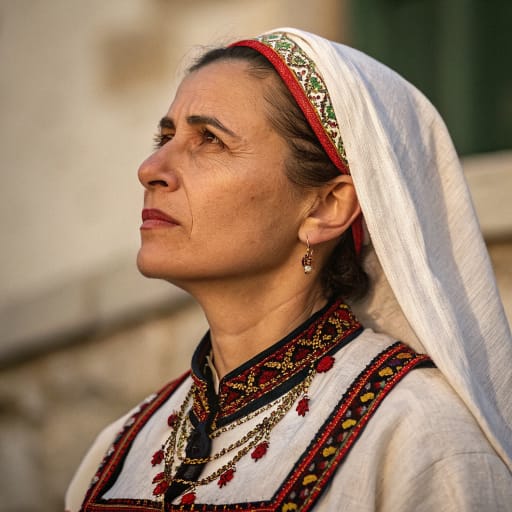
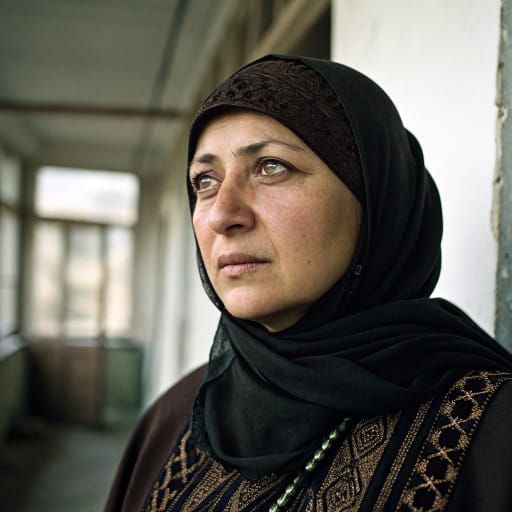
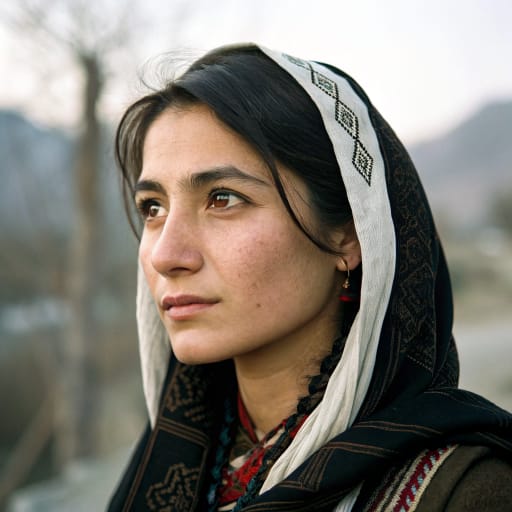
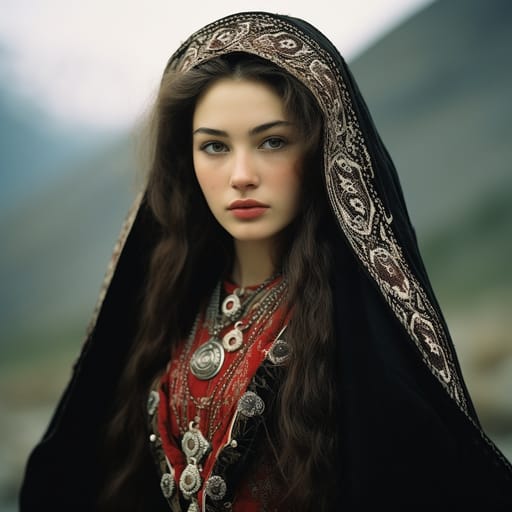
Typical Poles Phenotypes
Reference for AI generation: hair, eyes, skin, facial structure, build
Polish phenotype sits squarely in the Northern/Central European cluster, with a strong pull toward the lighter end of that spectrum. Hair runs from pale ash blond and wheat-blond in childhood — the famously "blond Polish kid" who darkens with age — through dark blond, light brown, and mid-brown in adults, with true black uncommon. Texture is overwhelmingly straight to loosely wavy; tight curls are rare. Red hair appears at a low but visible rate, usually in coppery or strawberry shades rather than the saturated auburn of the British Isles.
Eyes skew lighter than almost any other Slavic population: blue and grey-blue dominate, followed by green, hazel, and lighter browns, with dark brown eyes a clear minority. Eyelids are flat-creased without epicanthic folds, and the eye opening tends to be moderately wide and almond-shaped rather than rounded. Skin is Fitzpatrick II–III — fair, often with cool pink or neutral undertones, prone to flushing and freckling under sun, tanning to a light olive-tan rather than deep brown.
Facial structure leans toward what anthropologists historically called the Sub-Nordic and East-Baltic patterns: a relatively broad face with prominent, set-back cheekbones, a softly squared jaw, and a forehead that's high but not narrow. Noses are typically straight with a medium-height bridge and modest alar width — neither the long aquiline of the Mediterranean nor the small button of Northern Scandinavia. Lips are moderate, with the lower lip slightly fuller than the upper. The defining combination is broad cheekbones plus light eyes and fair, cool-toned skin — Maria Skłodowska-Curie's bone structure is a useful anchor.
Build is solidly tall: average male stature around 180 cm and female around 166 cm, placing Poles near the top of European height tables. Frames tend toward broad shoulders and substantial bone mass, with body composition that holds muscle readily and trends sturdier in middle age. Regional variation exists — Kashubians and northern Poles trend blonder and lighter-eyed, while southern highlanders (Górale) carry slightly darker hair and more rugged, angular features — but the overall range is narrower than in most European populations.
Poles Body & Anatomy Reference
Anatomy by feature, Eastern European / Slavic phenotype
Poles Boobs & Breasts
Bust reference for Poles women: medium-to-large cup, full, moderate-to-high projection, which is typical of Eastern European / Slavic ancestry. Areolas measure about 30-44mm across, with light-pink to medium-brown pigmentation. Body type (mesomorph, full hip-and-bust deposition) shapes the bust as well, so Poles tits are usually full and projecting, classic Eastern European curvy bust. In AI imagery, keep the forward-set shape rather than drifting toward the smaller East Asian bust.
Poles Ass & Hips
The Poles ass is typically medium-to-full, moderate-to-high projection, which sets it apart from the slim narrow-hip East Asian profile. Underneath, the pelvis shows medium iliac crests, full gluteal-femoral fat deposition, part of the Eastern European / Slavic skeletal pattern. For Poles butt pics and AI renders, match that silhouette and the overall build (mesomorph, full hip-and-bust deposition).
Poles Vagina & Pussy
Poles pussy and vulvar anatomy presents light-pink to medium-brown labial pigmentation, varied labia minora, consistent with the Eastern European / Slavic phenotype's pigmentation pattern. Poles pubic hair is typically wavy medium texture, blond to dark-brown, in the inverted-triangle pattern. For anatomically accurate Poles pussy renders the labial coloration should match the surrounding fair to light skin tone with a continuous gradient, and the hair should keep its wavy medium texture.
Poles Dicks & Penis
Poles dicks follow the Eastern European / Slavic reference data: regional mean ~13-14cm erect; moderate girth; light-pink to medium-brown shaft pigmentation. Shaft color should track the fair to light skin tone with a smooth change toward the glans, and Poles pubic hair keeps its wavy medium texture.
Poles Body, Curves & Build
Poles body type and overall build presents as mesomorph, full hip-and-bust deposition, with mean adult female BMI 23-26: the characteristic Eastern European / Slavic habitus. Poles curves and proportions should keep the regional skeletal frame (height, shoulder-to-hip ratio, limb proportions) rather than a generic mesomorph default.
Poles Skin Tone & Hair Texture
Poles skin sits in the fair to light (Fitzpatrick II-III) band. Hair is typically straight-to-wavy 1A-2B, light-blond to dark-brown, in keeping with the Eastern European / Slavic phenotype. In nude renders the skin should stay one even tone from face to body, and body, pubic and head hair should match.
Data depth
61/100Coverage of image-grounded phenotype observations · drives AI generation diversity
- Sample size
- 34/40· 36 images
- Image quality
- 17/30· 33% high
- Confidence
- 10/20· mean 0.63
- Source diversity
- 0/10· wikipedia
- ·Wikipedia-only source, not population-representative
Observed Distribution: Image Sample
Empirical observations from analyzed photographs · supplementary signal, not population truth
Sample: 36 images analyzed (36 wikipedia). Quality: 12 high, 16 medium, 8 low, 0 very_low. Avg analyzer confidence: 0.63.
Skin tone (Fitzpatrick): II (89%), III (3%), unclear (8%)
Hair color: gray/white (64%), light/medium brown (19%), black (6%), blonde (3%), dark brown (3%), unclear (6%)
Hair texture: straight (67%), wavy (17%), curly (3%), bald (3%), shaved (3%), covered (3%), unclear (6%)
Eye color: blue (33%), hazel (17%), brown (14%), dark brown (3%), unclear (33%)
Epicanthic fold: 0% present, 89% absent, 11% unclear
Caveats: Sample is 100% Wikipedia notable people, which skews toward male, public-life, and modern figures, not population-representative.
Last aggregated: May 7, 2026
Explore phenotype categories
Structured taxonomy with peer-reviewed scales · 22 anatomical categories
Notable Poles People
100 reference figures, sourced from Wikipedia
- Georges Charpak, 1995 Nobel Prize
- Maria Dworzecka, Polish-American computational nuclear physicist
- Artur Ekert, British-Polish, one of the independent inventors (in 1991) of quantum cryptog…
- Krzysztof Gawedzki, mathematical physicist
- Marek Gazdzicki, high-energy nuclear physicist
- Stanislas Leibler, Polish-French-American
- Maciej Lewenstein, theoretical physicist
- Albert A. Michelson, American, 1907 Nobel Prize
- Lidia Morawska, Polish-Australian
- Witold Nazarewicz, Polish-American nuclear physicist
- Jerzy Plebański, theoretical physicist
- Nikodem Popławski, theoretical physicist
- Sylwester Porowski, blue laser
- Józef Rotblat, 1995 Nobel Peace Prize
- Stefan Rozental, nuclear physicist
- Wojciech Rubinowicz, theoretical physicist
- Maria Skłodowska Curie, Marie Curie), two Nobel Prizes
- Marian Smoluchowski, kinetic theory, Einstein-Smoluchowski relation
- Haroun Tazieff, geologist, volcanologist, cinematographer, writer and French Cabinet minister
- Andrzej Trautman, mathematical physicist
- Witelo, philosopher, medieval optics
- Stanley Wojcicki, Polish-American
- Stanisław Lech Woronowicz, theoretical physicist
- Marek Żukowski, theoretical physicist
- Wojciech H. Zurek, theoretical physicist
- Jan Czochralski, modern semiconductors
- Tadeusz Estreicher, cryogenics pioneer
- Kazimierz Fajans, Polish-American physical chemist
- Kazimierz Funk, biochemist, the concept of vitamins
- Antoni Grabowski, chemical engineer
- Aharon Katzir, Israeli pioneer in electrochemistry of biopolymers
- Stanisław Kostanecki, organic chemist
- Ignacy Łukasiewicz, inventor of kerosene lamp
- Krzysztof Matyjaszewski, Polish-American
- Mark Miodownik, British materials scientist and engineer
- Krzysztof Palczewski, biochemist
- Tadeusz Reichstein, Polish-Swiss Nobel Prize winner
- Michał Sędziwój, Latinized as Sendivogius: alchemist, physician, discoverer of oxygen
- Zuzanna S. Siwy, Polish-American
- Maria Skłodowska Curie (Marie Curie), two-time Nobel Prize winner
- Wojciech Świętosławski, "father of thermochemistry"
- Filip Neriusz Walter, pioneer of organic chemistry
- Józef Zawadzki, physical chemist
- Joseph Babinski, French-Polish neurologist, discoverer of the Babinski reflex
- Gabriela Balicka-Iwanowska, botanist
- Napoleon Baniewicz, Polish-Lithuanian nobleman and neurologist, discoverer of the Baniewicz reflex
- Edmund Biernacki, physician, discoverer of erythrocyte sedimentation rate
- Czesław Bieżanko, entomologist
- Jan Biziel, physician, social activist
- Tytus Chałubiński, physician
- Napoleon Cybulski, neurophysiologist, discoverer of adrenaline
- Maria Antonina Czaplicka, anthropologist
- Jan Czekanowski, anthropologist
- Kazimierz Dąbrowski, psychiatrist, creator of the theory of positive disintegration
- Wiktor Dega, surgeon and orthopedist
- August Dehnel, biologist
- Józef Dietl, physician
- Hermann Dietz, physician, senator of the Republic of Poland, social activist
- Jan Dzierżon, zoologist, apiarist
- Stefan Falimierz, physician, herbalist
- Sidney Farber, American pediatric pathologist and cancer biologist, founder of the Dana-Farb…
- Edward Flatau, neurologist
- Ludwik Fleck, Polish-Israeli microbiologist, philosopher of science
- Eva Frommer, child psychiatrist and anthroposophist
- Marian Gieszczykiewicz, physician and bacteriologist
- Emil Godlewski, embryologist
- Samuel Goldflam, neurologist
- Adam Gruca, surgeon and orthopaedist
- Ryszard Gryglewski, pharmacologist, physician
- Tomasz Guzik, born 1974), physician
- Ludwik Hirszfeld, microbiologist and serologist
- Janina Hurynowicz, neurophysiologist
- Feliks Paweł Jarocki, zoologist and entomologist
- Stefania Jabłońska, dermatologist
- Walery Jaworski, physician
- Konstanty Jelski, ornithologist
- Zbigniew Kabata, biologist
- Ewa Kamler, born 1937), biologist and ichthyologist
- Zofia Kielan-Jaworowska, paleobiologist
- Aleksander Koj, physician, scientist
- Ryszard Kole, Polish-American pharmacologist
- Jerzy Konorski, neurophysiologist
- Stefan Kopeć, biologist
- Hilary Koprowski, polio vaccine
- Tadeusz Krwawicz, medical pioneer
- Elwira Lisowska, born 1930), biochemist
- Abraham Low, American neuropsychiatrist
- Margaret Lowenfeld, British paediatrician and pioneer of Sandplay Therapy
- Liliana Lubińska, neuroscientist
- Zofia Majewska, neurologist and professor
- Karol Marcinkowski, physician
- Eugène Minkowski, psychiatrist influenced by Bergson and phenomenology
- Ludwik Młokosiewicz, botanist
- Maksymilian Nowicki, biologist
- Ferdynand Antoni Ossendowski, biologist
- Marek Pienkowski, born 1945), Polish-American immunologist
- Piotr Ponikowski, cardiologist
- Moshe Prywes, 1914-1998), Israeli physician and educator; first President of Ben-Gurion Uni…
- Zbigniew Religa, cardiologist
- Józef Rostafiński, biologist
Erotic Poses & Sex Positions
From the pose catalog: 219 named positions with reference skeletons
Frequently asked questions about Poles people
Where is the Poles homeland?
The Poles homeland is Poland in Eastern Europe.
What language do Poles people speak?
Poles people primarily speak Indo-European / Slavic / Polish.
What religion do Poles people practice?
The predominant religion among Poles people is Christianity / Catholicism.






Make your own Poles images
Five a day, free, no credits to buy. The studio starts from this group's phenotype data, so you can set body type, pose and style and keep the traits accurate.
Start with Poles